Will Australia write a bold 'welcome'
pp. 13-14 · Read in the full issue
bold 'welcome' on the mat?
By Judy Tudor
ALTHOUGH the new Australian Government made much capital, before and after the December elec tions, out of extracting racial bias from Australia's immigration policy, it is doubtful whether, in practice, any more non-Europeans will have entry under Labor than they did under the old Liberal-Country Party govern ment.
In recent years the criteria for entry of non-Europeans into Australia has been whether the individual con cerned had the kind of skills and background necessary to fit into Aus tralian life. Somewhere between three and four thousand non-European migrants per year are being admitted in this way.
But there is one change that the new government proposes that will make it easier for some islanders and other non-Europeans—but it seems to have been designed to placate New Zealand more than the would-be migrants in question.
New Zealanders and NZ Maoris have always had free and open entry into Australia (just as Australians can move into NZ with no more trouble than moving interstate in their own country). However, Cook Islanders, other Islanders or any non- Europeans not Maori did not have automatic entry into Australia no matter how long they had been NZ citizens. This has always annoyed both official and unofficial New Zea land and this is where the change is to come.
Under the new set-up (in early February the details still had to be worked out) New Zealand citizens, with New Zealand residential status,
no matter what their race or their skills can enter Australia quite freely.
The key to entry for other than European or Maori New Zealanders seems to be "resident status”, as much as citizenship. This probably means that Cook Islanders or Niue Islanders, who are NZ citizens by birth, would have to be living in NZ before going to Australia. This point is not quite clear although it was one of four questions that we asked the Australian Department of Immigration recently. It probably will be cleared up in talks to be held shortly.
If you want the official view, as at January 31, read on. Our four questions and the department’s answers follow: _.it i a a Questwn-. . As Cook Islanders and Niue Islanders are New Zealand citizens, can they now migrate here direct from their own islands? Or must they first be resident m New
Zealand. .
Answer: In a joint communique issued on January 22, the Pnme Ministers of Australia and New Zealand sa id ; ...
“The Prime Ministers agreed that citizens of each country and citizens of other Commonwealth countries who have resident status in either Australia or New Zealand should henceforth be able to travel
between Australia and New Zea land, for permanent or temporary residence, without passports or visas. Talks between immigration officers of the two countries regard ing practical arrangements for the implementation of the new policy would take place as soon as pos sible.”
The talks referred to have yet to be arranged but the text of the com munique clearly indicates the decision taken.
Question : Presumably Samoans or other Islanders who have been long enough in New Zealand to have acquired citizenship also have right of entry?
Answer : Yes—if they are citizens of New Zealand or have resident status in that country and are travelling to Australia from New Zealand.
Question\ Are there any changes in policy towards admitting Islanders other than those with NZ citizen ship? If they have special skills or professions that are needed in Aus tralia, they presumably have the same chance of entry as anyone else. But this is not new—for example, Indian or Singapore Chinese doctors who have been able to migrate for some time.
Answer : No changes have been made except in relation to those having resident status in New Zealand and wish to travel to Australia from New Zealand.
Question : Apart from Islander New Zealand citizens who may be skilled or unskilled and still have entry, it appears that the Australian policy still tends to skim off the cream— precisely those people desperately needed in their own developing countries. Or if this assumption is not correct, will there be any attempt by Australia to alleviate economic or population pressures in some Islands by taking some unskilled migrants? For example, Fiji Indians who are landless and among whom there is considerable poverty; or Gilbertese whose un productive atolls are materially in
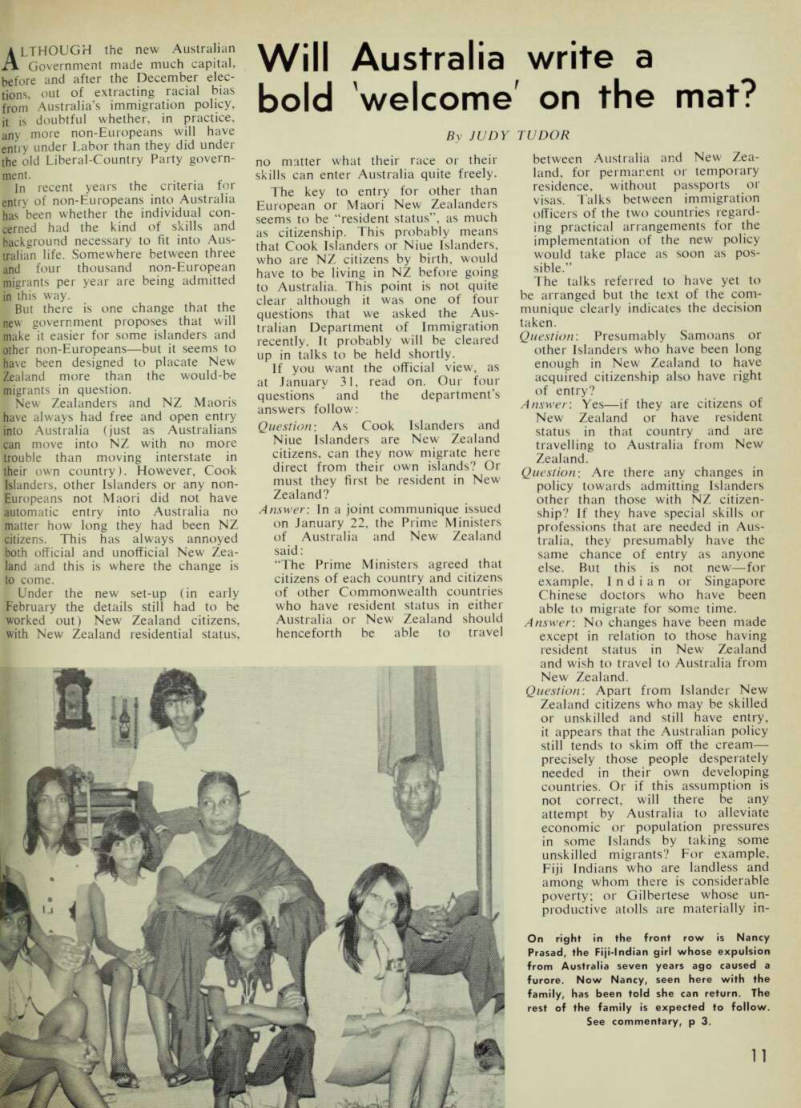
On right in the front row is Nancy Prasad, the Fiji-Indian girl whose expulsion from Australia seven years ago caused a furore. Now Nancy, seen here with the family, has been told she can return. The rest of the family is expected to follow.
See commentary, p 3.
adequate for sustaining the popu lation?
Answer: While being sympathetic to the problems of many people in under-developed countries, Aus tralia cannot solve such problems or even reduce them substantially by migration to this country.
Indeed, serious problems could develop in Australia by admitting large numbers of people likely to experience economic and social dif ficulties in settling into the Aus tralian community. Applications will, however, be considered on an individual basis having regard to qualifications possessed by ap plicants, their personal qualities and the contribution they could make in this country. This policy is being implemented in all countries parti cularly in view of the present economic and employment situation in Australia.
Prom Kathleen Hancock In
New Zealand New Zealand Prime Minister Norman Kirk set the tone for the meeting in Wellington with his Aus tralian counterpart Gough Whitlam when he said that he thought it was vital their parliaments should be represented at the South Pacific Forum. Not long afterwards he an nounced that he would head the NZ team to the next Forum meeting, in Apia in April.
After his meeting with Whitlam he said, “What we have done is to accept that in the Pacific matters are not settled by our decisions alone. They are settled by others,” meaning the Island territories in their own meet ings, the Forum, the SP Conference and the Bureau of Economic Co operation.
It is some time since Norman Kirk put forward his idea of a Pacific Council and major changes have taken place in the Pacific during the last few years. The Island territories themselves are virtually running the South Pacific Conference and the South Pacific Forum has emerged as
an arena for political discussion among the independent Pacific states.
These two new concepts obviously modified the Prime Ministers’ dis cussion of a possible Pacific Council.
As for the South Pacific Con ference, Mr Kirk said that if the South Pacific Conference was capable
of developing adequately, then tl was the course Australia and N« Zealand would follow. The mechani: in a policy wasn’t the vital thii The vital thing was the objective. ' the South Pacific Conference c provide the means of achieving tl end effectively and quicker than a other, then certainly we won’t pn changes.”
Immigration matters were cc sidered and altered. Formerly, en into Australia by New Zealand c zens of Asian or Pacific Island bio was restricted. Now these restrictic have been lifted. Mr Kirk was asl if he thought there was any lib hood of a roundabout flood Islanders and Asians into Australia this means, but he didn’t consider t likely. He reckons that the islam population of New Zealand—n about 30,000 —has really put th roots down in a country they f
“culturally more appropriate”.