Gruyere and
pp. 121-125 · Read in the full issue
Feasting on Gruyere and nickel cake
By Helen Rousseau
The French preoccupation with tasty foods tends to spill over even into the nation’s business life. So when the Caledonians discuss their island pebble of mineral wealth, they are likely to speak of splitting up the nickel “cake” or nibbling away at the “Gruyere cheese”. Like the Swiss cheese, New Caledonia has been left with many open cavities, where the nickel has been gouged out, and even more holes where international prospectors have whetted their appetites, sampling the rich flavours of the soil.
But the Caledonians have now entered upon 1973, which means that negotiators from the International Nickel Company of Canada have finally spent seven winters in Paris, talking with the French Government over prospects for this North Ameri can giant to enter the French Colony.
Maybe the INCO men have come to enjoy dancing the French farandole and sipping cognac, but their tongues do not seem to have been loosened enough to give the French a timetable of precise dates for oper ating any new factory at given pro duction levels.
For its part, the French Govern ment is insisting it could not possibly grant extensive reserves to a foreign company which could freeze such domains and not give guarantees of when they would work the deposits.
Under the present depressed condi tions on the nickel market, any precise timetable INCO might give would be of great value to the Paris authori ties, as it would indicate how soon such French groups as the Roths childs could profitably plan to expand their Caledonian operations.
And so the lingering battle con tinues over New Caledonia’s southern deposits of low-grade lateritic ore around Goro and Prony-Port Boise, fnese reserves are held mainly by the Pentecost family and the BRGM, the state minerals bureau. The BKGM domain covers about 12,000 *jes, estimated to include some JUO,OOO million tons of lateritic ore.
Meanwhile, following the with drawal of PENAMAX geologists from the area, another Franco-American group has laid claim to the southern reserves. This is the joint venture proposed by the US Freeport Minerals and the Aquitaine French state pet roleum company (SNPA).
Island Governor Louis Verger has often repeated French Government claims that there is room for two companies in the south, so that the French Aquitaine would counterbal ance the INCO interests. In early Janu ary the Paris government announced that it had invited INCO ond SNPA- Freeport to study the possibility of operating jointly around Goro, giving a reply to this proposal by mid- February. If co-operation is impossible, the French Government indicated it would try to split the BRGM reserves between the two mining groups.
The strength of the Aquitaine-Free port venture lies in the dominating French participation in this project and the fact that Freeport would provide a suitable technical process adapted from the one they are using on the Australian lateritic nickel ore project at Greenvale, in Queensland.
It is considered that generally five years would be required to complete feasibility studies, build a factory and develop all necessary facilities, al though Freeport’s Australian experi ence could help shorten this delay.
Production target would be initially 22,500 tons, with the possibility of rising to 50,000 or 100,000 tons ie the same potential as INCO has en visaged.
A certain scepticism continues to surround the nickel prospects for the north of the island, where the most recently-announced project has been for the Poum-Koumac region. In terested group is SOMMENI, com prising the French Patino subsidiary, COFREMMI, combined with French Pechiney-Ugine Kuhlmann and Swe dish Granges. Despite the passage through Koumac of certain industrial personalities and the arrival of a
group of prefabricated homes for the new venture, optimism has worn thin in New Caledonia and it has already been unhappily suggested that the “rose of Koumac” might well fade before it even has a chance to bloom.
When announcing this project to the Noumea press last July, Patino president. General Rene Leveque, in sisted that the project would be achieved. The main reason he gave to support his confidence was the fact that Patino is now entirely French. And the general outlined a detailed history of the company’s South American origins, showing how it had gone through the process of transferring its headquarters to Paris in a bid to become purely French, thereby re ceiving favourable Paris recognition for investment in New Caledonia.
But, however high nickel hopes may have been in the boom days at the end of the 60s, the sad fact remains for New Caledonia that intensive ex ploration in other parts of the Pacific, in Brazil, even in Europe, has led to the uncovering of extensive nickel de posits elsewhere, while companies planning operations in the French territory have had to reconsider feasi bility studies in the light of rising local costs and increased world com petition.
As far as INCO is concerned, early January saw the announcement of a 130 million loan from North America to allow the development of its PT International Nickel project to smelt ore in New Caledonia’s rival terri tory, Indonesia, And now, whatever the long-dis cussed prospects may be for the ex treme north and south of New Cale donia, the main current nickel problem has been posed by the Rothschild-con trolled Societe Le Nickel, which so far has maintained a monopoly over nickel processing on the island.
The SLN has been caught with extensive borrowing incurred over the financing of a SAIOO million factory expansion programme. New furnaces have been completed only to face
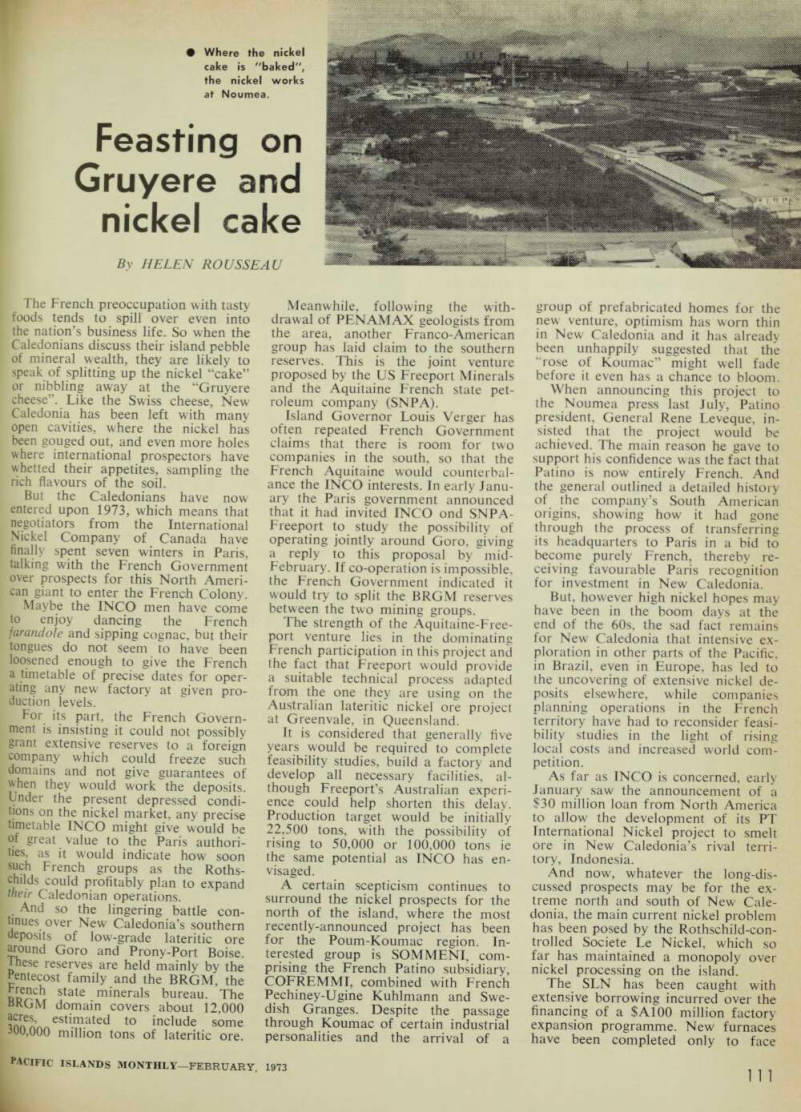
Where the nickel cake is "baked", the nickel works at Noumea.
feasting on Gruyere
the recession on the world nickel market. While the SEN complains of the Caledonian tax system on all nickel exports, regardless of com pany profit or loss, Paris rumours hinted at a possible retreat of the Rothschild bankers from the company or else a possible call for financial help from the English Rio Tinto Zinc group.
On the nickel ore front, the squeez ing out of business of small Cale donian operators, supposedly to favour the installation of big Paris companies, has led to a move from the Terri torial Assembly to penalise the big exporters, to help keep alive smaller miners. The assembly has proposed export tax rises which would mainly affect those exporting over 400,000 tons of ore per year, ie the SEN, Ballande and the Pentecost group.
The nickel ore sales crisis was eased late December, when Caledonian ex porters met with Japanese buyers in Sydney and accepted a lower price than they had initially been holding out for. Shipments to Japan, suspended since the October breakdown in price talks, were thus resumed from Janu ary. The new series of prices rise by April to 99.40 US cents per kilo nickel metal content. As an indication of the recent sales slump, New Cale donia shipped only 2.2 million tons of nickel ore to Japan in the first 11 months of 1972, compared to 3.6 million tons in the corresponding period of 1971.
As an intermediate measure to lift ore sales, the SEN press in Noumea had expressed great en thusiasm over an initial Caledonian sale of 200,000 tons of nickel ore with more proposed for future ship ment to the Sunhill Corporation of Victoria, Australia. The enthusiasm was hardly shared by Australian in vestors. who were then prepared to Pay only 6 cents each for Sunhill shares, ie below par value.
As one Sydney Stock Exchange broker commented on the Noumea press reports: “They’re always op timistic over there, but look what happened to Southland and other Australian interests that tried to get into New Caledonia!”
And so the question lingers on Noumea palates: how long will Paris reserve the Caledonian gruyere slice for the exclusive feasting of Paris based companies? And when, any how, will the Paris interests find it Profitable to settle down and finally Partake of the feast?
A gift of bulls
from Australia
A new strain of cattle has been introduced to Fiji to improve the local beef industry. Four Murray Grey bulls given to the Fiji Government by the Murray Grey Cattle Society of Victoria, Australia, will be used for mating with local cows and the offsprings will be evaluated for their growth rate and beef characteristics.
If the results are similar to those ob tained in Australia, it is hoped the beef will be of excellent quality.
Pacific Diesel plan Mr A 1 Fry, well-known in the field of diesel engines, has recently taken over the South Pacific distributorship for the Italian Viemme range.
He believes that the lack of service facilities and long waiting time for spares endured by diesel operators in the Pacific can be relieved.
His company, Pacific Diesel and Technical Agencies, has set up many agencies and is after more. Franchised agents will have an engineering back ground and sufficient facilities to carry out all after-sales work and maintenance, and also carry a full range of spare parts. If an otherwise
satisfactory company can’t afford a full stock of parts, Mr Fry’s firm is prepared to put them in on consign ment.
The Viemme range is available in six to 360 hp and are all air-cooled.
Having been operated in North and Equatorial Africa for some years with success, Mr Fry and his team see the Viemme as ideally suited to Pacific conditions.
PNG govt
ponders
takeover
Papua New Guinea’s coalition government has problems besides those of the Queensland border. One of them is decision on its attitude to a takeover in December by a Japanese firm of Commonwealth New Guinea Timbers.
CNGT is 65 per cent owned by Territory Deevlopment Ltd, all of whose shares are held by Placer De velopment Ltd. Placer is selling its shareholding to New Guinea registered New Guinea Sobu Pty Ltd owned by a wealthy Japanese family group—subject to govern mental agreement.
The point of the story is that the other 35 per cent shareholding in CNGT is held by the Investment Corporation of PNG on behalf of the PNG government, which is thus likely to find itself suddenly with a majority Japanese business partner.
The deal between Placer and the Japanese also includes Territory Fisheries Pty Ltd, all of which is owned by Territory Development Ltd.
PNG Chief Minister Michael Somare had hoped to get his state ment on PNG investment guidelines out by January 1, but it’s been de layed. Meanwhile Mr Somare says that “several rounds of discussions might be necessary” over the Sobu deal.
I Chairman of the PNG Investment Corporation Mr E. S. Owens, is not perturbed. He says that although he is sorry to lose the old association, the new arrangement would offer benefits to the corporation. “It gives us access to the Japanese markets,” he says, adding that the Japanese ob viously saw tremendous opportunities in PNG in the long term. He under stood that the price paid by the Japanese was in excess of the price paid by the corporation, which he sees as another example of the confi dence the Japanese have in PNG.
Don't worry'
PNG investors told
Foreign investors in Papua New oumea companies need have no worries about the safety of their money.
This assurance came from Papua [jew Guinea’s Chief Minister, Mr Michael Somare, in his Christmas message to the nation.
He said, “I assure all investors, both those already in the country and those who are looking at Papua New Guinea with thoughts of investing here, that they are welcome.
“There will be no expropriation ... no ultimatums and no veiled threats against private enterprise in this country under this government”.
However, the Chief Minister made it clear that, to protect the interests of Papuans and New Guineans, his government would drive some hard bargains with overseas investors WSS.-’S s b atd. S,raiBht ‘ .
The Papua New Guinea Cabinet would control its own banking and
it also had promised to lay down investment guidelines for overseas business.
“We, as a Government, said the Chief Minister,” have the responsibility to make sure that overseas investors d° . not lose confidence in Papua New Guinea and investment opportunities here, but at the same time we will mak * SUI ? * hat the interests of the people f Papua New Guinea are
fleeted.
He addecl that the House of As sembly had agreed to mining guide yet to decide detailed policies, the principles adopted by the House gave a solid base on which to build.