Business and Development
pp. 111-115 · Read in the full issue

Tough Times Are Coming Say
Geics Development Planners
Ocean Island phosphates will be exhausted in 1977 or 1978, when about 500 local people will cease earning $875,000 a year and the government will drop $2.5 million a year in phosphate tax. Together with the rising population this would cause a disastrous drop in living standards, almost halving per capita incomes and leading to an unimaginably severe cutback throughout the economy.
This gloomy prophecy in the early pages of the Gilbert and Ellice Islands Colony’s draft of the new, four-year Development Plan under lines the desperate need of the colony to hit its target of $lO million a year extra income to retain living stan dards at their present modest level.
The workers living on Ocean Island at present earn an average $1,170 a head, higher than anywhere else in the colony. By 1978 at the latest all will have left the island and their comfortable homes, and Ocean Island, gutted and useless, will revert to the Banabans of Rabi.
The plan forecasts that if the phos phate under land not leased for mining is worked, mining will end late in 1977; drying operations will end m September of 1978 and the last shipment will be made in October of the same year.
At June’s end, about 3,577,000 dry JJK of phosphate worth about M 3 m. remained to be mined. About 250.000 tons is stockpiled there and 11 15 Panned to increase this to 500.000 tons. Of the total reserves about 467,000 tons worth about J 5.6 m. lie under land which the Banabans have now agreed to lease
to the phosphate commissioners. But the Banabans, and not the GEIC, will get half the proceeds.
The GEIC Government’s new development plan, which was approved by the Legislative Council at its budget meeting at the end of November, envisages the spending of $11,441,000 of which Britain’s share in bilateral aid will be $8,605,000.
This much has been promised but after totalling income from other sources, the government estimates there will be a gap in finances of $1,611,000. This, says the draft of the plan “presents immediate and serious problems, about which the government is negotiating with Britain”. rp, , , The programme has already been cut t° keep spending on the plan in 1973 under $3 m. Other income is uncertain and that uncertainty is refleeted in the pages of the draft which points out that schemes are “subject to availabdhy of funds .
TTus has already drawn a bitter comment from Mr Reuben K. Uatioa, the Leader of Government Business who asked, during the debate on the
plan, "Have we been assured bv the United Kingdom that we are not going to get the money which is re- Quired for development? Are they f° r getting their responsibilities and duties towards these islands?”
No development plan was ever launched with a greater degree of un certainty than this one. Another dark c l°ud on the horizon threatens to ruin consi derably curtail it—the threat by the Ellice Islanders, “Any alteration in the present ar rangements would have major financial and administrative conse fences, requiring substantial modifi catlons to the programmes set out in P* an ’” it points out, and adds that the plan continues to treat the Gil bert and Ellice Islands as one political entity.
The sea is seen as the main source of the colony’s future income but the planners are pessimistic The colony is hoping to use its reserves and its income to maintain its living standards for 10 years after the last ton of phosphates leaves Ocean Island. After that, reliance will be on the success of the development plan “By 1988 additional sources of cash
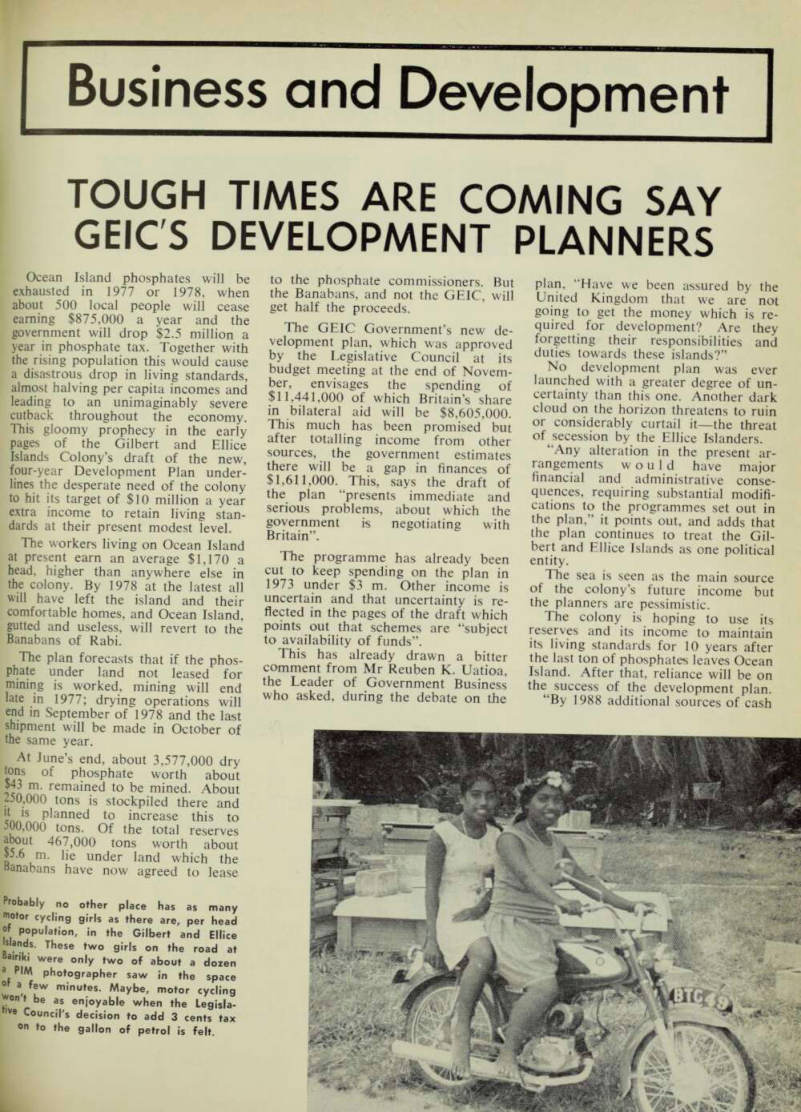
Probably no other place has as many motor cycling girls as there are, per head of population, in the Gilbert and Ellice Islands. These two girls on the road at Bairinki were only two of about a dozen a PIM photographer saw in the space of a few minutes. Maybe, motor cycling won't be as enjoyable when the Legisla tive Cou ncil's decision to add 3 cents tax on to the gallon of petrol is felt.
Tough Times For Geic
income worth $9.74 m. a year are re quired to make up for the loss of phosphate and meet the needs of a population of 90,000 at 1972 stan dards and prices,” the planners say.
“Though agricultural production and overseas employment (of the colony’s seamen on foreign ships and of labourers on Nauru and other islands) are vital parts of the income structure, the only prospect of gene rating cash incomes of the order re quired in the late 1980 s is by the total exploitation of the country’s marine resources. Research so far gives little grounds for optimism that this can be achieved.”
Fisheries development has been disappointing, the planners report, and the research programme received a shattering blow from hurricane Bebe which destroyed the researchers’ fleet, sinking all three ships while they were anchored at Funafuti.
The planners admitted that the best method of exploiting the ocean fish resources was not yet established despite a year-long survey with Van Camp, the United States fish canners.
Fish culture showed more promise, but there were no results yet on which to base any predictions of future in comes.
The survey has confirmed the existence of large stocks of yellowfin and skipjack but only limited supplies of baitfish which points to the need for bait culture and alternative methods of catching. If 1973 surveys are successful, one or more fishing bases could be established in the colony, with island fisheries com prising a small freezer-coldstore and a fleet of dories owned and operated by locals or co-operatives. These would provide frozen or part processed fish to a central collecting and exporting operation.
The plan retains a high priority for marine training for overseas employ ment which, in 1971, gained for the colony in seamen’s wages sent home $233,000 (from telegraphic money orders) plus $lOO,OOO, a guestimate of the amount the men brought back with them.
The target is set at 2,000 foreign going seamen by 1980 and it is calcu lated they will remit up to $1 million a year to their families and local savings.
Coconut production for cash and subsistence remains the priority in agriculture. Copra production aver ages 7,850 tons a year and it is hoped to step this up by new planting and the improvement of coconut groves throughout the colony. De
velopment will also continue in the Line Islands and it is hoped to in clude the Phoenix Islands in the operation.
Timber, poultry and pigs will be developed to save imports, but there is also emphasis on training man power for agriculture. There was a shortage of trained men at the begin ning of the decade but thanks to the 1970-72 plan this is being overcome and by 1975 it is hoped to have a trained staff of 52 including seven with professional qualifications.
It is hoped to attract new industries
with tax concessions, offer other in centives to set up industries on islands outside South Tarawa in accordance with the rural development policy and open small light industries. Men tion is made in the plan of such manufactures as bicycle trainers, string mats, handicrafts, of which a large number are on the way already, embroidered dresses and small cloth ing items and, perhaps, a machine for preparing pandanus leaf.
Local co-operatives, all to be helped under the plan, are combining with private enterprise to set up a biscuit factory which it is hoped to open in 1973 on South Tarawa. The factory may be able to replace bis-
Tough times for GEU
cuit imports amounting to 400,000 ' a year and also have some for expoi which isn’t exactly good news f( biscuit manufacturers in Fiji, who, 1970, exported something lil $37,000-worth of biscuits to tl
Geic.
The processing of coconut produc as well as the use of coconut pal wood is being investigated by tl colony’s Development Authority ar $lO,OOO is being provided each ye; of the plan period for pilot-sca operations.
Contrary to opinions and hopes e pressed in other countries about tl value of tourism, the GEIC planne don’t anticipate a fat living from th industry. The government will e courage the growth of tourism “ ensure the maximum return to tl territory from any investment tourism”, but it doesn’t intend to tal any initiative in tourist hotel develo ment “since the net local bene from tourism is unlikely to justii public investment. Airline and oth commercial interests will underta' any development. The government self and through the Gilbert ai Ellice Islands Development Author! will encourage interest in the GEI by potential investors, and will prepared to establish a Tourist Boai or authority if control appear necessary”.
However, the government may i quire, in return for investment ince lives, guaranteed equity openings fl local investors, equity participate for the government or the GEIDi an option to acquire majority owm ship, land rent on a sliding scale i lated to turnover or gross profit a] the employment of locals with tl introduction of a training programnr Pouring cold water on this asp« of the colony’s future planning, t draft states, “It is frequently argu by promoters that tourism has soc benefits. Pacific experience sugge the opposite. The impact of ri tourists, most of whom are insulat from local conditions, tends to rest in unwanted demonstration effects as in turn resentment among lo*< people. Employment likely to generated in GEIC circumstanu will be small. Although the cola has certain unique aspects —both c: tural, in traditional singing and da;j ing, and in the local natural enviro ment—these are likely to be sterilisi rather than stimulated by tourism”' Public utilities—water, electrici: sewerage, roads—will take quarter of the funds during the pl( period and 94 per cent of the sper;
ing will be concentrated on South Tarawa. Spending in utilities will reach a peak of $600,000 in 1979.
It is planned to build three more internal airfields between 1973 and 1977 at Nanumea (1973), Nonouti (1976) and Abaiang (1976-77).
When they are completed, the air service will cover about 40 per cent of the population outside Tarawa.
There is provision for expanding the King George V School and pro gressing towards universal primary education—but the greatest stress is placed on the need for family plan ning—“the greatest possible urgency attaches to continued and expanded efforts in population control”, says the draft, and reports that, because of the urgency, British aid has financed the whole of the family planning project which is expected to cost $60,000 in each of the years from 1974 to 1976.
The 1973 budget preceded the De velopment Plan in the Legislative Council and members learned that there would be some belt tightening in the next 12 months.
Financial Secretary Mr Douglas Freegard announced duty increases as, biscuits 20 per cent, coffee 10 per cent, tea 10 per cent, margarine 20 per cent, beer 25c a gallon, non-alcoholic drinks 10 per cent, petrol 3c a gallon, fuel oil 1c a gallon and meat 10 per cent.
There was one piece of cheerful news. Toilet paper was freed from duty.
Business briefs
• The Asian Development Bank will lend $U59,800,000 to the PNG Gov ernment for the remaking of two of the country’s most important roads, the Highlands Highway, which links Lae with the Highlands and serves almost half PNG’s population, and the Hiritano Highway. Seventy-five miles of the Highlands Highway from Munum to Waterais will be re aligned and sealed and the Hiritano Highway will be upgraded for 621 miles from the Veimauru River to bereina. Total bill for the improve ments will be SUSI 3 million.
O Majuro’s new 7,000 foot aircraft runway is now officially open, but permanent facilities in the way of a terminal building and for refuelling leave the airfield as “semi-opera tional”. Mobil Oil will install per manent refuelling facilities and a per manent terminal building will be com pleted by May, 1973. The first aircraft to land were an Air Micronesia 727 and a US Army DC4. The old Majuro airfield is seven miles to the south.
• Two Australian and two New Zealand companies are involved in a steel-rolling mill being built in Suva by the Swiss-based Desbro Investment Group. Burns Philp South Sea Com pany Limited and Millers Ltd, both Australian-controlled, each have a 10 per cent equity. The New Zealand companies, each with eight per cent equity, are the Fletcher group and New Zealand Steel Ltd. The mill de scribed by a Desbro spokesman as the first stage of a major steel complex requiring an investment of $5 million, will cost $750,000 and will be in production by next month.
• Built within the planned cost of $1.5 million, the South Seas Brewing Company plant in Lautoka will go into production as Fiji’s second brewery in June. The first bottle is expected to be ceremonially filled on June 1. The plant will use Lautoka’s town water supply.
The company is 51 per cent owned by Consolidated Hotels of New Zea land which is half owned by New Zealand Breweries, Directors are H.
H. Innes, J. R. Beck and L. J. Erik sen of New Zealand and M. M. Patel, Y. P. Reddy and P. K. Slimmer of Fiji.