expansion
pp. 53-59 · Read in the full issue
South Seas expansion
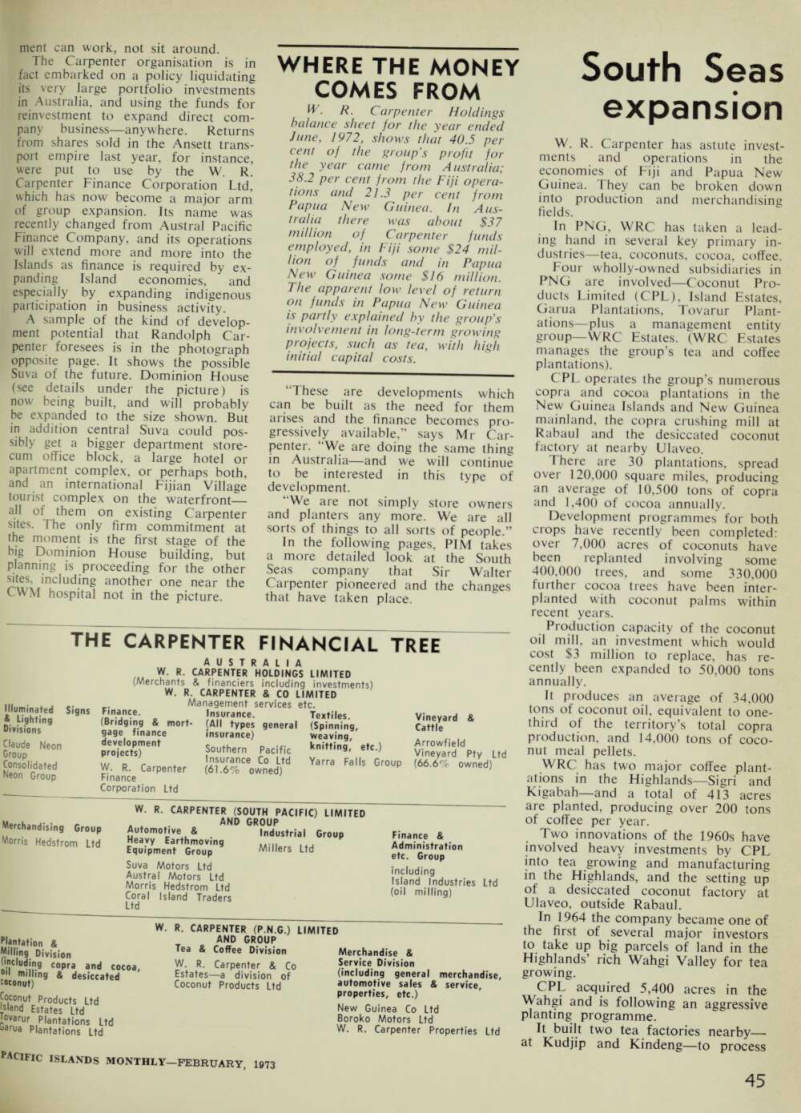
W. R. Carpenter has astute invest ments and operations in the economies of Fiji and Papua New Guinea. They can be broken down into production and merchandising fields.
In PNG, WRC has taken a lead ing hand in several key primary in dustries— tea, coconuts, cocoa, coffee.
Four wholly-owned subsidiaries in PNG are involved—Coconut Pro ducts Limited (CPL). Island Estates, Garua Plantations, Tovarur Plant ations—plus a management entity group—WßC Estates. (WRC Estates manages the group’s tea and coffee plantations).
CPL operates the group’s numerous copra and cocoa plantations in the New Guinea Islands and New Guinea mainland, the copra crushing mill at Rabaul and the desiccated coconut factory at nearby Ulaveo.
There are 30 plantations, spread over 120,000 square miles, producing an average of 10,500 tons of copra and 1,400 of cocoa annually.
Development programmes for both crops have recently been completed: over 7,000 acres of coconuts have been replanted involving some 400,000 trees, and some 330,000 further cocoa trees have been inter planted with coconut palms within recent years.
Production capacity of the coconut oil mill, an investment which would cost $3 million to replace, has re cently been expanded to 50,000 tons annually.
It produces an average of 34,000 tons of coconut oil, equivalent to one third of the territory’s total copra production, and 14,000 tons of coco nut meal pellets.
WRC has two major coffee plant ations in the Highlands—Sigri and Kigabah—and a total of 413 acres are planted, producing over 200 tons of coffee per year.
Two innovations of the 1960 s have involved heavy investments by CPL into tea growing and manufacturing in the Highlands, and the setting up of a desiccated coconut factory at Ulaveo, outside Rabaul.
In 1964 the company became one of the first of several major investors to take up big parcels of land in the Highlands’ rich Wahgi Valley for tea growing.
CPL acquired 5,400 acres in the Wahgi and is following an aggressive
planting programme.
It built two tea factories nearby— at Kudjip and Kindeng— to process
other growings as well as its own crops.
Using its own group branches in London in the past 36 months it has sold NG tea and has helped to win for NG tea a name as top-grade.
Recently, with the co-operation of PNG’s Department of Agriculture, Stock and Fisheries, CPL has begun a profit-sharing scheme with New Guinean smallholders in the Wahgi Valley.
Simply, the scheme means CPL undertakes to buy from smallholders their green leaf at agreed prices, providing the world ruling rates for tea remain constant.
CPL's tea production jumped from 590,000 kilograms in the 1971 fin ancial year to 820,000 kilograms in the 1972 year—a 39 per cent increase.
CPL’s desiccated coconut plant— one of the world’s most modern—re presents an investment of about $1.5 million, and produces about 4,500 tons a year, a valuable export earner for the territory.
The product here—since the start of the plant production in 1968—has unfortunately been subject to par ticularly severe price fluctuations, fol lowing Sterling devaluation in 1967 and the Philippines revaluation of 1970, and the recent Australian revaluation.
For its combined coconut, cocoa, tea and coffee growing, CPL employs a total staff of 4,600, of which less than 100 are European.
Tuna fishing is the most recent WRC primary industry project in PNG and WRC (PNG) has taken up a 25 per cent share of Carpenter Kaigai (PNG) Pty Ltd, to catch and freeze skipjack tuna in the NG Is lands area.
The new company plans to operate 15 fishing boats and three “mother” ships out of Rabaul. Within five years it hopes to catch 18,000 tons of tuna a year and to have 500 New Guineans employed in the business.
By 1977, hopes are to have 50 per cent of the company’s catch pro cessed in PNG, with a $500,000 cold store plant and a $250,000 tuna smok ing plant built near Rabaul.
A 55 per cent shareholder in the company is a Japanese group, Kaigai Gyogyo Kabushiki Kaisha, and 20 per cent of the operation has been offered to the PNG Government. . Carpenters merchandising and light industry activities in PNG may be divided into five spheres—retailing, gas supply, automotive, properties and paint.
As well the group’s insurance affiliate. Southern Pacific, has a terri tory-based subsidiary—Southern Cross Marine Insurance.
The wholesale and retail subsidiary
OH mills vital to economies
—New Guinea Company—operates substantial retail and wholesale stores in the capital, Port Moresby, with branches elsewhere, and a modern supermarket at Lae.
WRC has a joint share with the Boral Group in Moresby-registered Gas Supply Company, which pro vides gas for private homes and in dustry throughout PNG. Called “New Guinea Gas”, the gas is imported from Australia in liquid petroleum form by small gas tankers which main tain terminals at five PNG ports.
At the terminals, gas is marketed in bulk form or sold in tank-shape metal bottles.
Carpenter’s automotive interests are represented by Boroko Motors and the newly-formed Arawa Motors, of Arawa, Bougainville.
Boroko Motors is one of the terri tory’s largest vehicle firms, and its franchises include Ford, Datsun and Goodyear tyres. It operates in Port Moresby and all other main centres.
Arawa Motors is the group’s second venture in PNG to attract local share holding in its operations.
Thirty per cent of the company’s paid-up capital of $50,000 is held by a Bougainvillean, Henry Moses on behalf of his people.
It will handle all the Boroko Motors franchises and operate a large workshop at Arawa.
The WRC paint interests is a half share m Taubmans (NG) Ltd, which imports and sells paint to retailers
throughout NG.
W R. Carpenter (PNG) Ltd acts as the group’s holding company for the area.
In Fiji, WRC’s investment in pri mary industry is based entirely on the coconut. A subsidiary—lsland In dustries Ltd—operates the dominion’s coconut oil mill at Suva, with a capacity of some 40,000 tons.
Policy has been to sell off selected plantation holdings in Fiji—Laucala ™ d example—and reinvest in other Fiji industries.
J, 5 w orth mentioning here that while production capacity of either the mrefv fn r Su -T a coconut mills is rarely fully utilised, both mills are a Vltal elem ent of each country’s economy. J an l n Fi P’ th .e group’s merchandising and industrial activities are more fhese Se fi.M an itS , PNG °P era tions in se fields, and its investments in
partly-owned companies more numerou s- The group’s two major subsidiaries controlled through a holding investment company called WR Carpenter (South Pacific)—Morris Hedstrom and Millers Ltd.
Formerly a venerable family trading concern it still has smaller stores in Tonga and Western Samoa— Morris Hedstrom is one of the two major retailers in Fiji, whose stores, particularly in Suva, have prospered from tourism. . , .. k*?? °n er Mor , ns Hedstrom or about $2 million in 1956 and won what was then the largest trading and
planting group in the central and east South Pacific.
Hedstrom’s origins go back to the 1860 s and today its employees number some 1,500, almost all of whom are local residents WRC took over Millers Ltd at the same time as il bought Hedstroms, a ?. d today this means the operation of , bl BS est engineering and ship repairing group, outside of the govern me w-’,, , . M, .!! ers employs up to 1,000 people in and builds ships up to 140 ft long and 250 tons deadweight.
Many of its ships sell to other Islands groups. Millers is currently
undergoing a $500,000 ship repairing
Fiji Management Reorganised
expansion programme at its Walu Bay shipyard.
Its associated activities are numer ous —plumbing, the manufacture of furniture, fibreglass and ferro-cement products, construction of buildings and manufacture of refrigeration equipment.
It has recently formed a joint com pany with a big Australian building company, Mainline, to build more property in Fiji.
WRC has three subsidiaries associ ated with its automotive activities in Fiji—Suva Motors, Austral Motors and Coral Island Traders.
Suva Motors is the biggest of the three, with new salesrooms and ser vice divisions. It holds the franchise for Datsun vehicles and Caterpillar —makers of agricultural and earth moving equipment.
Coral Traders holds the Honda franchise.
Another subsidiary—lsland Trans port—provides tourist and service transport operations on Fiji’s main island of Viti Levu.
WRC’s two other wholly-owned operating subsidiaries are Bure Ad
™rtisin« Young’s Electroplating Company.
The group has a 50 per cent in lrest in Carlton Brewery (Fiji)— the dominion’s only brewer, and a new . co ™ « being formed to acc l uire this company s assets. The new company proposes to offer 15 per cent of its capital to the Fiji
mmm
Dominion Property i s h eZingV $3 million nine-storey building in Suva on WRC land The nrWicif d j 3 Banldng group Ss jo ned WRC in financing § the P venture and Mainline Miller* the ° e will erect the bu ldme gr ° UP The
bedrooms hotel-motel' shoos* Ind
offices notel mo,el - shops and
j&trnfr v* •*
other freehold the ¥?u P S
with demand and available finance.
The Carpenter group has also 50 per cent interest in three other Suva-
Si" WaSu
Meats The group’s Fiji management was recently re-organised Mr David Crowe was annointed managing director the company and chief executive of the area.
Mr Lyle Cupit became chief general Clemens industrial M ' Ken The tr »n m n • The top New Guir| ea executives k E ‘ Clay P ha "’ who is resident chairman with immediate responsibility for coastal plantations ""r manufa f ct “ rin 8: Mr C. W. Batten, a director of W. R. Carpenter (PNG) U ff W '‘ h respcnsibility for tea and coffee production; and Mr M. C.
ayyf<»sr sra
,s responsible for the group’s general