Seen In The Shops
pp. 105-106 · Read in the full issue
By Elizabeth Bell
Some shopping discoveries, for the theatrically minded Anything to do with the stage holds fascination for most of us, and a highly intriguing place to visit is The Prop Shop (51 Old Church Street, London, 5.W.3).
Hidden away in the section of Old Church Street which lies between King’s Road and the Chelsea Em bankment, the building has a theatrical heritage, for it once belonged to the famous Edwardian actress, Lily Langtry. The shop overflows with props, costumes, jewellery and acces sories, and in the small gallery up stairs, reached by a perilously steep flight of stairs, are the original designs for sets and costumes for many notable plays and films. At the time of my visit, these included the work of Cecil Beaton, Michael Annals and Carl Toms. I cannot, of course, say what will be there when this article
appears, for the items sell out quickly, but it is fairly safe to predict that there will be some of the costume and set designs for recent productions in London, Stratford-upon-Avon and Chichester. iMnong the costumes downstairs I noticed a flowing cream-coloured gown ornamented with gold em broidery which was worn by Joan Plowright as Portia in The Merchant of Venice. This was designed by Julia Trevelyan Oman and could be bought for £9O; it would in fact, provide a very distinctive and Portia-esque cock tail dress for any hostess. There was also a delicate white-and-gold ruff from the film Mary Queen of Scots (£2O) and a necklace worn by Pamela Brown in the film Becket (£l2). A dramatic skull mask on the wall was priced at £36, and grotesque doll figures (one with a pig’s head and the other, seemingly, a witch) lolled among a pile of cushions.
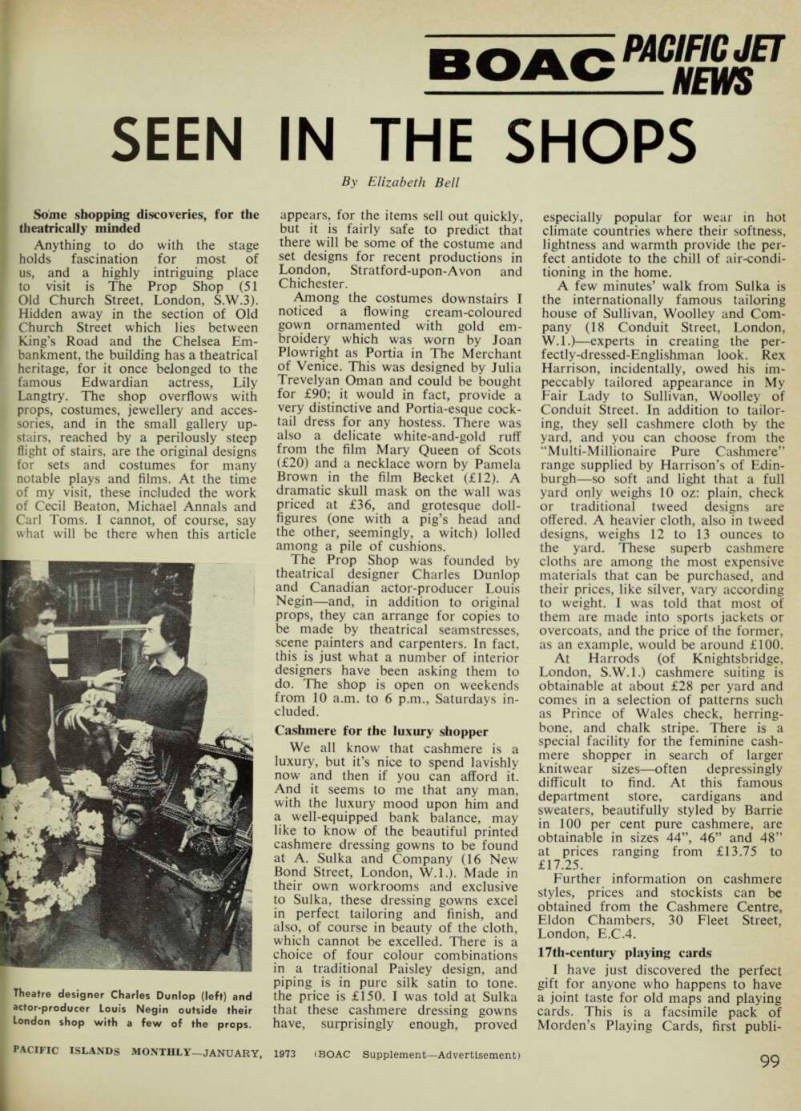
The Prop Shop was founded by theatrical designer Charles Dunlop and Canadian actor-producer Louis Negin—and, in addition to original props, they can arrange for copies to be made by theatrical seamstresses, scene painters and carpenters. In fact, this is just what a number of interior designers have been asking them to do. The shop is open on weekends from 10 a.m. to 6 p.m., Saturdays in cluded.
Cashmere for the luxury shopper We all know that cashmere is a luxury, but it’s nice to spend lavishly now and then if you can afford it.
And it seems to me that any man, with the luxury mood upon him and a well-equipped bank balance, may like to know of the beautiful printed cashmere dressing gowns to be found at A. Sulka and Company (16 New Bond Street, London, W.L). Made in their own workrooms and exclusive to Sulka, these dressing gowns excel in perfect tailoring and finish, and also, of course in beauty of the cloth, which cannot be excelled. There is a choice of four colour combinations in a traditional Paisley design, and piping is in pure silk satin to tone, the price is £l5O. I was told at Sulka that these cashmere dressing gowns have, surprisingly enough, proved
especially popular for wear in hot climate countries where their softness, lightness and warmth provide the per fect antidote to the chill of air-condi tioning in the home.
A few minutes’ walk from Sulka is the internationally famous tailoring house of Sullivan, Woolley and Com pany (18 Conduit Street, London, W.l.) —experts in creating the per fectly-dressed-Englishman look. Rex Harrison, incidentally, owed his im peccably tailored appearance in My Fair Lady to Sullivan, Woolley of Conduit Street. In addition to tailor ing, they sell cashmere cloth by the yard, and you can choose from the “Multi-Millionaire Pure Cashmere” range supplied by Harrison’s of Edin burgh—so soft and light that a full yard only weighs 10 oz: plain, check or traditional tweed designs are offered. A heavier cloth, also in tweed designs, weighs 12 to 13 ounces to the yard. These superb cashmere cloths are among the most expensive materials that can be purchased, and their prices, like silver, vary according to weight. I was told that most of them are made into sports jackets or overcoats, and the price of the former, as an example, would be around £lOO.
At Harrods (of Knightsb ridge, London, 5.W.1.) cashmere suiting is obtainable at alx)ut £2B per yard and comes in a selection of patterns such as Prince of Wales check, herring bone, and chalk stripe. There is a special facility for the feminine cash mere shopper in search of larger knitwear sizes—often depressingly difficult to find. At this famous department store, cardigans and sweaters, beautifully styled by Barrie in 100 per cent pure cashmere, are obtainable in sizes 44”, 46” and 48” at prices ranging from £13,75 to £17.25.
Further information on cashmere styles, prices and stockists can be obtained from the Cashmere Centre, Eldon Chambers, 30 Fleet Street, London, E.C.4. 17th-century playing cards I have just discovered the perfect gift for anyone who happens to have a joint taste for old maps and playing cards. This is a facsimile pack of Morden’s Playing Cards, first publi
Theatre designer Charles Dunlop (left) and actor-producer Louis Negin outside their London shop with a few of the props.
shed in 1676. Each card bears on its reverse side a small map of an English or Welsh county, and when laid out in the correct order the cards form a complete map of England and Wales. The set also includes facsimiles of Morden’s two pre liminary cards which explain, in 17th century wording, that the northern counties are Clubs, the western counties Spades, the eastern counties are Hearts, and the southern counties Diamonds. Instead of the traditional
playing-card pictures of the King and
Queen, Morden’s cards portray Charles II and his Queen, Catherine of Braganza, who were reigning at the time when they were first published.
Only one complete original pack of these cards is believed to exist, and this facsimile was the idea of Mr Harry Margary, a connoisseur in the field of old maps. He is the owner of one of the loveliest old homes in Kent —historic Lympne Castle, which stands on the edge of a steep escarp
ment high above Romney Marsh.
Strictly speaking, my heading “Seen in the Shops” should in this instance read “Seen in the Castle”, for visitors to Lympne Castle, (open to the public on Wednesdays and Saturdays until the end of October) can buy the cards there. They can be purchased by post,
however, at any time, and requests should be addressed to Mr Margary at Lympne Castle, Hythe, Kent. The price is £1.50 per pack; for post and packing. Morden’s Playing cards are the first of several old packs of cards which Mr Margary plans to reproduce.