Pacific Shipping
pp. 82-87 · Read in the full issue
Lash
service to
South Pacific
Exports from South Pacific Islands to some of the major markets of the world may soon be carried in LASH (lighter aboard ship) containers.
Pacific Far East Lines plans to start, in March, a LASH service from the American west coast (Canada and the US) to New Zealand and Aus tralia via Papeete and Pago Pago.
These ships will replace the existing service, which is operated with con ventional cargo ships.
Mr James T. Enzensperger, of Yokohama, Pacific representative of PEEL, recently spent some time in the South Pacific surveying port possi bilities for LASH. The survey in ! duded Suva, as well as Pago Pago and Papeete, but excluded a number of other ports.
Asked if other groups such as New Guinea, New Caledonia, New Heb rides and the BSIP would get the benefit of LASH services, he said: We have just not considered them.
We have enough problems getting started. But that does not mean we will not go to other ports”.
Even though PEEL has had ex perience with LASH ships, having introduced a service to the Near North (of Australia) about 15 months ago, Mr Enzensperger said there would be a lot of growing pains with the South Pacific service. The system is flexible enough to allow ships to unload containers at wharves, or quickly change cargo from the con tamer* to lighters and unload in the harbour if there was berth conges- Jp. The lighters are then sailed to tlwharf.
The crew then leaves the loaded Ughters and returns to the carrier ship X lighters left from the previous Jyage. These lighters may be full ?Ac e « pty ‘ Mr Enzensperger said a LASH carrier need spend only four or five hours in a port like Suva.
He emphasised there was no inten- Sf 1 anywhere of removing work from 2 i waterfront. The containers, p ether landed by lighter or direct rom the ship, would be handled on
the waterfront by traditional labour.
Asked what cargo could be picked up in the Pacific for major markets, he said logs could be loaded at Pago Pago for the US. Fiji was not yet on the LASH schedule, but if and when she was, PFEL would look at carrying sugar to Canada from Lautoka, and fish to Japan and the US from Levuka. The lighters, after they were unloaded at Suva, could be towed to Lautoka and Levuka, and loaded at leisure.
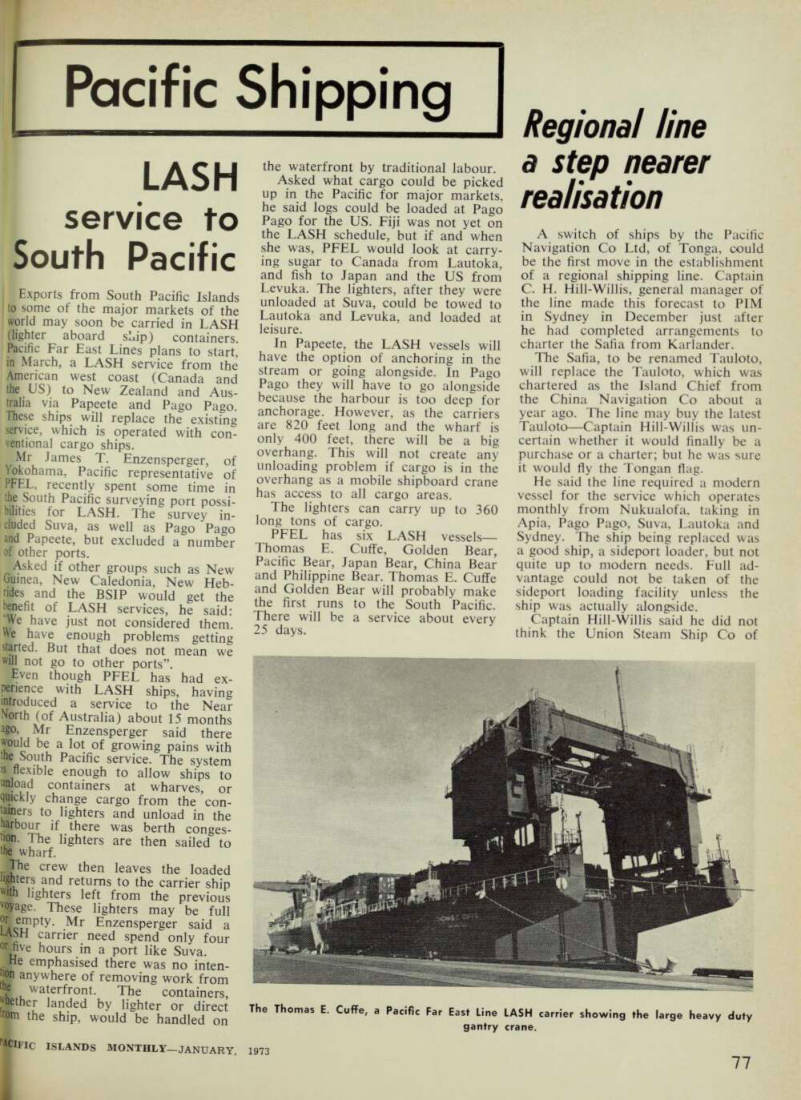
In Papeete, the LASH vessels will have the option of anchoring in the stream or going alongside. In Pago Pago they will have to go alongside because the harbour is too deep for anchorage. However, as the carriers are 820 feet long and the wharf is only 400 feet, there will be a big overhang. This will not create any unloading problem if cargo is in the overhang as a mobile shipboard crane has access to all cargo areas.
The lighters can carry up to 360 long tons of cargo.
PFEL has six LASH vessels— Thomas E. Cuffe, Golden Bear, Pacific Bear, Japan Bear, China Bear and Philippine Bear. Thomas E. Cuffe and Golden Bear will probably make the first runs to the South Pacific.
There will be a service about every 25 days.
Regional line
a step nearer
realisation
A switch of ships by the Pacific Navigation Co Ltd, of Tonga, could be the first move in the establishment of a regional shipping line. Captain C. H. Hill-Willis, general manager of the line made this forecast to PIM in Sydney in December just after he had completed arrangements to charter the Safia from Karlander.
The Safia, to be renamed Tauloto, will replace the Tauloto, which was chartered as the Island Chief from the China Navigation Co about a year ago. The line may buy the latest Tauloto—Captain Hill-Willis was un certain whether it would finally be a purchase or a charter; but he was sure it would fly the Tongan flag.
He said the line required a modern vessel for the service which operates monthly from Nukualofa, taking in Apia, Pago Pago, Suva, Lautoka and Sydney. The ship being replaced was a good ship, a sideport loader, but not quite up to modem needs. Full ad vantage could not be taken of the sideport loading facility unless the ship was actually alongside.
Captain Hill-Willis said he did not think the Union Steam Ship Co of
The Thomas E. Cuffe, a Pacific Far East Line LASH carrier showing the large heavy duty gantry crane.
NZ Ltd proposals to introduce Tarros class vessels to the New Zealand- Pacific Islands service would material ise. Nor would a proposal made by a San Francisco company. He also thought the Tofua would cease operat ing to the Pacific Islands in April.
Pacific Islands governments, par ticularly Fiji, had made it quite clear they wanted a regional line. Tonga intended to go ahead. “We have a viable ship and we have the per sonnel,” Captain Hill-Willis said.
Captain Hill-Willis also said there was a misconception about union opposition to a regional line. The NZ Seamen’s Union would not object to a shipping line, flying the flag of its own country and operating from there to NZ and back. What that union, and also the Australian Sea men’s Union objected to, was ships flying the flag of another country, using Australia or New Zealand as a base and not going near their own country.
He had discussed that question with Mr W. Martin, secretary of the NZ Seamen’s Union. Mr Martin had told him there would be no objection to a Tongan ship, flying the Tongan flag operating from Tonga to NZ with Tongan produce, and returning to Tonga with NZ goods.
The Troubles Of
Fiji Marine System
Faults, real and imagined, are many in Fiji’s marine system. The Fiji Ports Commission of Inquiry heard of them from Levuka, Labasa, Lautoka and Suva. Reading between the lines it is apparent that the new wharves built at Lautoka and Suva in the early 1960 s were obsolete be fore they were officially opened.
Levuka used a thriving fishing in dustry as a lever for upgrading of port facilities. The Pacific Shipping Co Ltd fleet is expected to rise to 68 in 1973.
The Levuka-based fishing industry has grown spectacularly, but practic ally unnoticed alongside mushroom ing tourism. The 1971 catch was worth $5 million. Final figures were expected to show a catch worth $8 million from more than 12,000 tons in 1972, while in 1973, the catch is expected to reach more than 15,000 tons, worth more than $lO million.
Fishing now rates next to sugar as a leading export industry.
Labasa organisations sought to have Labasa declared a port of entry.
This would help to cut trans-shipment costs. As it is, a number of ships call at Malau, near the mouth of the Lagui River to load sugar and timber, but they arrived empty. All Vanua Levu would benefit from
lower costs if these ships were a to unload at Malau instead of ports of entry.
Lautoka’s main complaint i about time lags in clearing cargo ; obtaining documentation for it. general manager of the Pacific Lu ber Co, Mr David Price, said once spent three days on the t phone trying to find the right mar allocate berthing for a tug anc barge due to arrive from Kadi with timber.
He said Customs officials “pas the buck” from one to another w their aid was needed.
Lautoka handles more of F exports than any other Fiji p There were complaints in 1961, w it was finished (it cost $3 millii that facilities were inadequate.
Custom House Agents’ Associa submitted three main complain heavy pilferage, chaotic storage, slow cargo deliveries.
Mr Don Aidney, a well-known businessman, and a director of y liams and Gosling Ltd, stevedc etc, was critical of cargo hand at both Suva and Lautoka. He vocated a port authority, indepem of the Marine Department, to cargo handling at both ports oui the hands of private contractors.
There was *a lack of incentive the present system, under which large merchandising firms were 1 agents and stevedores. Large porters used their import tonnag! get agency and stevedoring contr With little fear of losing the tracts, inertia crept in, and attitude filtered down to labour.
Mr Aidney said sugar would bulk loaded in a few years, in of high capital cost for equip! and a social problem—elimint work for many rural Fijians. T Fiiians had little chance of firr other work.
Modern ships required bulk I ing to operate economically, had to be loaded quickly becaus high charter rates.
Suva stevedores were criticise*; the secretary of the Copra Board!
Tony Moore. He blamed the cost of handling copra on theiu different work—unloading the o ships from the outlying islands smoke-o, talanoa and half a bv of yaqona. Other slow work he to raise the cost of handling cope Suva alone to $5.31 a ton. In the cost was $3.85 a ton.
Pilferage was another matt© receive attention. It is rampanr some wharves, because of lac: supervision and long delays in o ing cargo, said Mr Geo O’Meagher, Fiii manager of ; Guardian Royal Exchange Assuii
group. He considered pilfering costs ran into tens of thousands of dollars each year. Pilfering helped to send up insurance premiums. To meet the higher premiums importers passed on the cost to customers.
Three 'Saved 7 In Fiji
Salvage Week
It was “salvage week” in Fiji at the end of November when three grounded ships were refloated. One of the ships “saved” was the Tata Siddhi, a shrimp catcher, which went aground on Motualevu Reef, near Laucala Island, during hurricane Bebe. She was refloated by the Salmar. which towed her to Suva.
The Tata Siddhi had a slightly dam aged hull. ■Another Bebe victim, Rebel, a )arquentine, was towed off a mud jank near Lautoka. A Marine Pacific ng took three days to haul the Rebel )00 feet over the mudbank to deep vater. The Rebel, with minor hull iamage, was towed to Suva for ■cpairs.
The Tae Yang 116, a Korean fish ng ship, which went aground on Yasilai Reef, near Suva, early in >eptember, was towed off by another K me j Pacific tug. Her hull was »adly damaged, but the interior of he ship was in fairly good condition.
The crew of the Salmar, after tow ng the Tata Siddhi to Suva, then i'ent out again to try to tow the Tata yoti, a sister ship of the Tata Siddhi, a reef near Nasilai lighthouse, mere it was blown during the hum ane.
ARPENTERS' shipping
Oss In Fiji
A hardy annual, which appeared l m p°j; tOPO L Us . regularity in the urns Philp chairman’s ren 0 rt for wk y u a , r i’/ nd which eventually led > the old firm” selling its merchant nu may T s ? read t 0 W - R - Carpenter foldings Ltd. This was lack of profits. ig F from’ £?“ Philp Ships ’ °Perat g from Sydney and Brisbane to r£rp eW /T nea ’ N °rfolk Island, *ney and hC NeW Hebr ides, lost Now, in Fiji, Island Transport Ltd, s s bs [ d . iar y, may replace inter-island ships, the Komaiwai 1(1 the Ai Sokula, with tugs and 7l g Isla . nd Transport Ltd lost /1, 061 m the last financial year, and JU one of its three ships. Now, to shipping to profitability, a Jige to tug and barge operation is 'senna!, the company says in the puai report.
Fiji won’t be the same without a omaiwai or Ai Sokula under the
Carpenter flag, although those familiar names could be given to the smaller boats.
Uss Co—The
Philanthropist
The Union Steam Ship Co of NZ Ltd will continue to act as a philan thropist on services from New Zea land to Fiji, Tonga, Niue and Samoa.
It will absorb continuing losses rather than increase freights.
Sir Peter Abeles, chairman of the USS Co, announced recently in Auckland that the loss on the service was about $300,000 a year. There were two ways to overcome the prob lem: (1) Keep the present old ships in service and adjust prices; or (2) bring new ships into service in con junction with Islands governments.
The latter policy would be the obvious course in view of a previous offer, and because of the interest several Islands governments have shown in setting up a regional ship ping line.
New Vessels For
Nauru-Pacific
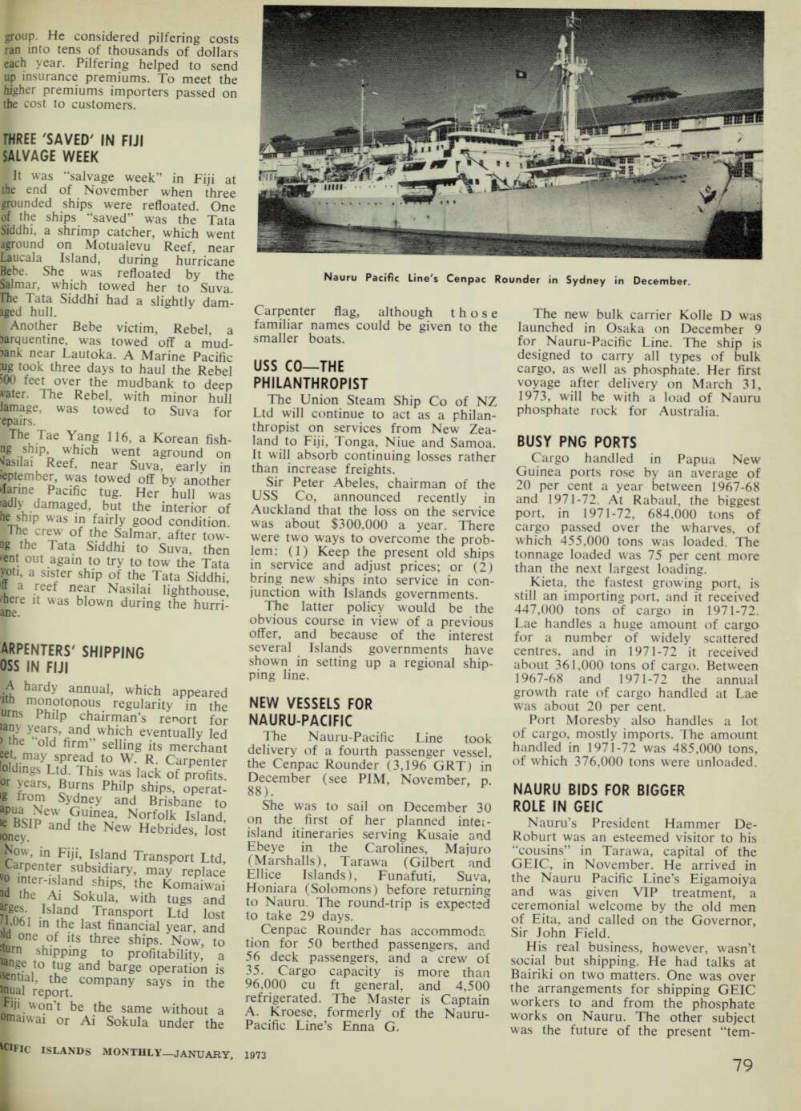
The Nauru-Pacific Line took delivery of a fourth passenger vessel, the Cenpac Rounder (3,196 GRT) in December (see PIM, November, p. 88). y She was to sail on December 30 on the first of her planned intei island itineraries serving Kusaie and Ebeye in the Carolines, Majuro (Marshalls), Tarawa (Gilbert and Ellice Islands), Funafuti, Suva, Honiara (Solomons) before returning to Nauru. The round-trip is expected to take 29 days.
Cenpac Rounder has accommoda tion for 50 berthed passengers, and 56 deck passengers, and a crew of 35. Cargo capacity is more than 96,000 cu ft general, and 4,500 refrigerated. The Master is Captain A. Kroese, formerly of the Nauru- Pacific Line’s Enna G.
The new bulk carrier Kolle D was launched in Osaka on December 9 for Nauru-Pacific Line. The ship is designed to carry all types of bulk cargo, as well as phosphate. Her first voyage after delivery on March 31, 1973, will be with a load of Nauru phosphate rock for Australia.
Busy Png Ports
Cargo handled in Papua New Guinea ports rose by an average of 20 per cent a year between 1967-68 and 1971-72. At Rabaul, the biggest port, in 1971-72, 684,000 tons of cargo passed over the wharves, of which 455,000 tons was loaded. The tonnage loaded was 75 per cent more than the next largest loading.
Kieta, the fastest growing port, is still an importing port, and it received 447,000 tons of cargo in 1971-72.
Lae handles a huge amount of cargo for a number of widely scattered centres, and in 1971-72 it received about 361,000 tons of cargo. Between 1967-68 and 1971-72 the annual growth rate of cargo handled at Lae was about 20 per cent.
Port Moresby also handles a lot of cargo, mostly imports. The amount handled in 1971-72 was 485,000 tons, of which 376,000 tons were unloaded.
Nauru Bids For Bigger
Role In Geic
Nauru’s President Hammer De- Roburt was an esteemed visitor to his “cousins” in Tarawa, capital of the GEIC, in November. He arrived in the Nauru Pacific Line’s Eigamoiya and was given VIP treatment, a ceremonial welcome by the old men of Eita, and called on the Governor, Sir John Field.
His real business, however, wasn’t social but shipping. He had talks at Bairiki on two matters. One was over the arrangements for shipping GEIC workers to and from the phosphate works on Nauru. The other subject was the future of the present “tem
Nauru Pacific Line's Cenpac Rounder in Sydney in December.
porary” service operated to Tarawa every' six weeks by the Eigamoiya. So far this is on a trial basis. President Deßoburt, looking for more work for the Nauruans’ shipping line, Jwants it on a permanent basis. ■ And the latter subject is exercising the attention of Columbus Shipping tine, GElC’s one regular sea link Iwith the outside world. GEIC, one lof the most isolated territories in the world, wants all the links it can get.
It thinks its communications could be ■mproved but there’s no room for Itwo shipping lines.
I One will have to go. President De ißoburt wants his to stay. Columbus, ■with big plans for the future, doesn’t ■want to be pushed out either. Next ■larch, Columbus will launch its first ■container service from Australia and ■New Zealand to the West Coast of I the United States, similar to the one ! already operated from Australia and New Zealand to USA’s East Coast. It is planned to continue calling at ■Tarawa and, in fact, giving the Gi lberts an improved service through the Icontainers but there’s one difficulty I—how to get the containers onto the ■wharf.
I At first there will be three fully cellular 12,000-ton dwt container ■ships, two operating in the first ■quarter of next year and the third Eater in the year. They have been chartered by Columbus’s parent com pany in Hamburg and are equipped to meet the requirements of the Aus tralian trade with the United States. llf the trade develops, Columbus will [build its own ships.
I Each ship has 400 containers of ivhich 140 are refrigerated, and each jfcarries a gantry crane so that there will be no problem getting the con tainers off the ship and on to the lighter barges. The problem will be to lift them from the barges to the wharf but Columbus’s man on Tarawa, Captain J. F. Roubal, man ager at present of the South Pacific Marine Service there, thinks there’s a solution.
The big advantage to the GEIC, he said, was that with containers giving a much quicker turn-round, Columbus fcould have a ship in Tarawa every 19 days which, with a shortage of refrigerated space on Tarawa, is something to think about. Unloading would take only six to eight hours instead of days as at present.
This could be the decider between the rival services but there’s another consideration. The Gilbertese and the ■aururans are kith and kin.