jet travel
pp. 51-52 · Read in the full issue

More Pacific jet travel on the way
Air Pacific, the Islands’ regional airline, has plans to extend its jet coverage next year with the intro duction into service next September of a second BAC One-Eleven jet. It is also hoping that some airstrips in the region, notably at Nukualofa in Tonga and Tarawa in the Gilberts, will be upgraded to take the BAC and so allow even greater extension of the service.
The airline had a Christmas present for the people of Labasa, Vanua Levu’s sugar centre, in the shape of an improved service. December 25 was to see the start of a new HS74B direct service to the town from Suva and Nadi. At present the town is served by Herons. This will also help to improve the services to Matei, on Taveuni, and Savusavu on Vanua Levu.
The BAC is expected to fly Fiji/ Tarawa when the airstrip at Tarawa has been rebuilt and given a tarmac runway at a total cost of $230,000, a bill which is being met by the British taxpayer. The improvement to the airstrip is being viewed with mixed feelings by the people of the GEIC. Britain is expected to pay the bill by diverting funds which were intended for other projects in this year’s programme in the colony. Some of them may have to wait until an other year, but the colony’s govern ment is expected to approach London for an extra grant.
The people are also worried that the faster BAC with its greater pas senger capacity may reduce the fre quency of the service from Fiji, through Funafuti, which at present is three times a fortnight. .Certainly, Funafuti will be over flown by the BAC which, the Ellice Islanders fear, may leave them with out a direct service and require them to fly on the internal service to Tarawa to catch the BAC. To fly the Heron, which is the colony’s internal carrier, as far as Funafuti another staging post would be needed. Nanu mea, which has a wartime strip, is ttpected to be the extra stop, in which case Air Pacific would need more than one pilot on the internal service.
Air Pacific, however, may have
other plans which could set the colony people’s fears at rest. An HS74B could still operate from Fiji to Tarawa via Funafuti, perhaps.
Whatever happens, Air Pacific assured PIM that a service to Funa futi will be maintained and that the Ellice Islanders will not be “any worse off”. Their communications will continue to be at a satisfactory level.
The airline is looking back with satisfaction at its operations last year, when it carried more than three times the number of passengers on its regional service than it did five years ago. Total last year was 32,977, 6,915 more than in 1970 and 22,000 more than in 1967. Passengers carried on the domestic service last year totalled 146,163, 32,168 more than in 1970.
Work is continuing on Nukualofa’s new airstrip at Fua’amotu but bad weather and a shortage of plant has slowed down operations. Completion date is now expected to be the middle of 1973. The new strip will be 5,800 ft between thresholds and with a two-inch bitumen seal over 15 inches of compacted coral will be capable of taking the BACs.
This last 12 months has been frus trating, both for travellers into and out of Tonga and Air Pacific. Bad weather has closed the airstrip on numerous occasions and several times Tongatapu has been without air links for four and five days at a stretch.
Apart from heavy rain directly on to the old strip, which was built during the war by the United States forces, water is also draining from the new strip onto the old strip.
When the new strip is in service Air Pacific will be able to maintain its schedule.
...and so are the Pacific's own airline pilots
Localisation is moving fast in Fiji too fast, complain some people in cluding trade unionists—but there is one well-paid job which won’t be fully localised for some years and its total strength at present is only around 50 —all men.
That job is up in the air as a pilot.
It is being localised but at the rate of not less than two or three a year.
So far only six out of 41 pilots flying with Air Pacific are locals and none is an aircraft commander. But no one could sustain an argument against it.
The Fiji Government and Air Pacific refuse to be hurried over localising air services—it’s a life or death matter, a job where there’s no room for mistakes, but when the job is completely localised Fiji’s fliers will be second to none. That’s the guarantee from those who handle the training scheme, from the govern ment selection board in Fiji, through the flying school in England and through the seven or eight years which elapse after a pilot has got his commercial pilot’s licence before he can take control of Air Pacific’s more sophisticated aircraft. The waiting’s worth it for then the local lad, at today’s rates, is earning around $9,000 a year. It has cost $lO,OOO just to transport him, clothe, feed and train him in the UK flying school for a little over a year—at no cost to himself.
Psychology allied to commonsense and the usual methods of choosing
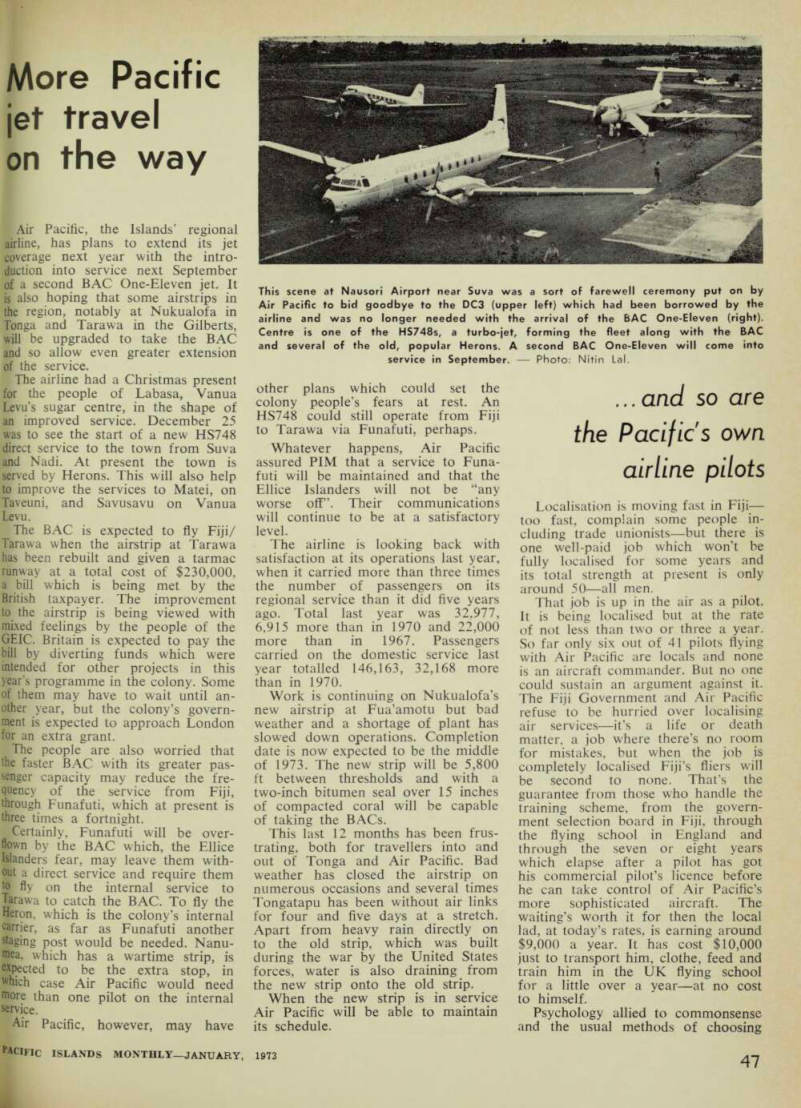
This scene at Nausori Airport near Suva was a sort of farewell ceremony put on by Air Pacific to bid goodbye to the DC3 (upper left) which had been borrowed by the airline and was no longer needed with the arrival of the BAC One-Eleven (right).
Centre is one of the HS748s, a turbo-jet, forming the fleet along with the BAC and several of the old, popular Herons. A second BAC One-Eleven will come into service in September. - Photo: Nitin Lal.
Not For Money
people on an academic yardstick are used by Fiji’s selection board to pick out the two or three lads who, each year, are sent to the flying school, usually the one at Kidlington near Oxford. Maybe a dozen or more young men are chosen from those who respond to the advertisement inviting applications from would-be fliers. The applicant who hasn’t got his university entrance certificate hasn’t much chance of going to the school. If he’s bright and measures up to academic standards, then the psychological side comes into the picture.
If he’s applied for the job with a big salary in mind, he’s out before he’s even in.
Says Controller of Transport and Civil Aviation Jim Verran, a war time pilot and flying instructor, “We can spot the one who’s only after the money right away. It’s surprising how some of the lads who come for interview before the selection board indicate from the word ‘go’ that they are wasting their time and ours. All that has attracted them is the money.
“The likely candidate we can also spot. Not only has he the educational background—and he must have maths and physics among other things to be able to understand everything said in the classroom—but he must
want to fly; must be interesteo aircraft and flying.
“If he’s already in an aero then, all other things being e« he’s in. He wouldn’t be in the if he wasn’t interested in flying.’
After adaptability tests, which 1 another weeding-out process, the b goes to the flying school, does intensive course which takes a over a year and returns to Fiji an with about 250 hours flying perience, a commercial pilot’s lice an R/T licence and has also o pleted a course on Rolls Royce; turbine engines.
Then he’s only beginning. AI are other courses in Fiji—additi navigational training, convei training on the HS74B, as he’s on small planes up to then, an technical course on the 748 folic by an airworthiness examination the type, which really proves worth. After the conversion cc on the 748, usually after 15 hi flying, he puts the first officer’s up and joins the flight crew, at with a training captain and tr after about 100 hours, goes on tc normal first officer pilot’s roster.
Every six months, the young p in common with every other o mercial pilot, has another hurdll clear—a searching medical checH For several years he flies as a officer and, as Captain Neil Gai.
Air Pacific’s operation manager, “He has four or five years first oft training under his belt before hi likely to take command of an HJ so that, altogether, he has somefl like 2,000 to 3,000 hours flyings perience before that day comese A wartime bomber pilot usv qualified after 250 hours. “They their crews were expendable,”
Captain Ganley. “Passengers af expendable and the Fiji Governi certainly encourages us to mail proper standards and there are pressures on us to localise service beyond a lad’s capabill These lads are just as capabhJ every way as any in the world., have very high standards and t lads have to keep up to tf standards. We haven’t had a far yet!”
Fiji’s flying students have eas high praise at the flying school J everyone has done better average in classroom work, says Verran.
At present there are five Fiji j at the Oxford flying school. W they return home with a comma licence they will be paid $3,32* year—but that is only a six wj job. Then, as a first officer in thea his salary jumps to $4,311 with a scale of $5,691.