New Zealand Prepares For A
p. 11 · Read in the full issue
New Look At South Pacific
From KATHLEEN HANCOCK in Wellington
The dust of New Zealand’s land slide election is settling down; Well ington's “House on the Hill” is sort ing out Labour names on office doors; and hints, but only hints, of the new government’s Pacific policies are be ginning to filter through.
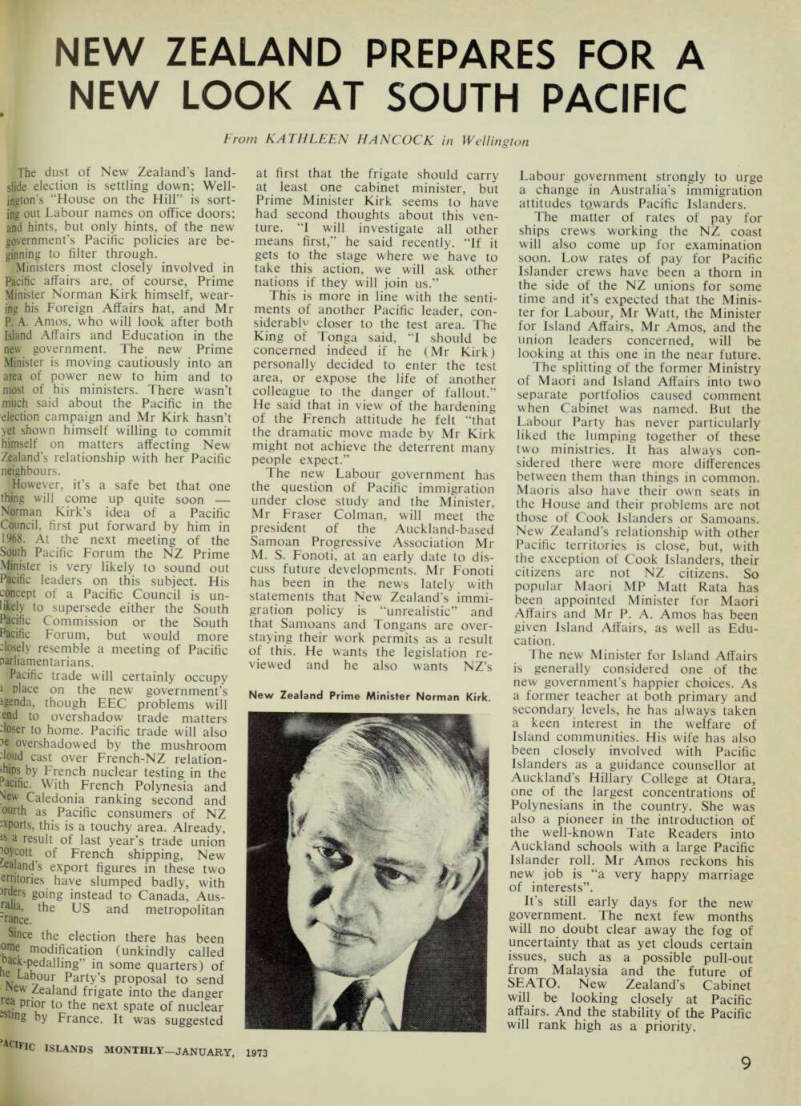
Ministers most closely involved in Pacific affairs are, of course, Prime Minister Norman Kirk himself, wear ing his Foreign Affairs hat, and Mr P. A. Amos, who will look after both Island Affairs and Education in the new government. The new Prime Minister is moving cautiously into an area of power new to him and to most of his ministers. There wasn’t much said about the Pacific in the election campaign and Mr Kirk hasn’t yet shown himself willing to commit himself on matters affecting New Zealand’s relationship with her Pacific neighbours.
However, it’s a safe bet that one thing will come up quite soon Norman Kirk’s idea of a Pacific Council, first put forward by him in 1968. At the next meeting of the South Pacific Forum the NZ Prime Minister is very likely to sound out Pacific leaders on this subject. His concept of a Pacific Council is un likely to supersede either the South Pacific Commission or the South Pacific Forum, but would more closely resemble a meeting of Pacific parliamentarians.
Pacific trade will certainly occupy i place on the new government’s igenda, though EEC problems will end to overshadow trade matters closer to home. Pacific trade will also oe overshadowed by the mushroom cloud cast over French-NZ relation ihips by French nuclear testing in the Pacific. With French Polynesia and Caledonia ranking second and ■ourth as Pacific consumers of NZ exports, this is a touchy area. Already, a result of last year’s trade union boycott of French shipping, New -ealand’s export figures in these two erntories have slumped badly, with >r«rs going instead to Canada, Aus the US and metropolitan "ranee.
Since the election there has been
JHJf modification (unkindly called
oack-pedalling” in some quarters) of Labour Party’s proposal to send New Zealand frigate into the danger rea prior to the next spate of nuclear .sung by France. It was suggested
at first that the frigate should carry at least one cabinet minister, but Prime Minister Kirk seems to have had second thoughts about this ven ture. “I will investigate all other means first,” he said recently. “If it gets to the stage where we have to take this action, we will ask other nations if they will join us.”
This is more in line with the senti ments of another Pacific leader, con siderably closer to the test area. The King of Tonga said, “I should be concerned indeed if he (Mr Kirk) personally decided to enter the test area, or expose the life of another colleague to the danger of fallout.”
He said that in view of the hardening of the French attitude he felt “that the dramatic move made by Mr Kirk might not achieve the deterrent many people expect.”
The new Labour government has the question of Pacific immigration under close study and the Minister, Mr Fraser Colman, will meet the president of the Auckland-based Samoan Progressive Association Mr M. S. Fonoti, at an early date to dis cuss future developments. Mr Fonoti has been in the news lately with statements that New Zealand’s immi gration policy is “unrealistic” and that Samoans and Tongans are over staying their work permits as a result of this. He wants the legislation re viewed and he also wants NZ’s
Labour government strongly to urge a change in Australia’s immigration attitudes towards Pacific Islanders.
The matter of rates of pay for ships crews working the NZ coast will also come up for examination soon. Low rates of pay for Pacific Islander crews have been a thorn in the side of the NZ unions for some time and it’s expected that the Minis ter for Labour, Mr Watt, the Minister for Island Affairs, Mr Amos, and the union leaders concerned, will be looking at this one in the near future.
The splitting of the former Ministry of Maori and Island Affairs into two separate portfolios caused comment when Cabinet was named. But the Labour Party has never particularly liked the lumping together of these two ministries. It has always con sidered there were more differences between them than things in common.
Maoris also have their own seats in the House and their problems are not those of Cook Islanders or Samoans.
New Zealand’s relationship with other Pacific territories is close, but, with the exception of Cook Islanders, their citizens are not NZ citizens. So popular Maori MP Matt Rata has been appointed Minister for Maori Affairs and Mr P. A. Amos has been given Island Affairs, as well as Edu cation.
The new Minister for Island Affairs is generally considered one of the new government’s happier choices. As a former teacher at both primary and secondary levels, he has always taken a keen interest in the welfare of Island communities. His wife has also been closely involved with Pacific Islanders as a guidance counsellor at Auckland’s Hillary College at Otara, one of the largest concentrations of Polynesians in the country. She was also a pioneer in the introduction of the well-known Tate Readers into Auckland schools with a large Pacific Islander roll. Mr Amos reckons his new job is “a very happy marriage of interests”.
It’s still early days for the new government. The next few months will no doubt clear away the fog of uncertainty that as yet clouds certain issues, such as a possible pull-out from Malaysia and the future of SEATO. New Zealand’s Cabinet will be looking closely at Pacific affairs. And the stability of the Pacific will rank high as a priority.
New Zealand Prime Minister Norman Kirk.