Pacific Islands Monthly
pp. 8-9 · Read in the full issue
New Hebrideans Turn An Economic
Crisis Into A Political One
After gnashing its gums fruitlessly for years the New Hebrides Advisory Council last month found some teeth —perhaps a better word would be dentures, since the biting mechanism was somewhat artificial.
After five days of seemingly inter minable discussion of the condomin ium estimates for 1973, the council told the French and British Resident Commissioners that the Budget was not acceptable and that they rejected it entirely. The move had obviously been pre-considered by Council mem bers who were unanimous in their verdict.
More than a little taken aback the two Resident Commissioners, who are accustomed to having the game played their way and did not like seeing the ball removed from their possession, asked the Council to put on paper the changes it would like to see made in the estimates and then suspended the 24th session until February. They hope the re-examina tion and re-drafting of the year’s estimates can be done by then.
There was more to this demonstra tion of disaffection than disapproval of the estimates (though that was certainly strong enough). It was the culmination of years of increasing frustration to Council members, not so much because their role is only advisory, but because the advice they give has not been listened to.
Two years ago they moved that a financial sub-committee should be appointed from among their members so that they could play a more active part in the preparation of estimates: this was not done and, despite the lip service that the Joint Administration has paid to ‘not governing in the face of opposition’ from Adco, there is no doubt that it prefers to do things its own way. An example of this was the Joint Administration’s proposal last year that, beginning in 1972, duty on imported goods and materials (by far the largest source of revenue to the territory) would be levied on the CIF (landed) value, not on the FOB (port of origin) value.
No matter how beneficial this
might be to the Condominium’s finances, the members of Advisory Council feared the inflationary effect, fears which have since proved justi fied, and voted almost unanimously against the proposal. The effect of this rejection? Nil. The Joint Adminis tration cruised majestically ahead with its plans, firm in its belief in its own infallibility.
Even so, it took a hefty straw to break the back of the long-suffering camel.
In the earliest stages of the Decem ber Session, members made it very clear that they didn’t think much of the idea of boosting the Condomin ium Budget from $4.4 million to $6.1 million when, as the Resident Com missioners themselves made clear in their opening speech, the territory is in economic difficulties due to low copra prices (and New Hebrides prices are the lowest of the low) and the continuing effects of the disas trous cyclones earlier in the year.
“The 1973 Budget has been pared to the bone” said the two administra tors, but Council members questioned whether 43 new civil service posts
and an overall increase in expei of 26 per cent could be called j there was a bit of fat left on where. So for five weary, consch days they sat and made sugg as to how cuts could be acl and listened to government t explaining why the various ini were absolutely essential.
At the end of the five dai effects of their suggestions c estimates were as one membe “precisely nil”. Not for the fin the council’s ‘advice’ had politely and studiously ignore; this time it was ready. Instt going on to vote on the various of the estimates, as is the usu: cedure, the members asked the dent Commissioners for an recess so that they could talk themselves and when the sessi sumed, Mr Bob Paul, api spokesman as the longest-:member, read the following d tion.
“The members of this • reject in its entirety the condon budget. The administration hi acceded to our requests in thi particularly with regard to the: lishment of a finance committe does not feel obliged to accede: way to the budget proposals.”
Somewhat shaken, the R 1 Commissioners sat in silence while and absorbed the implir of the statement. The estimatl taken four months to prepai, council couldn’t mean it! But When the French Resident O! sioner, M Langlois, asked for ; of hands, not a single one was against the statement and mr made it perfectly clear that the no intention of changing their So, adopting a positive app the British Resident Commifi Mr Allan, proposed that mr should put all their suggestio changes in the estimates on pafl present them the following daj When the Council met atJ next morning, Mr Paul was ags appointed spokesman. He saidfc “Mr President, for many\
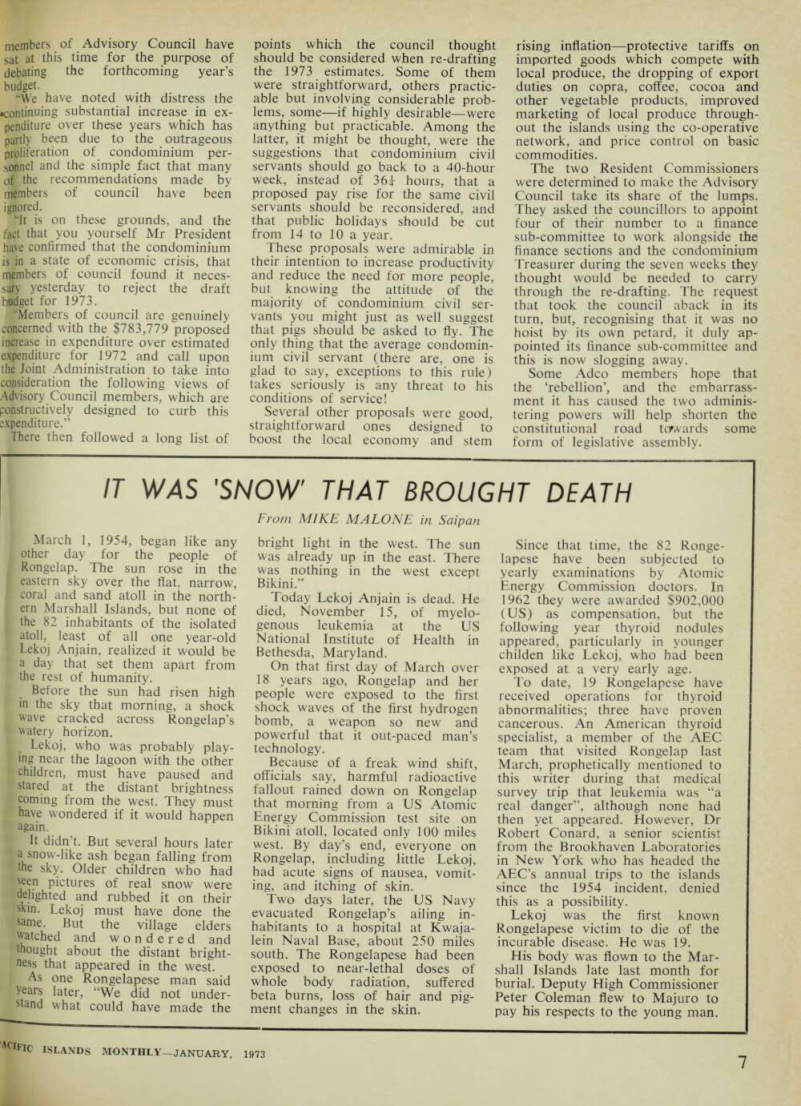
Advisory Council spokesman, Mr Bob Paul.
members of Advisory Council have sat at this time for the purpose of debating the forthcoming year’s budget.
“We have noted with distress the continuing substantial increase in ex penditure over these years which has partly been due to the outrageous proliferation of condominium per sonnel and the simple fact that many of the recommendations made by members of council have been ignored.
“It is on these grounds, and the fact that you yourself Mr President have confirmed that the condominium is in a state of economic crisis, that members of council found it neces sary yesterday to reject the draft budget for 1973.
“Members of council are genuinely concerned with the $783,779 proposed increase in expenditure over estimated expenditure for 1972 and call upon the Joint Administration to take into consideration the following views of Advisory Council members, which are constructively designed to curb this expenditure.”
There then followed a long list of
points which the council thought should be considered when re-drafting the 1973 estimates. Some of them were straightforward, others practicable but involving considerable problems, some—if highly desirable—were anything but practicable. Among the latter, it might be thought, were the suggestions that condominium civil servants should go back to a 40-hour week, instead of 36i hours, that a proposed pay rise for the same civil servants should be reconsidered, and that public holidays should be cut from 14 to 10 a year, These proposals were admirable in their intention to increase productivity and reduce the need for more people, but knowing the attitude of the majority of condominium civil servants you might just as well suggest that pigs should be asked to fly. The only thing that the average condominium civil servant (there are, one is glad to say, exceptions to this rule) takes seriously is any threat to his conditions of service!
Several other proposals were good, straightforward ones designed to boost the local economy and stem
rising inflation—protective tariffs on imported goods which compete with local produce, the dropping of export duties on copra, coffee, cocoa and other vegetable products, improved marketing of local produce through out the islands using the co-operative network, and price control on basic commodities.
The two Resident Commissioners were determined to make the Advisory Council take its share of the lumps, They asked the councillors to appoint four of their number to a finance sub-committee to work alongside the finance sections and the condominium Treasurer during the seven weeks they thought would be needed to carry through the re-drafting. The request that took the council aback in its turn, but, recognising that it was no hoist by its own petard, it duly ap pointed its finance sub-committee and this is now slogging away, Some Adco members hope that the ‘rebellion’, and the embarrass ment it has caused the two adminis tering powers will help shorten the constitutional road towards some form of legislative assembly.