King Solomon's
p. 109 · Read in the full issue
Decision
For developers in the South Seas nothing is certain these days, as Wu vulu Holdings Pty Ltd has found in its efforts to develop New Guinea’s Wuvulu Island as a get-away-from-it all retreat for an exclusive few. After nearly three years of planning and nine months of confusion, one of the company’s directors, Mr Paul Stocker, said in Sydney in November that “the troubles are over”.
Wuvulu is 3,420 acres of butterfly shaped land about 90 miles off the north coast of New Guinea from Aitape. The development company bought 2,760 acres of it in 1970 and marked out 181 choice one-acre blocks which they proposed to sell at 130,000 each to people who would also have to belong to the “Bismarck Planters Society”—a sort of private club which would run a hotel on the island and assist the 550 native islanders in various ways, with schools, hospitals, electricity, roads, sewerage, etc.
The islanders lived on two native reserves—all the rest of the island was the development company’s, pur chased freehold and unencumbered.
Or so it thought.
After the development deal was offi cially approved by the PNG Govern ment at the end of last year (see PIM, Feb, p 36), a friend of the Wuvulu Islanders, old Rabaul identity Fred Archer, who has lived in New Guinea for 49 years, started asking questions that embarrassed the Administration and upset the plans of the developers.
Archer was able to show that 628 acres of the developer’s “freehold” was in fact encumbered by the old German Government for possible use by the islanders. It turned out that when titles that had been lost with other official records in World War H, were restored in the 1960’s this encumbrance had been ignored by the Administration and a freehold title
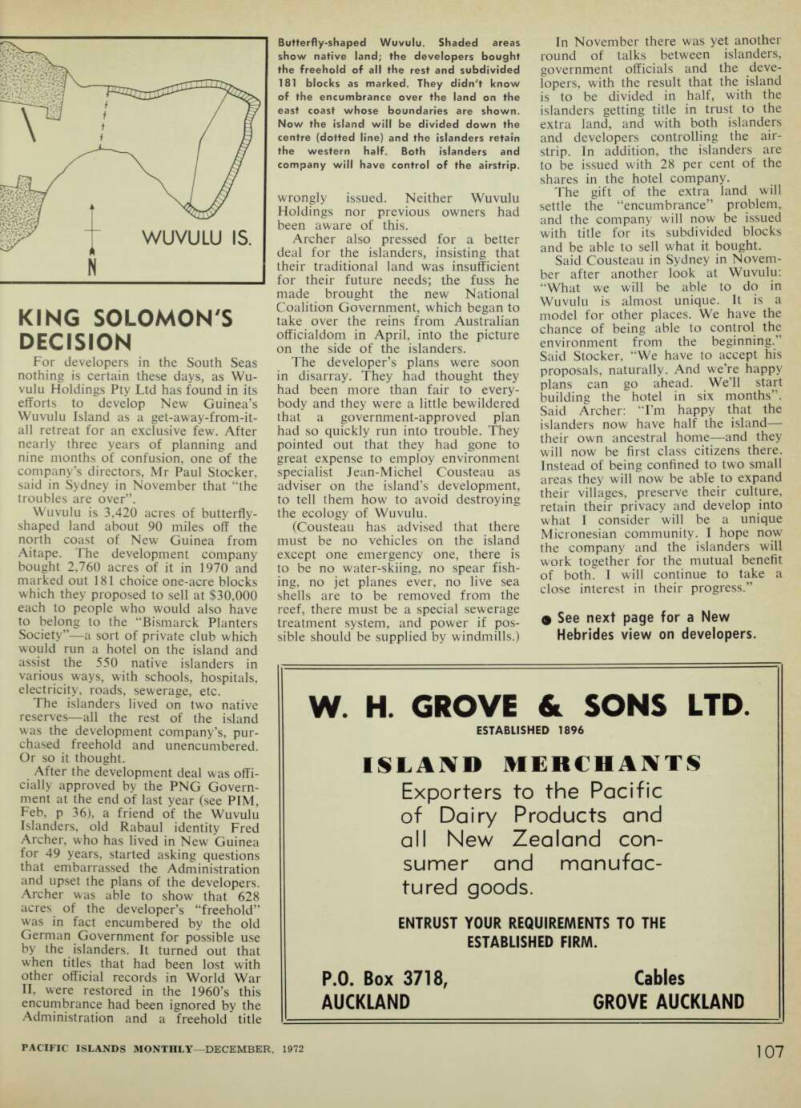
Butterfly-shaped Wuvulu. Shaded areas show native land; the developers bought the freehold of all the rest and subdivided 181 blocks as marked. They didn't know of the encumbrance over the land on the east coast whose boundaries are shown.
Now the island will be divided down the centre (dotted line) and the islanders retain the western half. Both islanders and company will have control of the airstrip. wrongly issued. Neither Wuvulu Holdings nor previous owners had been aware of this.
Archer also pressed for a better deal for the islanders, insisting that their traditional land was insufficient for their future needs; the fuss he made brought the new National Coalition Government, which began to take over the reins from Australian officialdom in April, into the picture on the side of the islanders.
The developer’s plans were soon
in disarray. They had thought they
had been more than fair to every body and they were a little bewildered that a government-approved plan had so quickly run into trouble. They pointed out that they had gone to great expense to employ environment specialist Jean-Michel Cousteau as adviser on the island’s development, to tell them how to avoid destroying the ecology of Wuvulu. (Cousteau has advised that there must be no vehicles on the island except one emergency one, there is to be no water-skiing, no spear fish ing, no jet planes ever, no live sea shells are to be removed from the reef, there must be a special sewerage treatment system, and power if pos sible should be supplied by windmills.)
In November there was yet another round of talks between islanders, government officials and the deve lopers, with the result that the island is to be divided in half, with the islanders getting title in trust to the extra land, and with both islanders and developers controlling the air strip. In addition, the islanders are to be issued with 28 per cent of the shares in the hotel company.
The gift of the extra land will settle the “encumbrance” problem, and the company will now be issued with title for its subdivided blocks and be able to sell what it bought.
Said Cousteau in Sydney in Novem ber after another look at Wuvulu: “What we will be able to do in Wuvulu is almost unique. It is a model for other places. We have the chance of being able to control the environment from the beginning.”
Said Stocker, “We have to accept his proposals, naturally. And we’re happy plans can go ahead. We’ll start building the hotel in six months”.
Said Archer: “I’m happy that the islanders now have half the island — their own ancestral home —and they will now be first class citizens there.
Instead of being confined to two small areas they will now be able to expand their villages, preserve their culture, retain their privacy and develop into what I consider will be a unique Micronesian community. I hope now the company and the islanders will work together for the mutual benefit of both. I will continue to take a close interest in their progress.”
9 See next page for a New Hebrides view on developers.