Pacific Shipping
pp. 87-91 · Read in the full issue
Another
move tor
Islands line
Powerful shipping interests are wooing at least three Pacific Islands governments. Two companies have now offered to set up a new regional service covering Fiji, Samoa and Tonga, and presumably Niue Island, from New Zealand and/or New Zealand and Australia. Waiting in the wings is the NZ Seamen’s Union, which has the capacity to cause trouble. There is one common factor in the latest moves—Tarros class con tainer ships will be used.
The Union Steam Ship Co started the ball rolling three months ago (PIM, Oct., p. 83) with an offer to set up a new company, in which Islands governments would be offered a 50 per cent interest, to operate a service to the islands from NZ.
The USS Co would charter two Tarros class ships from Interocean New Zealand Ltd to run the service.
The Islands governments had reserva tions, one of which was over manning the ships. They were keen to have them manned by Pacific Islanders, but the NZ Seamen’s Union president, Mr W. Martin, said his union would provide the crews.
While the Islands governments were pondering the USS Co suggestion, a San Francisco company entered the lists. It made an approach to the Western Samoa Government, offering a majority of shares in a new ship ping line to serve the area. This com pany, Marine Chartering Co Inc, like Interocean New Zealand Ltd, is a subsidiary of the British Furness Whitting group, which also owns the Shaw Savill Line.
The offer was announced by Mr T. Hallaraker, general manager of Interocean New Zealand Ltd, on behalf of the San Francisco-based company. He added it was also avail able to any other Island government which wanted to join in a common shipping venture.
Marine Chartering suggests a service to take in Australia, as well as New Zealand and the three Pacific Island groups. It also suggests a service from the Islands to the US west coast.
Marine Chartering would provide 49 per cent of the estimated start-up capital of $250,000. It would be happy with as little as 1 per cent of the equity. Pacific Islanders would man the ships under the Marine Charter ing plan. This would immediately lead to a confrontation with the NZ Seamen’s Union. This union wants ships on runs traditionally NZ-manned to be NZ-owned and operated.
To some extent they are reinforced in their attitude by a recent statement by the NZ Prime Minister, Mr John Marshall. Mr Marshall said he con sidered private enterprise shipping in Australia and New Zealand, in partnership with Islands governments, should operate a South Pacific ship ping line. That was the “most prac tical and immediate way” to improve shipping services in the region.
Ironically it was Mr Marshall, when he was NZ Labour Minister, who
deregistered the NZ Seamen’s Union late in 1971, following a series of irresponsible union acts over a number of years, me amh OUTS ON . ... rp||K r r f r N r ' ,JI LKU,it altiNC When it comes to calling a spade a spade—or a boat by its proper name—Fiji’s steadily expanding cruise industry contains some confusing anomalies.
The 83 ft topsail schooner Fiteach ban, which once featured in a tele vision series called “The Adventures of the Seaspray” and has been known as Seaspray ever since, has recently been renamed.
She’s now the Vusa Ni Ua—Fijian for “foam of the sea”—which is likely to be as confusing to visitors as the Welsh name Fiteach-ban.
The operating company, South Seas Island Cruises Ltd, couldn’t use Seaspray, which it would prefer, be cause that name has been registered by another Fiji company, which runs a cruise vessel called the Stardust, South Seas Island Cruises Ltd has
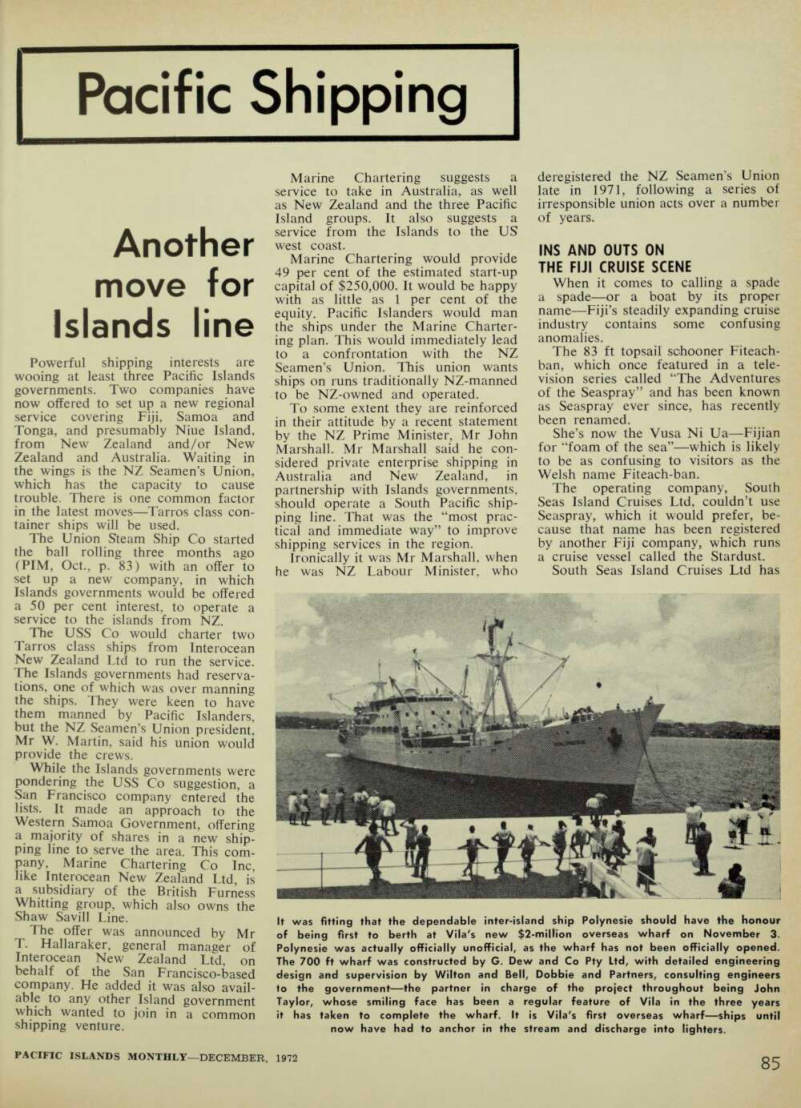
It was fitting that the dependable inter-island ship Polynesie should have the honour of being first to berth at Vila's new $2-million overseas wharf on November 3.
Polynesie was actually officially unofficial, as the wharf has not been officially opened.
The 700 ft wharf was constructed by G. Dew and Co Pty Ltd, with detailed engineering design and supervision by Wilton and Bell, Dobbie and Partners, consulting engineers to the government —the partner in charge of the project throughout being John Taylor, whose smiling face has been a regular feature of Vila in the three years it has taken to complete the wharf. It is Vila's first overseas wharf —ships until now have had to anchor in the stream and discharge into lighters.
renamed another of its cruise vessels, the 90 ft J. B. Walker, recently brought from Singapore for day trips to the newly-opened Mana Island re sort. The cruiser is now the South Sea, which is appropriate enough.
The 72 ft sea defence motor launch Maroro—which has a long association with Fiji—has been acquired by Beachcomber Cruises Ltd and brought from New Zealand for day cruises out of Lautoka.
Once the only vessel of the now defunct Fiji Royal Naval Volunteer Reserve, the Maroro (the same name as Captain Stan Brown’s well-known working ketch) has been renamed Viti. She goes into service, carrying day trippers to the Tai Island re sort, in December, The name-game doesn’t end there.
Beachcomber Cruises operator Dan Costello has been having trouble be cause of confusion over the name of his company and the name of Fiji’s newest hotel. Flagship Beachcomber.
Bookings and even bills for the hotel have been arriving at Mr Costello’s Lautoka cruise office and he’s been very disturbed about it. He has asked the hotel management to stress the word Flagship and not Beachcomber in promotion material, but the con fusion persists.
Never one to miss an opportunity, the quick-witted Mr Costello is getting his own back. His company was due to take delivery in November of a new 33 ft deep-V Hartley design ex express cruiser, built by Millers Ltd in Suva.
He is naming the new cruiser Beachcomber’s Flagship!
With bunk accommodation for four people and space for 20 day passen gers, the Flagship is to be available for fishing charters at around Sioo per day.
Meanwhile, completion of the $lOO,OOO cruise vessel being built at Millers’ shipyard for Stinsons Ltd has been delayed until January.
The 78 ft cruiser, which will have air-conditioned accommodation for 10 people, will be named Mollie Dean, after the wife of Fiji’s Minister of Finance, Mr Charles Stinson.
The charter tariff for Mollie Dean hasn’t been finally decided yet, but the word is that it will be expensive —somewhere between S4OO-S5OO per day, with everything thrown in.
And just one more name oddity.
The cruise vessel generally known in the tourist industry as “Bounty” is actually called the Casa Mia. The operating company, Bounty Cruise Ltd, wanted to rename her Bounty— since she cruises the waters sailed by Captain Bligh—but found it was registered elsewhere.
Fiji now has around 25 vessels
operating on regular half-day, full day and three-day cruises out of Lau toka and Suva, largest is the 124 ft Talei-Anda, which was built at the Fiji Government shipyard and put into service by Blue Lagoon Cruises Ltd in October, two months earlier than expected,
Sofrana's New Ship
And New Service
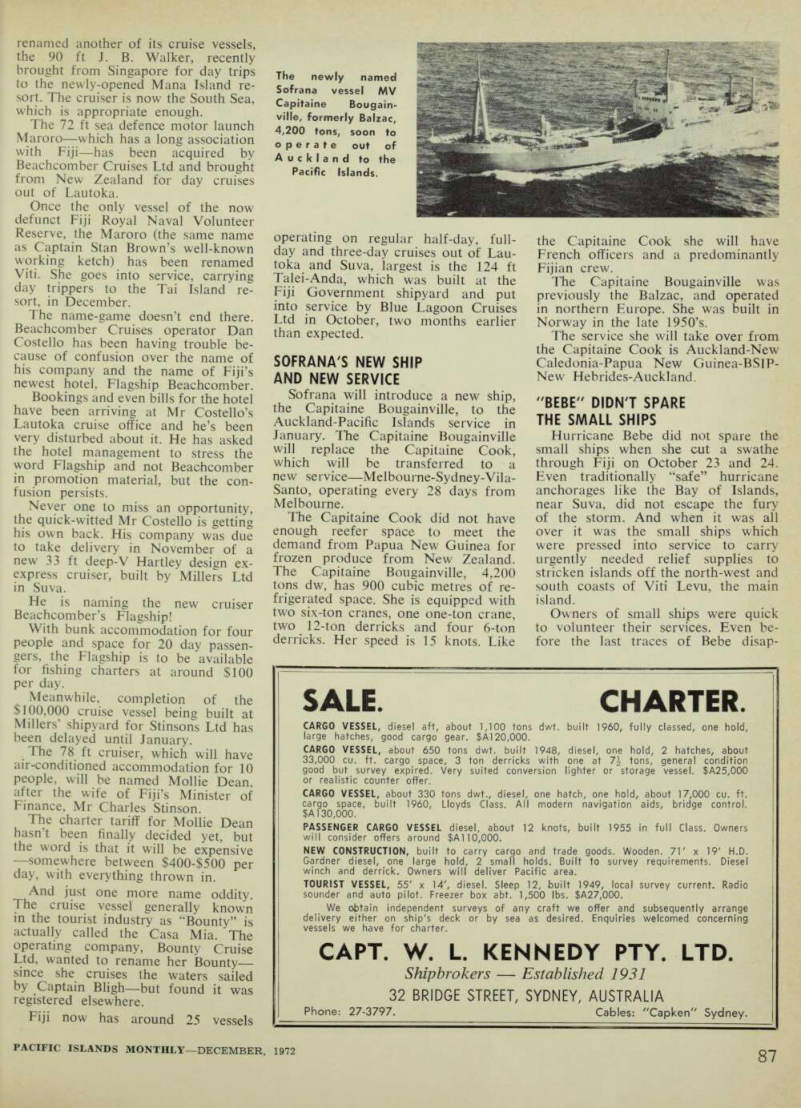
Sofrana will introduce a new ship, the Capitaine Bougainville, to the Auckland-Pacific Islands service in January. The Capitaine Bougainville will replace the Capitaine Cook, which will be transferred to a
new service—Melboume-Sydney-Vila-
Santo, operating every 28 days from Melbourne.
The Capitaine Cook did not have enough reefer space to meet the demand from Papua New Guinea for frozen produce from New Zealand.
The Capitaine Bougainville, 4,200 tons dw, has 900 cubic metres of re frigerated space. She is equipped with two six-ton cranes, one one-ton crane, two 12-ton derricks and four 6-ton derricks. Her speed is 15 knots. Like
the Capitaine Cook she will have French officers and a predominantly Fijian crew.
The Capitaine Bougainville was previously the Balzac, and operated in northern Europe. She was built in Norway in the late 1950’5.
The service she will take over from the Capitaine Cook is Auckland-New Caledonia-Papua New Guinea-BSIP- New Hebrides-Auckland.
"Bebe" Didn't Spare
The Small Ships
Hurricane Bebe did not spare the small ships when she cut a swathe through Fiji on October 23 and 24.
Even traditionally “safe” hurricane anchorages like the Bay of Islands, near Suva, did not escape the fury of the storm. And when it was all over it was the small ships which were pressed into service to carry urgently needed relief supplies to stricken islands off the north-west and south coasts of Viti Levu, the main island.
Owners of small ships were quick to volunteer their services. Even be fore the last traces of Bebe disap
The newly named Sofrana vessel MV Capitaine Bougain ville, formerly Balzac, 4,200 tons, soon to operate out of Auckland to the Pacific Islands.
peared, members of the Royal Suva Yacht Club were plying their craft up the flooded Rewa River, and in the Rewa delta, offering whatever help might be needed.
The adventures of four small shrimping vessels, on their way from Mexico to southern India, were hard to beat. They lost sight of each other in Fiji waters, scraped over reefs, two of them going aground, before the other two groped their way to Suva.
These ships were the Tata Siddhi and Tata Jyoti, both owned by Tata Oil Mills, a subsidiary of the vast Tata complex of India, and Ave Maria I and Ave Maria 11, owned by Esmeralda Fernando of Quilton, Cochin.
The Tata Siddhi, after narrowly missing a manned lighthouse at Wai lagilala, in the north of Fiji, drove ashore on a reef. The Tata Jyoti hit Nasilai Reef, about 20 miles north east of Suva. The Fiji Government’s Degei picked up the crew of the Tata Siddhi, The ship itself was a wreck.
The crew of the Tata Jyoti took to the lifeboats and rowed out to a pas sing ship, the Canterbury Star, which took them to Levuka.
The Ave Maria I and Ave Maria II drifted for two days in the storm before making Suva.
The Nam Hae 278, a Korean fishing vessel, was driven aground at Biunika, about three miles south of Levuka, At Levuka, the heavy seas tore away parts of the decking of the small ships’ wharf.
In Suva, four ships at the Kings Wharf, rode out the storm the hard way, doubling their anchors.
In the Bay of Islands, Captain Stan Brown’s auxiliary ketch, Maroro, was driven aground, but not holed.
The tourist cruise boat Sayandra, also sheltering in the Bay of Islands, was driven ashore, and was refloated later.
Offers of ships to help alleviate distress were made immediately Bebe passed. The Carpenter group put two ships at the disposal of the govern ment. These were the Ai Sokula, which made a run to Rotuma, and the Komaiwai, which took supplies to Kadavu, Carpenters met the cost of the voyages.
Blue Lagoon Cruises, operating from Lautoka, offered the use of the Lycianda and the Taleianda. Both these ships took supplies to the Yasa was. Also taking supplies and water out from Lautoka were three govern ment ships, Rogovoka, Gonedau and Agnes. Lautoka businessman, Mr Dan Costello, was another to offer the use of a cruise vessel, the Ratu Buluma kau.
In the Ellice Islands at Funafuti, which was first hit by Bebe, two fishing boats were sunk, and the mother ship, Van Camp 1, was washed onto a reef and heavily damaged. The three ships were on a skipjack tuna research mission. The crews were Koreans and Okinawans.
Shipping Briefs
• Admiralty charts of Fairway Reef, west of New Caledonia, were strongly criticised, following the recent rescue of 17 survivors of a Nationalist Chinese fishing boat off the reef. Captain H. C. Walker, master of the P & O freighter Zaida, who rescued the men, said “soundings in the area bear no relation to the ones of the Admiralty chart and were alarming”. • The Levuka-based Neptune 1. which went aground on a reef near Noumea on October 15, may be abandoned. She is in such a position that a salvage vessel would find it difficult to get near. The steel-hulled Neptune 1 is owned by the Pacific Fishing Co. She arrived in Fiji about three years ago.
• The harbour entrance at Taunganui Landing, Mauke, Cook Islands, is finished. The inner harbour is now being deepened. Work on the landing and the approach to the harbour, including construction of retaining walls and the wharf, is in progress. • Next move to establish a regular shipping service from Sydney to Norfolk and Lord Howe Islands rests with the promoters in Norfolk Island. Their Sydney agent Hethering ton Kingsbury Pty Ltd, is watching the market for a suitable vessel, and if anything offers, it will investigate and report to the promoters. But, before a ship can be bought, a com pany will have to be formed, and the necessary capital raised. • The people of Labasa, Fiji, are unhappy about the state of the local wharf. Supported by their local council, they say it is inadequate the volume of traffic which passes over it. They complain that ap proaches to the government have been abortive. Conditions would im prove if Labasa were declared a port of entry. The wharf caters only for local ships. Overseas vessels calling at Labasa for timber and sugar load by lighter at Malau near the mouth of the Labasa River.