Magazine Section
pp. 71-77 · Read in the full issue
Port Moresby's First Missionaries
Were Pacific Islanders
By Marjorie Tuainekore Crocombe
• The United Church in Papua New Guinea is celebrating the centenary of Christian mission work in Papua. The first missionaries were Pacific Islanders, and the doyen of them was the Rarotongan, Ruatoka. In the first of a two-part story last month, PIM told how Ruatoka's party had had a disastrous beginning on the Papua coast. They now move to the embryo Port Moresby under instructions from the missionary A. W. Murray, on Cape York.
On their arrival at Port Moresby on November 26, 1873, Murray wrote: As we drew near the beach the place seemed deserted. We saw only empty houses. At length a few individuals appeared, the teachers were recognised by some who had seen them at Manumanu, and all at once the place was in motion. Men, women and children flocked to the landing place to give us an enthu siastic reception. . . ,38 Rau, who had learnt the Motu language at Manumanu, explained to the people why they had come. They agreed that Ruatoka and Heneri should live at Elevala, and Rau and Anederea at Hanuabada. Although the transfer to Port Moresby was probably more the result of Moresby’s recommendation than of the invita tion to the Cook Islanders by Lakani Toi, the Motu tradition sees the latter as the sole reason.
Whereas Murray reported a friendly welcome, the Motu tradition records some hostility: ... As soon as the messenger from the village told Lakani Toi about the visitors he returned home quickly to get into the war canoe to meet the landing party. The war canoe (Rikugai) was accompanied by another war canoe (Manugai) belonging to the Tubumaga clans. These two canoes acted as protectors for the strangers.
The boat and her passengers were escorted ashore by the canoes. . . .
Lakani Toi was heard repeatedly to say, “You will have to kill me first
before killing these people” They were kept in the house of Kwaradu buna until the people became friendly towards the strangers. Although the village was quiet, the people from Kwaradubuna clan posted guards every night to protect these strangers.
Whatever the historical facts, the tradition determines behaviour in Hanuabada today, and Lakani Toi’s descendants enjoy the status of the inviters and protectors of the first missionaries.
The mission party found many dif ferences between their way of life and the Motu, who lived in houses built on stilts over the water. It was embarrassing to the newcomers to urinate and defaecate over the water and to “see their own faeces”. This was one reason given in the Motu oral tradition for their early move to a temporary house on shore.
They soon moved to a second site at a higher level, and moved again after Ruatoka’s son died. Ruatoka
was also given planting land by Dagu- Lohia on a block called Taora, in return for some axes, red calico and some handkerchiefs. 39 The Samoans named the Europeans “papalangi” or “cloud-bursters”, and the Mangaians thought Captain Cook’s men were the spirits of the great god, Motoro. 40 The Motu similarly told the missionaries that when they first saw a foreign ship they thought they were spirits, for the men in them seemed to emerge from the sky. They knew of no country except their 0wn. 41 Sunday church services introduced by the missionaries were well attended at first, but the novelty soon wore off, particularly when the people asked for food for attending the services, but were not given any.
When the missionaries preached that, “Jehovah made the earth, and caused the rain to fall,” the Motu asked them to tell God to send some rain: in Port Moresby’s dry climate it was a natural request! When rain did not fall, many people told the missionaries that their god was useless, and they stayed away from the services.
The missionaries persisted in their teachings but were unsuccessful in getting anyone to learn the alphabet.
They wanted to be paid. The LMS considered it essential for everyone to read the Bible for himself, and that meant beginning with the alphabet. It became something of air obsession with some teachers, and a ritual act for some students who wanted only to learn the letters, but not how to put them into words. 42 Murray returned to Port Moresby in March, 1874, and was pleasantly surprised to find Ruatoka and his companions well. Malaria had not yet taken its toll. On his previous trip he had weighed the disadvantages of Port Moresby’s lack of timber, infertile soil and probable shortage of vegetable foods, against a plenti ful supply of fish and wallabies, and a sheltered harbour which gave the all-season anchorage which was es
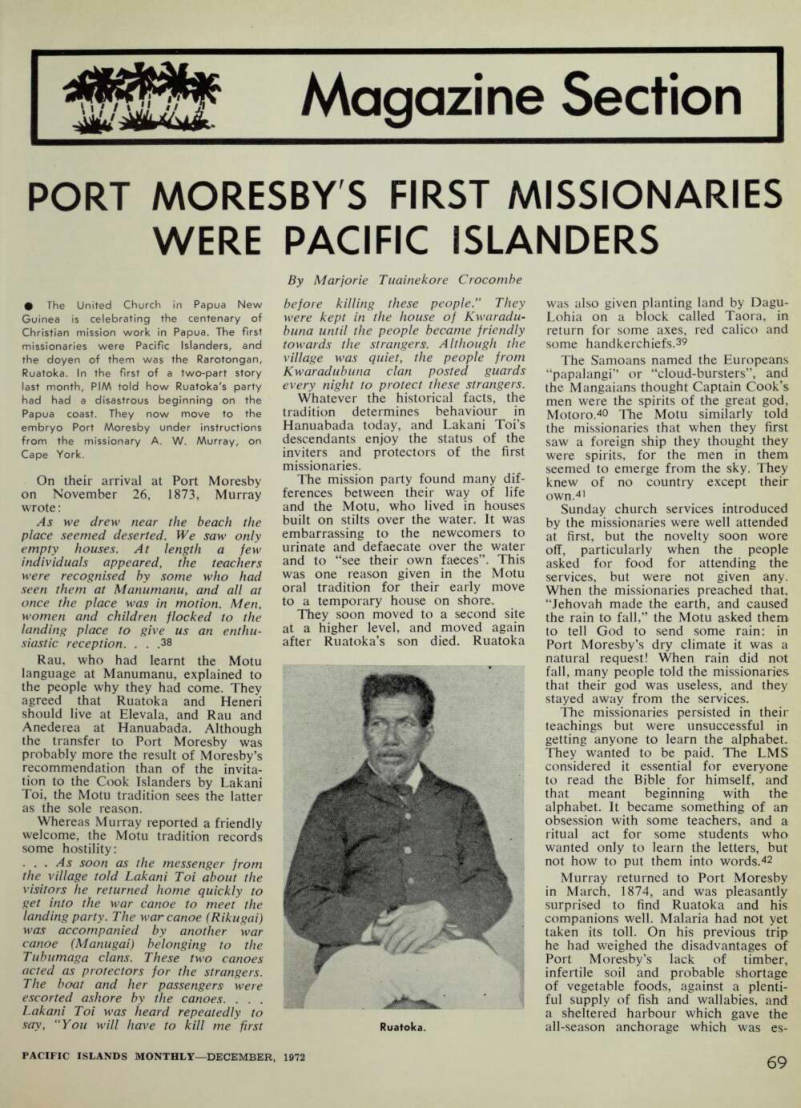
Ruatoka.
sential for a site for the main LMS station in Papua 43 On November 22, 1874, the Rev.
W. G. Lawes arrived to take charge of all LMS operations in central Papua, from a base to be set up at Port Moresby. Within three days of his arrival, the mission party negotiated successfully for a permanent site on a ridge overlooking Hanuabada. A tent was erected for Lawes as a temporary shelter while the crews of the two mission ships started building what was to become the mission headquarters for the region for the next century. Ruatoka became Lawe’s closest associate, and interpreted for him until the latter mastered the Motu language. 44 The healthy condition of Ruatoka’s companions during their first year at Port Moresby did not last. In 1875 two of the new recruits died from malaria and McFarlane had to re move three others to Cape York to save their lives. 4s McFarlane wanted to shift all the missionaries from Port Moresby to a healthier climate, pos sibly Yule Island. On his return in June he reported that all the islands missionaries had “lost heart and wish to return to their homes,” because of the severity of malaria and the relative drop in status and influence that they had suffered as a result of Mr Lawes’ arrival. 4s Lawes and his European colleagues had more status and power, and more goods to distribute, so the people would crowd around him and neglect the Islands missionaries. For these reasons McFarlane became convinced that European missionaries should not live among the people but should be located in central stations from which they could visit the Islands missionaries regularly. 47 The LMS Board of Directors in London left it to Lawes to decide whether to remain in Port Moresby or go elsewhere. In fact, it would have been difficult to find a healthier climate or a better harbour anywhere on the Papuan coast, and Chalmers gave strong support of Lawes’ decision to stay in Port Moresby. In reply to McFarlane’s statement that European missionaries should not live among the people, Chalmers retorted, “If white missionaries cannot face the dangers of the climate and savages, should we ask native teachers to do 50?” 43 While the controversy continued, those at Port Moresby carried on.
Ruatoka acted as supervisor while Lawes was away on sick leave in 1875, and when Lawes was able to visit Port Moresby during 1875-76 he found Ruatoka “faithful and vigilant”, the best member of the staff. A good number of children attended school regularly and the
problem of thieving was decreasing. 49 The only disapproval of Ruatoka was shown by Lawes in 1877 when the Cook Islands missionaries demanded a rise in pay. Led by Ruatoka and Piri, they demanded that their allowance of £ls be raised to £IOO. Lawes regarded their attitude as “angry and insolent.” so They threatened to resign, but were eventually persuaded to stay.
However, a letter by Chalmers to the LMS directors showed that there was cause for resentment. He con sidered the £ls annual allowance sufficient if paid in full, but noted that they received only £lO worth, for it was spent on goods supplied by the mission, which charged 50 per cent, for freight, expenses and profit.
Chalmers felt “sore, very sore indeed” about this charge, even though the income was used for the upkeep of the mission vessel. He asked the directors to allow them to take the money either in cash or goods; if the latter, Chalmers felt that the LMS should pay the freight, as it did for English missionaries. sl I have been unable to find out whether the LMS modified its arrangements, but no more difficulties over mission pay are recorded.
Chalmers was always an outspoken supporter of the Cook Islands mis sionaries, just as Lawes was favour ably biased towards the Niueans, McFarlane to the Loyalty Islanders and Murray to the Samoans—the places where each had previously lived and worked, and the people whose language they understood.
Ruatoka was a good carpenter. He and Lawes, with the help of eight Motu labourers and the other mis sionaries who could be spared, built the first Training Institution in Port Moresby in 1882. He was also
responsible for making the coffins for the dead, for preparing the graves and performing the burial services.
Although I was unable to find written evidence, Ruatoka probably helped Lawes to build Vatorata Training Institution at Rigo and Ela Church for Europeans at Port Moresby.
The mission wanted to expand as quickly as possible but it was a slow process because of the shortage of staff. Frequent trading contacts between the Motu villages helped to spread the news about the presence of Ruatoka’s party at Port Moresby, so that when they had a missionary available, he was usually welcomed into a new village. One such example was Piri’s introduction to Boera in 1874.52 Cheerful, good-natured Rau, who excelled in the Motu language, be came the most popular member of the party. Being such an effective “contact man”, Murray asked Rau to accompany Piri and his wife to Boera on the coast about half-way between Hanuabada and Manumanu) to set up a new station there. The people of Hanuabada objected, but a compromise enabled Rau to go to Boera for a month.
One of the Hanuabada leaders ac companied Rau to ensure that he returned at the agreed time. The mission party was well received and four years later Ruatoka attended the opening by Piri, at Boera, of the first stone church in New Guinea.
Ruatoka guided many exploration trips by Lawes and Chalmers. The first was in 1876 when they travelled ten miles inland, and Lawes became the first white man to cross the Laloki River. In 1877 Ruatoka took Chalmers, McFarlane and Mr Goldie (a gold prospector and trader in Port Moresby) on a three day expedition inland for about 70 miles. 53 The longest trip Chalmers and Ruatoka made was in June-July, 1880, when they travelled for six weeks mostly behind the Owen Stanley Range, discovered the headwaters of the Kemp Welch River and followed it down to emerge at Hood Bay. The aim of the expedition was to find out who lived inland and to seek suitable locations for mission stations.
Though they travelled for more than 500 miles and climbed very rugged mountains, they were accompanied for the whole distance by Granny, an old Papuan widow who insisted on being Lawes’ servant at all times.
An invaluable cook and interpreter, she always carried her pots in a swag. s4 Ruatoka was also active in placing new recruits, sometimes with Chalmers and sometimes alone, and their names became (and remain) widely known among both coastal
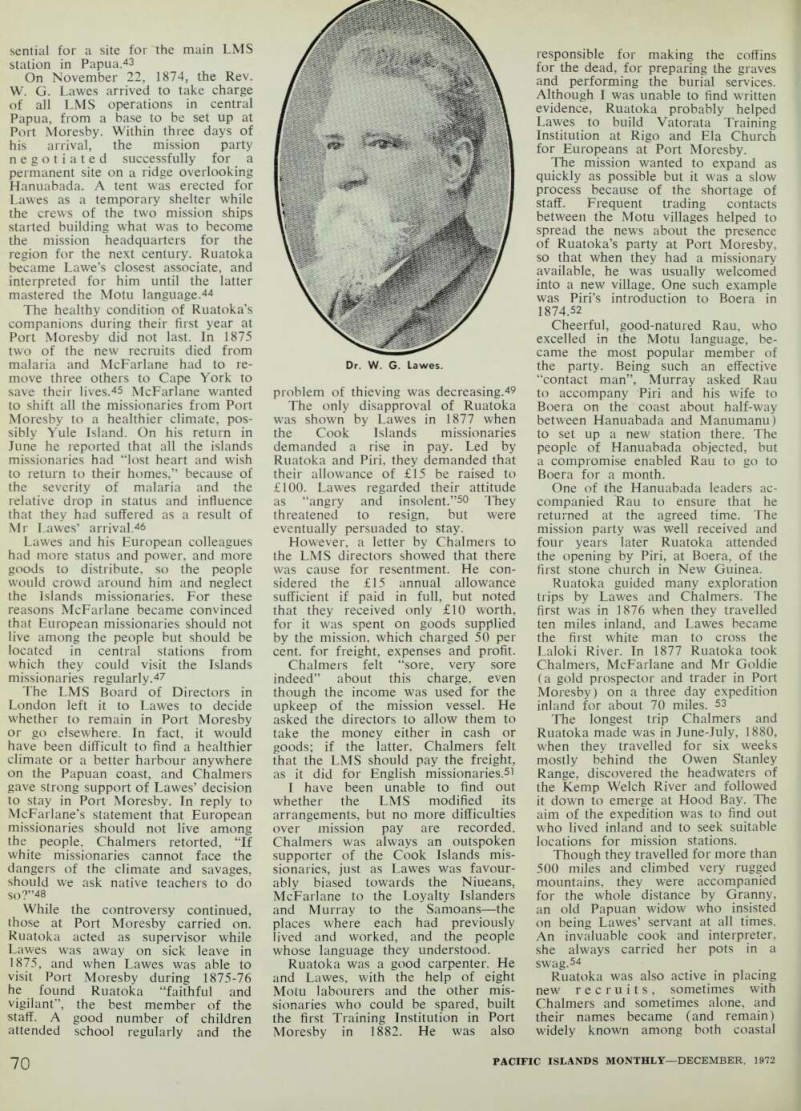
Dr. W. G. Lawes.
and inland people. On such ex peditions he inspected the various stations en route, travelling mainly by mission ship when one was avail able, or by whale-boat for the short runs to coastal stations near Port Moresby.
As a classroom teacher Ruatoka was not an outstanding success, but with very little schooling of his own, he could hardly be expected to be so. One missionary characterised his classroom teaching as ‘vigorous in effectiveness,” observing that he “commanded that school of small children at Port Moresby in a stentorian tone.” Consequently, by the young people, he was “more feared than 10ved.” 55 It is not surprising that the mission school took a long time to achieve much
educationally.
There were also cultural dif ficulties. Motu children were pre viously free to do what they liked, whereas at school they were expected to sit still and learn to write foreign letters. Papuans felt that they were doing the missionaries a favour by participating in church activity, and felt entitled to be paid for learning letters and attending services.
Ruatoka’s stern discipline, and the pointless effort of learning strange etters, could not have had much lasting appeal. Nevertheless, dedicated and faithful, he gave of his utmost with simple earnestness to teach the children and adults of Hanuabada Ruatoka’s first wife, Tungane, seems to have been more successful at teaching. She was New Guinea’s nrst domestic science teacher, for she successfully taught Motu girls sewing, ironing and other domestic 1 a u/u as eII as readi ng and writing.
When Ruatoka was away on his many visits to other stations, Tungane replaced him as far as possible, and conducted the schools and the services alone. It was one of her S™ 0 " B ’. del ivered one Sunday during Ruatoka s absence, that won over New Guinea’s first baptised convert.
Aruadaera, who became a faithful deacon of the church and Ruatoka’s assistant. s6 Tungane died in 1885 after a short illness.
Ruatoka as an
evangelist
Ruatoka’s second wife, a Papuan woman from Hula village and the widow of a New Guinean teacher was particularly skilled in music, and helped Ruatoka in “rendering the service of song lively and efficient.” s9 Ruatoka and his colleagues intro duced the distinctive style of singing prophet” songs among the Motu which are still popular today. Some
of these songs of worship still retain the original Rarotongan words.
He was more successful as a preacher than as a teacher, and had considerable influence among Papuans as well as Europeans. One example of his personal influence is frequently quoted in the mission records. A Scotsman was building a store on a Sunday while Ruatoka was conduct ing a service. He endured the noise for a while, then he ended the service, walked over to confront the trader and ordered him down from the roof.
Flourishing an English Bible before him and pointing to the passage “Remember the Sabbath Day, to keep it holy,” he berated the man for working on Sunday and making Ruatoka look a fool before the Motu people. In the eyes of the Papuans, Ruatoka’s teachings seemed to apply only to them, for the Europeans did what they liked. The humiliated trader put away his tools, though one writer attributed this to Ruatoka’s being not only a Christian, but “a very muscular Christian.” sB One of Ruatoka’s fervent sermons against Sunday work so affected a Hanuabada elder that after the
service he stood guard at the main water supply, armed with a bar of iron and some rope to tie up any woman who tried to fetch water.
Other followers waylaid women to stop them from going to the village waterholes. s9 On another occasion an old man named Gheita murdered a sorceress and her sons because she claimed to have withheld rain. Timely rain after the murder caused Gheita to brag to converts about his provident removal of the sorceress and her sons.
Ruatoka paid Gheita a visit—and the old murderer promised never to kill again. 6o When the missionary A. E. Hunt was absent for 18 months during 1898-99, Ruatoka again supervised the Port Moresby district. On Hunt’s return he found that Ruatoka’s over sight had been careful. There was a large congregation and fund-raising at the May meetings was so lucrative that the contributions had trebled.
The largest amount of money ever given was contributed during this period.
Hunt said Ruatoka performed best on his own, and Lawes had made a
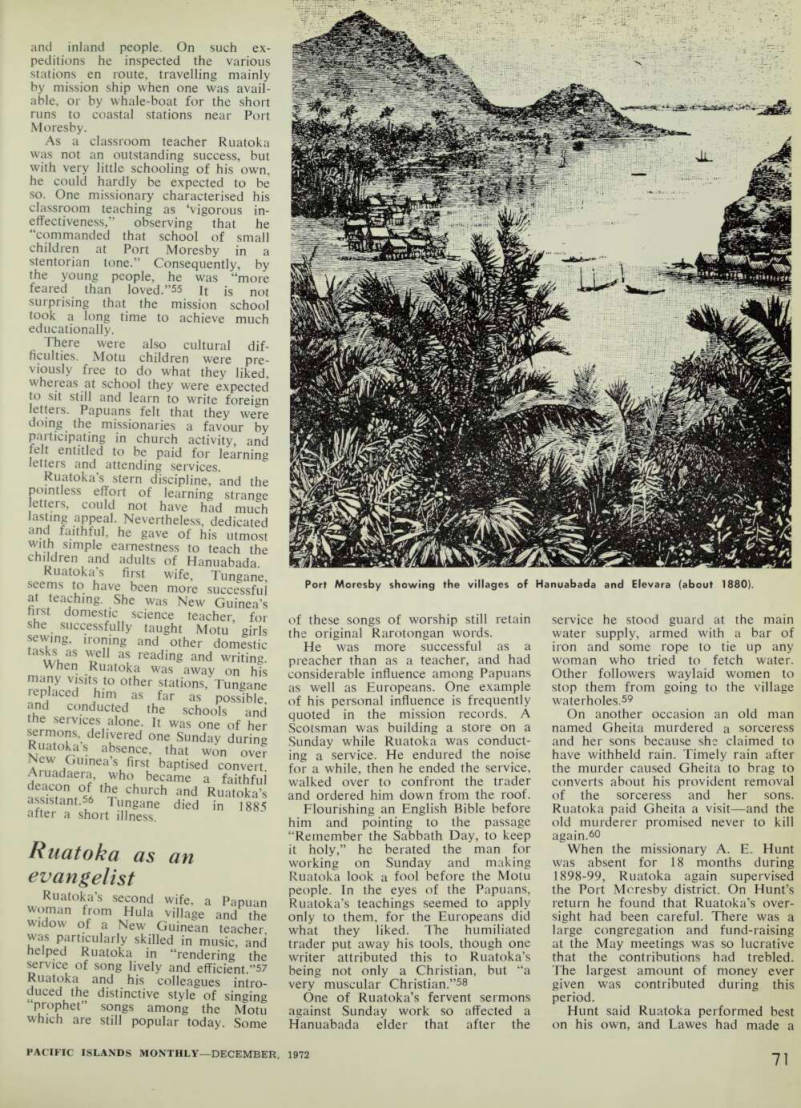
Port Moresby showing the villages of Hanuabada and Elevara (about 1880).
similar statement the previous year, when, disappointed with the large turnover of English missionaries at Port Moresby, he was consoled by the fact that Ruatoka was “discharging all the duties of a bishop effectively” and that he was at his best when in sole charge of the mission. 6l
Involvements with
government
Missionaries were supposed to keep out of politics, but as Koskinen has observed, it was often not possible for them to do so 6 2 They preached against warfare which was one of the important means for settling dis putes, and were therefore obliged to help bring peace by negotiation. Many local people consulted missionaries about political problems that beset them. Missionaries often, and under standably, negotiated with chiefs or headmen.
The following Motu oral tradition may illustrate the kind of punish ment meted out by missionaries to wrongdoers before formal govern ment was established. Warfare and physical aggression were denied to them, but “peaceful” substitutes were effective. No references to this incident appear in the written sources, and it probably happened while Ruatoka was supervisor of the Port Moresby Station when Lawes was away in 1875.
Ruatoka and his companions put up a store. They placed all their rice, sugar, clothing, beads, axes and different things in it. After that a man of Hohodae called Tauoa Konena went many times, each time taking whatever he wanted from the store.
He did so frequently. They didn’t discover him.
When they took stock they knew that some of their goods had been lost. The great Ruatoka assembled the people of the village and said, “I called you because I have dis covered how our food and goods were lost. Those things were stolen by Tauoa of Hohodae. I have found them. We should punish him.”
He told them not to get their weapons, but to bring vines only. .
“Take your vines and fasten them to the posts, cross pieces, and timbers of Tauoa Konena’s house . ..”
He, with the people of Elevala, took their vines and canes and fixed them firmly. Then sadly, they pulled at the house until it tumbled down. They took the thatch and burned it at Konedobu.
Then they bound the hands and feet of Tauoa Konena and took him to a green ants’ nest and bound him, and there he stayed. The ants bit him all over. They raised weals on his
eyebrows, mouth, face and whole body. He suffered thus until nearly sundown, when they released him.
Then he bathed in the sea. Thus they punished him because at that time there was no prison , 63 The year 1884 was politically im portant. There had been much talk about annexation, though Chalmers and Lawes both opposed it. On April 4, 1883, the Police Magistrate at Thursday Island, Mr H. M. Chester, hoisted the British flag at Port Moresby on behalf of the Queens land Government.
The missionaries at Port Moresby were asked to participate. Lawes translated into Motu what the pro clamation meant; Ruatoka distributed £5O worth of trade goods to all the heads of families at Hanuabada village. In the afternoon the villagers bore gifts to the mission house, then Lawes and Chalmers entertained all the Europeans, the missionaries and their wives, and Boe Vagi, one of the leaders of Port Moresby.
All the festivity was for nothing because the British Government refused to recognise the Queensland Government’s proclamation. The second attempt came in November, 1884, when H. H. Romilly misunder stood his instructions and proclaimed New Guinea a protectorate.
Later in November, Commodore Erskine, Commander-in-Chief of the Australian Station arrived, accom panied by four ships of the Aus tralian squadron. He disregarded Romilly’s action, and in order to ensure that the Papuans really under stood the significance of the flag hoisting, Erskine despatched Chalmers on HMS Espiegle to pick up im portant leaders in the villages between Port Moresby and Round Head and bring them to Port Moresby to see the ceremony.
Ruatoka went on HMS Raven as far west as Redscar Bay. Lawes was responsible for attracting those within the Port Moresby area. The third attempt at the proclamation was suc cessful, Ruatoka and all the other missionaries being given places of honour at the ceremony. Ruatoka was also present at the annexation of New Guinea by Britain in 1888.
Relations with the
miners
Ruatoka’s dedication in helping others was fully demonstrated during the gold rush to the Laloki River, 30 miles from Port Moresby, in 1878.
After the discovery of gold at Laloki in 1878 Lawes feared an influx of Australian miners who would be un sympathetic to the mission and who could not be adequately controlled in the absence of civil government. 64 Actually relatively few miners came and though there were some prob lems with local people, their worst enemies were malaria and other diseases which killed many of them.
Though its facilities and medical supplies were limited, the LMS bore the brunt of providing hospital services to sick miners. Both Lawes and Chalmers paid tribute to Ruatoka as the “hero of this humanitarian service.” He and his wife fed and nursed sick miners at their own expense.
On an annual pay of £l5 it was indeed a sacrifice. 6s At least twice Ruatoka carried to his home on his back, and over considerable distances at night, sick miners who had been left to die in the bush because Papuans who found them were afraid to touch dying men in case their spirits haunted them 66 Ruatoka was also an effective
Raising of the British flag in Port Moresby, November 6, 1884, by the naval con tingent led by Commodore Erskine (inset right).
mediator between the miners and the local landowners. In one instance he heard of an imminent attack upon a prospector’s camp and warned the miners. He offered to pacify the vil lagers but refused the offer of an armed escort. He went among the armed warriors of Moumiri and “reasoned with them, preached to them [and] prayed for them.” 67 The attack was averted and the Moumiri warriors dispersed to their homes.
Ruatoka’s courage and zeal earned him the respect of all the miners, who joined together to present him with a testimonial thanking him for his kindness and services since their arrival. They mentioned in particular his help in mediating between the Papuan landowners and themselves.
Chester’s suggestion that Ruatoka’s work need only be made known “to ensure some recognition from the people of New South Wales and Queensland” was acted upon in October, 1878. Recognition came in the form of a gun, inscribed with the words: Presented by the Government of Queensland to Ruatoka, a teacher in the employ of the London Missionary Society, in token of their appreciation of his kindness and attention to the sick gold-diggers from Queensland at Port Moresby, October, 1878.68 Chalmers noted that the present was a splendid breechloading fowling piece,” but was silent about its connotations. Chalmers always insisted that missionaries went unarmed. Soon after his arrival in New Guinea in 1877 he had been disappointed to find each island missionary the owner of two or three guns.
After seeing some examples of these being used to coerce villagers he reminded everyone in the mission that these “guns were for shooting birds, wild pigs and kangaroos and not to frighten the natives. ” 69
Chalmers never carried arms, and he expected others working with him to follow his example.
A life remembered
This description of Ruatoka’s work from 1872 to 1903 probably gives the impression of a vigorous, healthy man, but in fact, he often suffered from illness. When Chalmers sug gested in 1893 that Ruatoka should go for a visit home to Mangaia, he refused, saying that Papua was now his home. 7o Only once did he travel overseas, to spend a few days at Cooktown.
Lieutenant-Governor McGregor’s prediction in his 1888-89 report that Ruatoka “has done so much that his name should never be forgotten” has indeed come true. 71 He is the most written about of all the Pacific Islands
missionaries to New Guinea and there are many oral as well as physical testimonies to his memory to this day.
The people of Boera village for instance, value today an armshell which they say was brought to their village when Piri opened their first church in 1876. The armshell, parti cularly prized for exchange in marriage ceremonies, is named Ruatoka. 72 There is a Ruatoka Road in Port Moresby, and 30 miles from that town, at Kwikila, there was until recently Ruatoka College, where the United Church trained teachers for its mission schools.
His name lives on beyond Papua.
The United Church college at Gaulim in New Britain has called one of its main buildings “Ruatoka Home”, and the Pacific Theological College in Suva on December 5, 1969, dedicated a new block of student flats as Ruatoka House.
For over 20 years Chalmers and Ruatoka, whom the former called his “own son in the faith,” worked as close friends and colleagues. When Chalmers and the Rev. Oliver Tompkins were murdered at Dopima village in April, 1901, Ruatoka offered to work among the Dopima people, but the offer was declined, as Ruatoka himself was nearing the end of the road. He died on September 12, 1903, having spent 31 years in New Guinea, thus amply absolving Chalmers for allowing the ailing Ruatoka to go from Raro tonga with that pioneer group of missionaries in 1872.
In the Port Moresby cemetery Ruatoka has a permanent memorial in an honoured place. As the Pacific islands seek out indigenous heroes to supplement or replace the foreign heroes who have been given dis proportionate emphasis in the past, Ruatoka is likely to become much more widely known.
Memorial stone at Boera, commemorating the church opened by Piri in 1876.