Footnotes
pp. 45-47 · Read in the full issue
Let's Bring The
Spelling Dilemma
To A Hed
J HAVE referred before in this column to my interest in the Indonesian language and my efforts, at an age when learning a new language is no longer easy, to learn it.
Having this interest, my attention was attracted a few months ago by an announcement that Indonesia and Malaysia had come to an agree ment to use a common orthography for writing their virtually identical national languages. Their previously variant orthographies had grown out of their different colonial backgrounds—Dutch in one case and British in the other.
Now a friend who shares my interest in Bahasa Indonesia and greatly outdistances me in his knowledge of it has given me a copy of an Indonesian magazine in which the new agreed orthography is used.
This set me thinking about the perennial argu ment on the spelling of English. Everybody agrees about the need for reforming the spelling of
English, but most of us boggle over the practical problems of changing over from one system of spelling to another, even if we could agree as to what system we want. Yet what a boon a reformed English spelling would be to the peoples of Melanesia and Poly nesia, whose multiplicity of ver naculars make the adoption of English as a Pacific lingua franca an unavoidable necessity.
An ingenious Australian, Harry
Lmdgren of Canberra, has proposed attacking the problem piecemeal and invites us to begin with what he calls SR 1 (SR for Spelling Reform, of course). SR 1 simply spells the short “e” sound with an “e”, whatever the conventional spelling may be. Thus “ready” becomes “redy” and “friend” becomes “frend”.
Harry Lindgren is most insistent that no further step should be taken till SR 1 is well established, and once reprimanded me for offering a tentative suggestion as to what SR 2 might be.
Enyway, lets use SR 1 from this point onward and see how it goes. And woe betide PlM’s printers if they try to “correct” my spelling.
But back to the Indonesians. They have grasped the nettle with a vengence. Not content with an
SR 1, they have introduced their SRs 1 to 4 in one fell swoop. So “j” becomes “y”; “dj” be comes “j”; “tj” becomes “c”; and “ch” becomes “kh”.
Although a mere beginner in the language I found no difficulty in adjusting myself to the new spelling, or in switching back to the old spelling when reading some of the advertisements which had not been re-written in the new. Nor do the printers seem to have had eny trouble.
One of the arguments agenst
reforming English spelling has
been that it would throw the print ing trade, and particularly the printing of daily newspapers, into dire confusion. I don’t know how the Indonesian dailies are getting on, but the publication my frend has given me is a “Time” style of 50 pages, and its printers don’t seem to have cracked under the strain.
Someone will no doubt point
out that the two cases are not on a par. Bahasa Indonesia has always been spelled as spoken, and all that has happened now is that some of the symbols have been changed; whereas English spelling is in a state of utter confusion. This is true enough. However, the Indonesian experience does seem to suggest that the advocates of re formed English spelling may have been a bit too pessimistic about some of the difficulties.
One of the meny interesting things which I have learned from my frend’s magazine is the Indonesian expression for “drop out”. There’s no doubt about it, as the writer has obligingly put the English words “drop out” in brackets after it. (Over)
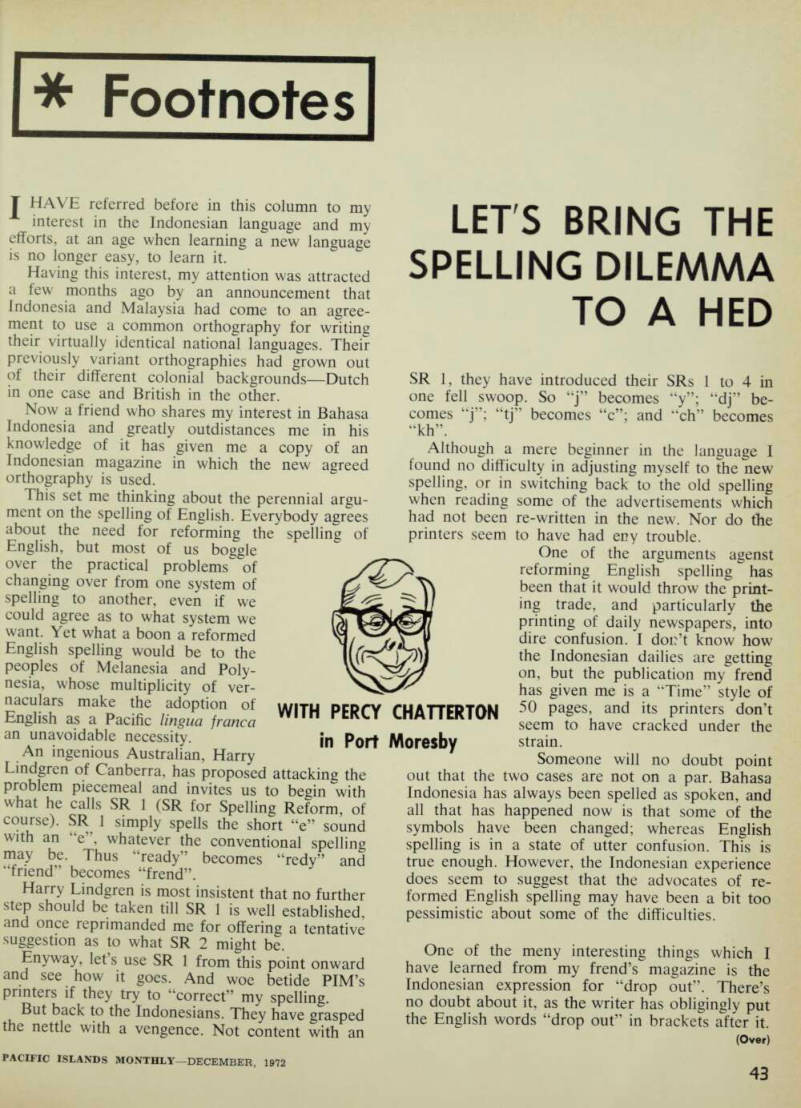
With Percy Chatterton
in Port Moresby
In Indonesian it is “gagal sekolah”, that is, “school failure”.
Oh dear, how crude!
Here in Papua New Guinea we have abolished failure. We have substituted for it the E Pass.
And as 1972 draws to a close there will be a fresh crop of E Pass holders wondering why their pieces of paper are not getting them enywhere.
The Standard 6 (primary tops) examination, which created the E Pass (in addition, of course, to A-D passes), is on the way out. It will pass away, I think, unwept, unhonoured and unsung.
Whatever its merits may have been when it was started, it has latterly reminded me more and more of pre-war Papua’s bob-a-nob system.
Through two decades, from 1921 to 1941, Papua harboured a system of payment by results schooling invented in Victorian England. Once a year, every pupil (not merely in the top standard but in all the standards) in mission schools registered as schools teaching English was exam ined by an external examiner—generally a retired Queensland school inspector.
Those pupils who scored 50 per cent or over had the letter “P” entered agenst their names and earned a grant for their mission, ranging from 5/- a hed for Standard 1 passes to 25/- a hed for Standard 5 passes. How we cherished those potential twenty-five bobsworths in Standard 5 during the weeks preceding the examination.
Those who scored less than 50 per cent, had (I hate to confess it) the letter “F” entered agenst their names and earned nothing but opprobrium.
The chief difference between our pre-war bob-a-nob and the post-war Standard 6 exami nation appears to be that in the latter case the prize has gone to the pupil insted of to the school, and has taken the form of a place in high school insted of a cash grant.
The other main difference is that in pre-war Papua the examiners were kindly, if not very well clued, old gentlemen from Queensland who administered the dosage in person, whereas in post-war Papua New Guinea they were faceless gentlemen in Konedobu who administered it by proxy. I doubt whether this was really an im provement.
As to the certificates, a certificate—eny certi ficate—should be a certificate of competency, and, hard as the saying may seem to be, a primary school leaver in PNG is not really competent in enything. He is not effectively literate in eny language. He has been deprived of the oppor tunity of becoming literate in his own language, and his ability to read English with understanding is confined to simple straightforward narrative or
specially prepared texts in limited-vocabulary English.
In saying this I am not criticising the meny dedicated teachers who are doing their best, within the system, to provide their pupils with a happy, stimulating and relevant schooling. But the system itself is ripe for a long, hard look.
One thing which is becoming clear is that it’s easier to get rid of the Standard 6 examination than it is to find a satisfactory substitute for it.
The current idea seems to be that selection for high school and other forms of post-primary education will be made by school “boards of management”, chosen by the community served, on the basis of the teachers’ assessments.
In theory this is excellent. But how will it work out in a society in which kinship loyalties are very strong and accusations of favouritism inevitable?
By the way, SR 1 is pretty painless, isn’t it?
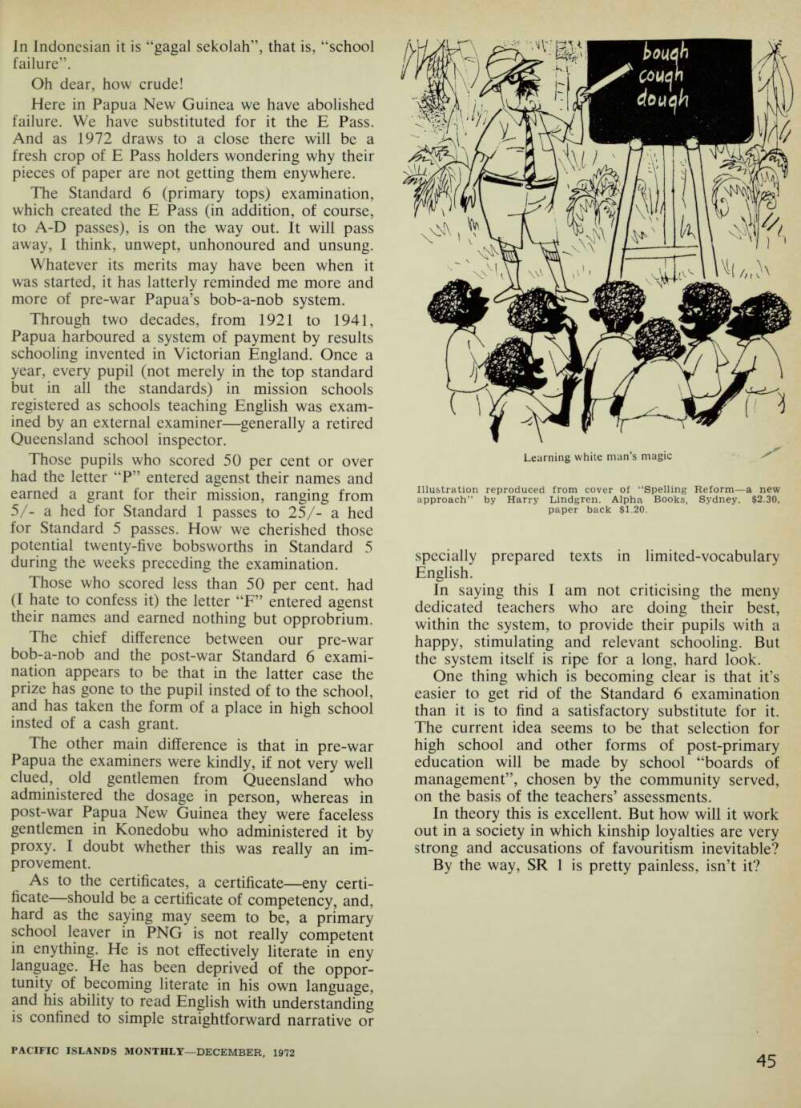
Learning white man’s magic Illustration reproduced from cover of “Spelling Reform—a new approach” by Harry Llndgren. Alpha Books, Sydney. $2.30, paper back $1.20.