constructive political opposition'
p. 13 · Read in the full issue
What New Guinea needs is a constructive political opposition'
7 rom Percy Chatterton, in Port Moresby
An assessment of the proceedings »f the November meeting of Papua »lew Guinea’s House of Assembly vi\\ have to wait, because the meeting las not progressed far enough, as his issue of PIM goes to press, for be final pattern to emerge. But, Doking into the crystal ball, I xpect that the United Party opposi ion will make an all-out effort to iscredit and destroy the National Coalition.
Since the September meeting it as become almost hysterical in its riticism of the government, and the bsence of several ministers overseas lay encourage it to hope that it ould win a snap division, possibly n a vote of censure.
Some of the criticism, particularly lat relating to loss of confidence mong overseas investors, has been itelligible and intelligent. Criticism f the public behaviour of individual linisters, and of an alleged “jobs ir the boys” approach by the overnment to certain senior ap ointments, is also fair enough, and alls for convincing refutation by le government.
But criticism by the United Party f the government’s handling of [ighlands famine relief is un arranted, and discredits only the ritics. It may be true that the avernment was a bit slow off the lark at the start, failing at first to ;alise the seriousness of the cata rophe. But once it moved, it moved lassively and effectively.
The United Party’s claim that the tuation has been exploited politically y the National Coalition will hardly jar examination. The Chief Electoral fficer, about as neutral a person Dlitically as one could find, has jaded the fund raising committee, hile the Civil Defence chief, a public rvant, has headed the actual relief Derations. It is difficult to see how e exercise could have been made ore unpolitical.
Father John Momis’ motion on iture mining activities has already uched off a major debate. Father [omis wants a PNG share-holding : at least 50 per cent in any future rge-scale mining ventures, and he so wants agreements for such sutures to allow for re-negotiation n the light of changing circumstances id the acquisition of new know dge”.
It should be noted that Father
Momis’ proposal refers only to future agreements. Mines Minister Paul Lapun’s hot potato—re-negotiation of the Bougainville Copper agree ment, is unlikely to be seriously debated at this juncture.
A commentator has pointed out that the Bougainville agreement “has only been recently negotiated in good faith, and approved by many of the same people now in power”.
This is verbally correct. But as one who took part in that “approval”
I cannot but remember that the agree ment was presented in a cut-and-dried, take-it-or-leave-it form by official members still confident of the sup port of an unsophisticated Highlands bloc.
We were told that it had been thrashed out between the experts on both sides, and that our experts had secured a good bargain for us for which we should be duly grateful.
Some of the more irreverent of us wondered privately whether perhaps CRA’s experts were more expert, as they were no doubt more expensive, than our experts. Anyway, the agree ment was bulldozed through.
Whether we like it or not, it is inevitable that decisions taken and agreements made by the Administra tion-dominated first and second Houses will be called into question by a genuinely autonomous legisla ture. But not, perhaps, just yet.
Those of us who would like to see Westminster-style democracy succeed in Papua New Guinea cannot but be dismayed by the performance of the present United Party opposi tion. Disappointed, disheartened and disarrayed, its only thought seems to be, as one of its own officials put it, to “destroy” the National coalition, without, apparently, a thought as to what happens if it were destroyed.
Matthias To Liman, who performed so well in the Education portfolio in the second House, seems to have be come more and more emotional in his outlook as leader of the op position, and is currently awaiting the outcome of his appeal against a sentence of two months’ imprison ment imposed on him for “riotous behaviour” on a occasion on which it was alleged he let his feelings run away with him.
What Papua New Guinea needs more than anything else at this juncture is an intelligent, urbane and constructive opposition.
During the debate in the November House of Assembly, Father John Momis watered down his motion to lay down radical new policy guide lines for foreign mining companies in PNG.
Father' Momis removed from his motion a call for worker participation in management, deleted the contro versial provision for re-negotiation to be written into all mining agreements and removed a phrase which would have allowed equity to be bought “in other no-interest ways”.
However, call for a majority share holding paid for from future earnings remained.
Despite the changes the opposition United Party still attacked the guide lines, describing them as “an im possible imposition”.
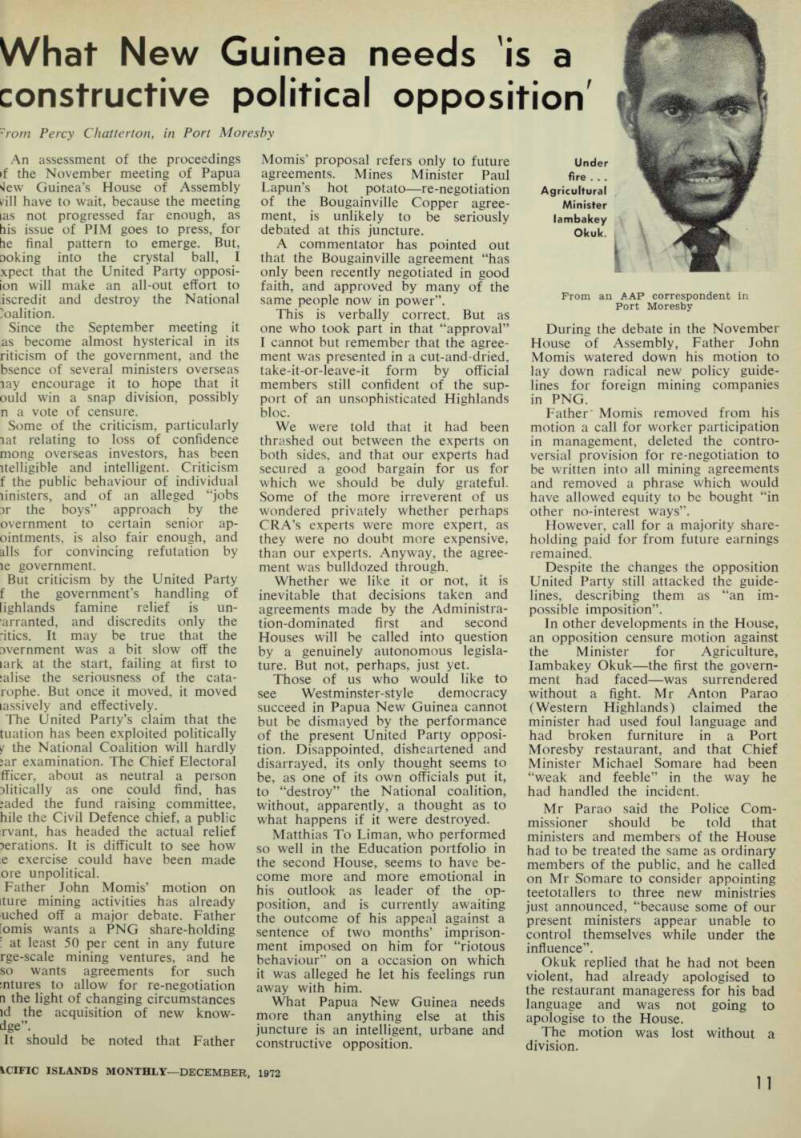
In other developments in the House, an opposition censure motion against the Minister for Agriculture, lambakey Okuk—the first the govern ment had faced—was surrendered without a fight. Mr Anton Parao (Western Highlands) claimed the minister had used foul language and had broken furniture in a Port Moresby restaurant, and that Chief Minister Michael Somare had been “weak and feeble” in the way he had handled the incident.
Mr Parao said the Police Com missioner should be told that ministers and members of the House had to be treated the same as ordinary members of the public, and he called on Mr Somare to consider appointing teetotallers to three new ministries just announced, “because some of our present ministers appear unable to control themselves while under the influence”.
Okuk replied that he had not been violent, had already apologised to the restaurant manageress for his bad language and was not going to apologise to the House.
The motion was lost without a division.
Under fire . . .
Agricultural Minister lambakey Okuk.
From an AAP correspondent in Port Moresby