Business and Development
pp. 103-109 · Read in the full issue
European Common Market and the Pacific
Britain enters the European Com non Market on January 1 next year, ess than two months distant. The JK - Australia Trade Agreement UKATA) ends on February 1 next ear, less than three months distant.
Despite warnings over several ears, only minimal study has been one to assess the likely impact of liese events on the Islands.
Although Japan, other Asian ountnes (especially China) and the JS are all playing a bigger role in dands trade, the Islands maintain rong and strategic commerce links I th the UK, Australia and New ealand, all of which will be signifi antly affected.
Australia and New Zealand must ancentrate on new markets outside urope and the UK, particularly in sia. But what lies before the lands, whose business is largely in rimary produce?
Nauru is the only member of the ritish Commonwealth with “asso ate membership status”, rather than
, e developing status”,
Fiji, Tonga and Western Samoa, heir position is outlined in the terms British accession to the ECM negotiations between the UK and e ECM earlier this year.
These countries are offered three )tions: association through participa nt m the Convention of Association will supersede that in force at esent with the Associated African ates and Malagasy; separate con ntions of association on Article 238 the ECM; or new commercial reements with the enlarged ECM.
Fiji, Samoa and Tonga have until nuary, 1975, to make up their mind these points, although the ECM II pressure them to come to a cision by August 1, 1973. Britain II progressively apply ECM tariffs these countries.
The New Hebrides, the Gilbert d hllice Islands and the Solomon ands are defined as “Brifsh depen nt territories” under ECM rules
and will be offered association with the ECM, under ECM Treaty, section four. It is presumed they would accept this, but no definite statement has yet been made.
Papua New Guinea popped up under Article 125 of this year’s London negotiations and the ECM has agreed to allow continuing agreements between the UK and PNG to last for five years after British ECM entry—January 1, 1973, to December 31, 1977. A review of PNG arrangements with the UK is provided for, and is certain should the territory gain independence before January, 1978, which is at present likely, to say the least.
PNG is very happy over these arrangements. It now has time to plan for alternate markets, and depart mental officers are currently closely involved in these plans. PNG will look towards the Pacific Basin nations —big powers such as Japan, Canada and the US—and intensive promotion aimed at penetrating these markets can be expected soon. But the Austrahan and European markets will not be neglected. Briefly, PNG has to
<^l^ru
The French territories of New
Caledonia (including Wallis and Futuna) and French Polynesia are already associate members of the ECM because of France’s member ship.
Hie US Trust Territory and American Samoa will be unaffected because of their close economic ties with the US and Japan, The Cooks, as a dependent terri tory of New Zealand, could face some adverse winds which will undoubtedly hit the dominion, Of interest to Fiji are the UK ECM negotiations over sugar. The Commonwealth Sugar Agreement will stand until February 28, 1975, which gives Fiji some breathing space.
Fiji’s future sugar sales to the UK will depend on the status it takes up. ka • • Minister COy On * DM/"*
nationalising IH r NCj
"We are looking forward to nationa lising companies.”
The quote came from Mr John Poe, New Guinea’s 39-year-old Minister for Trade and Industry, and was to the dozen or 80 newsmen gathered at a Sydney press conference in
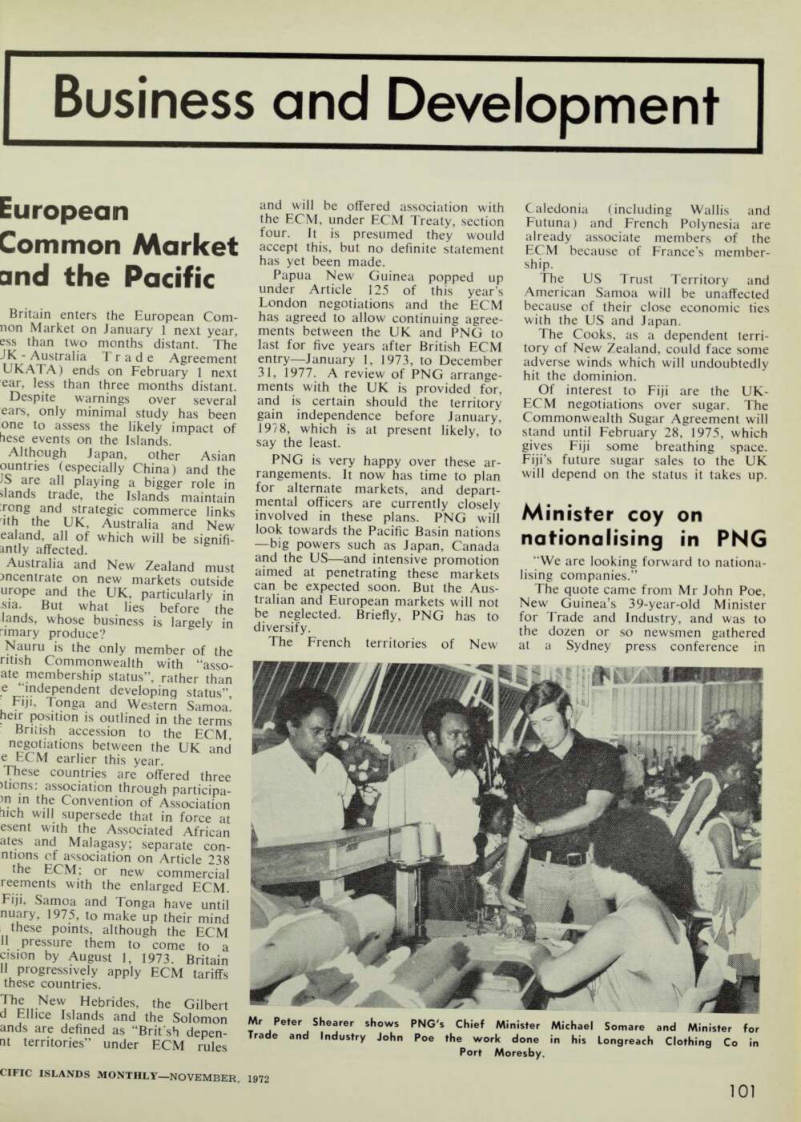
Mr Peter Shearer shows PNG's Chief Minister Michael Somare and Minister for Trade and Industry John Poe the work done in his Longreach Clothing Co in
Port Moresby.
October. It produced pens and note books out of thin air.
“The government won’t take over firms by force,” Mr Poe went on.
“We will buy them out.” Mr Poe would not disclose which industries the PNG Government was exami ning to “nationalise”, but he did add that “much concern” was felt by Papua New Guineans because all in dustry was overseas-owned.
Asked to comment on recent statements from Papua New Guinea saying that some big contracts such as the Bougainville Copper project, would have to be “re-negotiated” with the PNG Government, he said: “This is not the true attitude of the govern ment. I think when the Bougainville agreement was signed it was afair deal. I still think it is a fair deal, but we may look into it later on.”
Mr Poe was on a short visit to Canberra to open a new menswear store owned by a firm with a Port Moresby subsidiary.
He wouldn’t enlarge on his com ments but they were sufficient food for thought. Unfortunately, no pro bing would bring more details.
Mr Poe was being interviewed while in Sydney to see the principals of a new PNG clothing factory (see below).
Making and selling 18,000 trousers and shorts a month, turning over $612,000 annually, is the achievement of 29-year-old Australian businessman Peter Shearer in Papua New Guinea.
Peter went to New Guinea in 1969 to start a clothing factory, won a five-year’s tax free holiday under the territory’s Pioneer Industries Act, and built a $350,000 plant at Gordon, Port Moresby.
Seventy-five per cent, of his sales are long trousers, selling from $2.95 to $6.50 a pair; his shorts sell from $1.50 to $6.50 a pair Peter told PIM he had no trouble finding labour in Port Moresby. His major problems were expensive train ing programmes and getting his pro ducts accepted by PNG retailers, who previously sold only fully imported wear. He now employs 200 people, of whom only four are Europeans, and of the 196 locals, 75 per cent, are women. His company, Lonereach Clothing Company Pty Ltd intends to export to the Solomons in the near future, and has a long-range plan of exporting to Canada.
Shirt production is proposed for later this year and he hopes to boost staff to a total of 1,000 in five years.
Peter says he can undersell Aus tralian trousers by about $4, but Communist Chinese trousers in New Guinea are still more than a match tor Longreach.
Biq Samoan contract
J The SUSIm contract to design and construct Tafuna Industrial Park, near Pago Pago International Airport, American Samoa, has gone to Honolulu-based engineering and planning firm. Belt Collins and Associates Ltd. Belt Collins signed the contract in late September.
The firm’s first job is to prepare plans for a 63-acre site including utility facilities, streets and roads.
Contract stipulations also call for the preparation of an environmental impact statement and standards for architectural and site development.
The plan must be submitted to
the US Economic Development Ad ministration for approval before im plementation. Target date for com pletion of the park is May I, next year.
Two companies—Pacific Time Inc (a Bulova Watch subsidiary) and Gulli Construction Co—already occupy sites in the park area,
OoiltOS chortCT
Holidays 111 Fiji
The F[i Government has given the green Mght for Qantas to go ahead with j ts p j an to operate inclusive tour charter flights to Fiji, despite a very cool reception from local travel
agents and some hotels. The Qantas charters will probably begin in April next year and operate at off-peak periods, bringing in about 160 passengers a week.
The week-long holidays look like costing Australians in the vicinity of S2OO, although no price had been officially announced by mid-October.
Fiji has also granted entry rights to one of the world’s largest charter companies, Trans-International Air lines. The company has been given permission to operate nine ITC flights between August, 1973 and February, 1974.
Local travel agents are far from enthusiastic about the Qantas charters, because the airline will be marketing all-inclusive seven-day holidays at a price far lower than the agents can offer. Hotels are concerned that the airline should limit its charter pro gramme to the off-peak periods. The rest of the time, many Fiji hotels don’t really need the business.
New look at
Carpenters (SthP)
Sweeping changes are taking place in one of the South Pacific’s oldest companies, W. R. Carpenter (South Pacific) Ltd, a subsidiary of Sydney based W. R. Carpenter Holdings Ltd.
Eight companies are embraced by the South Pacific subsidiary which operates in Fiji, Western Samoa and Tonga—Morris Hedstrom Ltd, Millers Ltd, Carpenters Fiji Ltd, Island Industries Ltd, Island Transport Ltd, Suva Motors Ltd, Mainline Millers Ltd and Carlton Brewery (Fiji) Ltd.
Carpenters own half the shares in the last-named company.
For years, the companies have operated separately, but management is to be streamlined for greater efficiency and as part of the process of localisation.
A shuffle of positions among the top executives announced in June foreshadowed the reorganisation which places Mr David Crowe as the first chief executive the group has had.
He became managing director and chief executive with overall respon sibility for the group’s development. (Mr I. M. Hedstrom remains resident chairman of the Fiji-based group).
Mr Lyle Cupit, formerly general manager of Suva Motors Ltd and Carpenters (Fiji) Ltd, is now chief general manager with the key respon sibility for day-to-day operations of the whole group and also executive director of the motor group.
Ex-resident director of Morris Hedstrom Ltd at Lautoka, Mr Laurie Glover is next in line as executive director of the merchandising group.
Other executives are Mr Tom
Copley (administration), Mr Alwyn O’Reilly (finance) and Mr Ken Clemens (industrial).
Changes in the new set-up will include: • The taking over of Millers retailing activities by Morris Hedstrom; • Improvements in M.H.’s Suva stores; • New Ford sales and service centre in Argo Street, Suva; o Redevelopment of Millers industrial area at Walu Bay which includes the rapidly-developing ship building yard; • A tractor sales and service centre at Walu Bay, and,
? T? 16 , in partnership
with Barclays Bank, of the nine storey shop and office block in Suva which will be called Dominion House Mr Cupit told PIM that the three well-known names, which have figured so prominently in Fiji’s economic development. Millers, Carpenters and Morns Hedstrom will be retained Reorganisation will make its influence felt among the local employees who will have greater op portunities for promotion and will pe helped by a training scheme, part )f which centred in new workshops ias already cost $50,000. In the end, dr Cupit said, the scheme will make i profit.
The reorganisation plan, which will ake care of operations for the next ah °r envisa B es a greater hareholding for Fiji’s citizens, dready locals can buy into Carlton aewery (Fiji) Ltd and the Dominion louse project. Later, local participa on m the major holding company , be considered but so far this is nly a possibility.
Operating in wholesaling and retail ing merchandise and building supplies, motor and machinery sales and
service, shipbuilding, engineering,
refrigeration, copra processing, ship ping, coconut plantations, car rentals and property development, the group had a sales turnover in 1971-72 of S4B million. Profit after tax the previous year was $2 million and the tax and duties bill came to $5.4 mil lion. The group also paid out $3.8 million in wages.
At June this year the group employed 3,740 people in Fiji, West ern Samoa and Tonga and only 43 of these were expatriates on work permits. Next year there will be less
than 30 expatriate employees, well below one per cent, of the total strength.
Polynesian Airlines
are doing better
Polynesian Airlines Ltd held its annual general meeting recently and it was a momentous occasion. For many years since the start of the air line in 1960, the company had been operating at a loss. In fact it was these losses that had made govern ment participation in the company easier.
Now, for the second year in a row,
Lyle Cupit, Carpenters (South Pacific) Jcutive director and chief general nager. An Australian, he has been in for 18 years and has applied for Fiji
citizenship.
oard chairman Ted Annandale was bie to announce to the shareholders lat the company had made a profit f $W535,531 for the financial year iding March 31, 1972, as compared ith SWSI 1,357 for the previous year, evenue and expenditure for the year rider review amounted to $839,970 id $804,439 respectively and, Mr nnandale said, revenues for 1973 ere expected to exceed the million ark.
Of greater national importance was e foreign exchange earning achieve ent of Polynesian. In 1971/72 the >mpany earned net foreign exchange excess of SWS2OO,OOO, said Mr nnandale.
All this information must have eased the shareholders immensely, course. The airline is at last begin ng to make money, but apparently is not yet quite ready to face com tition, from PanAm, that is. Pan in has repeatedly been trying to •tain landing rights in Western moa but has repeatedly been re iffed by the government, or more ecifically, by the Minister of Civil /iation, Tupuola Efi.
It appears that there are many ople, some of them influential, who >uld like to see the establishment of PanAm service to Western Samoa, icy are of the opinion that this >uld help create more efficient air e services and this in turn would in the interests of the public.