Pacific Shipping
pp. 88-91 · Read in the full issue
OFFER FOR P & O RAISES DOUBTS
On Passenger Plans
Shipping giant and major cruise line in the South Pacific, P & O, received a $470 million takeover bid in early October. The bid, in shares and cash from a rival, but more successful, British shipping group, Inchcape, is one of the biggest attempted coups in world shipping history. P & O doesn’t support the bid.
The bid itself ended months of rumours throughout the financial heart of London, where both these groups are headquartered. A bid for the ailing “old man of the sea” was deemed certain. It was merely a matter of who and when.
The P & O Group was widely known to be rich in assets and poor in management. The group’s chair man, Ford Geddes, virtually adver tised the group as “up for sale” when he recently forecast poor immediate prospects. Ford Geddes, in the same breath, said P & O properties were undervalued by at least $lOO million.
Geddes, however, is not the key figure in the current takeover attempt.
Lord Inchcape, head of the highly profitable Inchcape Group, is on P & O’s board and has opposed a recent P & O move to acquire a big UK property and construction group.
The Inchcape bid is sure to arouse more controversy in the UK and it would not surprise to see another bidder come forward for the rich P & O group.
The bid comes at a time when P & O is going through a series of massive internal changes. The group is trying to re-organise its dozens of subsidiary companies (such as New Zealand Shipping) into five operating divisions and in turn do away with traditional company titles going back over 100 years.
This has led to a big drop in morale among old staff, and also major retrenchments in the UK and overseas. P & O recently disposed of its loss-making Union Steam Ship Company to New Zealand and Aus tralian interests, a move which many thought meant the group was with drawing from big operations in the South Pacific.
This, however, isn’t true. P & O will maintain and even increase its South Pacific cruising out of Australia to ports such as Suva and Noumea.
The cruises sell well for P & O, and if they don’t always make profits, they provide a constant form of liquid turnover for P & O which is valuable for the viability of other company projects which don’t pay so well.
In Fiji P & O has a small but significant interest in the South Pacific’s biggest land development scheme, Pacific Harbour. P & O has about 11
per cent, of Pacific Harbour and is finding its investment here a good one, and this company reported a £890,000 profit recently (PIM, Apr., p. 95).
A P & O director, Lord Geddes, got the group involved in Pacific Harbour several years ago, during a trip to Fiji.
Other P & O investments in the South Pacific include a subsidiary, Pandair, which is the UK’s biggest air forwarding company. Although Pandair has recently undergone some contraction in overseas countries, it has a big operation in Australia and may attempt to take up a bigger share of Islands business soon.
As reported in PIM, P & O has been selling some of its aged liners and obviously it will cut down on its traditional “long-line” voyages, on the UK-Australasia route.
However, the world liner trend is to short cruising, and it’s here P & O
could continue to play a major part, At least two middle size liners are based in Australia for Island cruises, One handicap of the group in the Islands, which have relatively less developed ports than the West Indies or the Mediterranean, is that the biggest liners, such as the 40,000tonners Canberra and Oriana cannot berth at the small Islands wharves, Papeete, particularly, is where P & O misses out and many tourists from Australia and New Zealand take other cruise companies’ liners to see Tahiti.
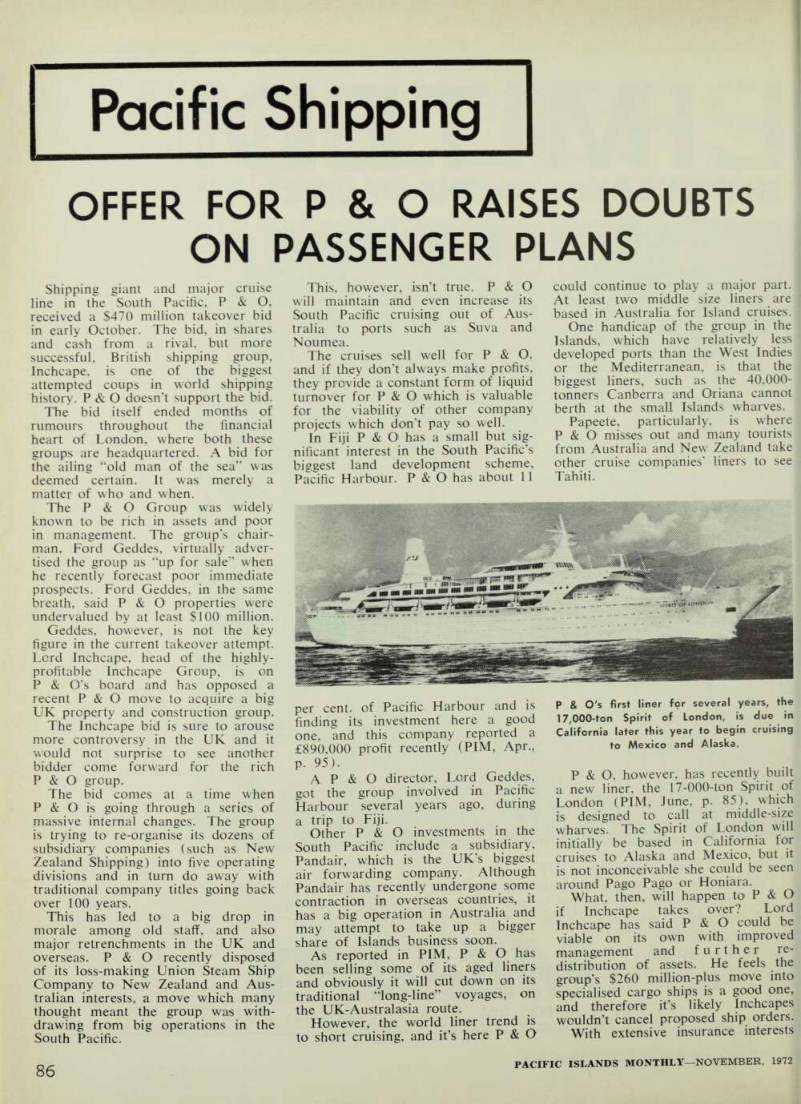
P & O, however, has recently built a new liner, the 17-000-ton Spirit of London (PIM, June, p. 85), which is designed to call at middle-size wharves. The Spirit of London will initially be based in California for cruises to Alaska and Mexico, but it is not inconceivable she could be seen around Pago Pago or Honiara.
What, then, will happen to P & O if Inchcape takes over? Lord Inchcape has said P & O could be viable on its own with improved management and further re distribution of assets. He feels the group’s $260 million-plus move into specialised cargo ships is a good one, and therefore it’s likely Inchcapes wouldn’t cancel proposed ship orders.
With extensive insurance interests
P & O's first liner for several years, the 17,000-ton Spirit of London, is due in California later this year to begin cruising to Mexico and Alaska.
of its own, Inchcapes would be in clined to merge P & O insurance (Bishopsgate) companies, and also sell oft P & O real estate not earning good returns (and there’s plenty of that!). Lord Inchcape’s views on P & O’s liners, whicn until several months ago comprised the world’s biggest liner fleet, are unknown.
Last year, on its world-wide liner operations (Passenger Division), P & O earned $76 million in turn over, but cost $BO million to main ain, producing a good liquidity iource (always $l6 million in cash, >n hand), but hardly producing an overall profit picture. It is in this ;ection of the diverse P & O interests hat the biggest questions arise, akeover or not.
4 Ew Law For
Rongan Ships
Tonga’s Parliament has passed the lew Snipping Act, which will enable oreign ships to register under the fongan flag (PIM, Sept., p. 128).
"he act in early October was await ag the king’s signature.
While the legislation will go some /ay towards modernising Tongan hipping regulations in line with de elcped countries and international onventions, it also introduces possi ilities that the kingdom may attract verseas shipping companies to sgister their ships for tax and other masons.
However, the idea of attracting verseas companies to use Island orts as registration bases has yet to chieve any great success. Nauru led the same in very early legisla on, following its independence, in 968. With a couple of minor excep ons, Nauru has not attracted any gnificant overseas tonnage.
Most successful has been Vila, in le New Hebrides, which has dracted several Australian and New paland shipowners to register ships, iberia and Panama, the world’s mice registration centres, have lost => sleep over possible Island rivals.
Indeed, shipping sources in London, e acknowledged hub of world ship ng, are mostly unaware of Nauru’s gislation, let alone similar Tongan Forts.
It would be unfair, however, to te the new Tongan Act as merely i attempt to attract overseas lippers intent on saving dollars. The t incorporates everything from reckage to safety regulations. Its ccess in Parliament means that Dnga still wishes to play its part regional shipping services, despite me misadventures in recent years.
Tonga realises its own hand in ipping means trade, overseas
revenue and strategic value. Just how to go about it is Tonga’s problem, one which the king will have no small say in when it is made.
Skimming The Waves
Around Viti Levu
A Sydney businessman has plans to ease the ordeal tourists in Fiji face when they motor over the Queen’s Road, linking Suva and Lautoka. Mr John Bracey, managing director of Downhead Manor Pty Ltd, will have a 100-passenger hydrofoil running a return ferry service with stops at the Fijian Ho t el, west of Sigatoka, and Naboutini (near Korolevu) just as soon as he can get a chartered hydro foil, the Sun Arrow, to Fiji.
The idea has been in the melting pot for two years, when Mr Bracey went to Fiji to look at an island on which he had an option. He wanted to enter the Fiji tourist industry, but saw the major problem was to get people to the island. He then looked at the transport situation generally, and after driving over the Queen’s Road, he decided a hydrofoil service would save tourists a lot of jolting and jarring.
The Port Jackson and Manly Ferry Service and Mr Bracey were linked in plans to set up the service; earlier this year the company pulled out, and now Mr Bracey is “going it alone”. He has one problem, and it is a big one. He has chartered a ferry in Italy for six months with an option to purchase. He is allowing six weeks to get it to Fiji, three months for operations, and six weeks to get it back to Italy, if he decides not to buy it. He has to find a
suitable ship to get it to either Suva or Lautoka, and late in September he had not been successful.
However, he has been granted a trial licence to operate the service.
But before he can get a full licence he has to do a passenger reaction survey and show the results to the Fiji Marine Department.
The hydrofoil will carry 100 passengers at speeds of up to 40 mph.
It is 94 ft long and weighs 64 tons.
It can operate in seas with waves up to 12 ft, and in some circumstances in waves up to 17 ft. The journey between the two main centres will take 4j hours. The hydrofoil will be crewed by a master, a mate, an engineer, two sailors and two hostesses. The crew will be local, except for the master and mate. Mr Bracey has given an undertaking to train local men to take over as cap tain and mate. He will send them to Hong Kong where they may qualify for their licences.
The time-table and fare structure are; Leave Lautoka 8 a.m., arr.
Fijian Hotel 9.36 (SI 1.40); leave Fijian Hotel 9.56, arr. Naboutini 10.56 (515.55); leave Naboutini 11,16, arr. Suva (Tradewinds Hotel) 12.36 (522.50). On return the hydro foil will leave Suva at 1.16 p.m., arr. Naboutini at 2.36, leave at 2.56; arr. Fijian Hotel at 3.56, leave at 4.16; arr. Lautoka at 5.52. In the cooler months the hydrofoil will arrive at Lautoka after dark. Inter mediate fares will be: Fijian Hotel- Naboutini, $4.15; Fijian Hotel-Suva, $14.50; Naboutini-Suva, $10.35.
Mr Bracey says he will add Deuba to the schedule later.
Cutting Time Lost
On Sydney Waterfront
A determined effort will be made to eliminate expensive delays in hand ling Pacific Islands’ cargo on the Sydney waterfront. A time-slot system will be introduced under which ship pers will be given a time to send their cargo to the wharves.
Successful operation of the scheme depends on the complete co-operation of shippers.
A committee was set up last year to go into the question of delays on the waterfront. Represented were ship ping companies, the Australian Steve doring Industry Authority, the NSW Maritime Services Board (which con trols the wharves), shippers and transport operators.
The appointment of the committee was not before time. Delays were chronic. Long queues of trucks waited in streets for access to the
Harder Look At Norfolk Island
Hetherington Kingsbury Pty Ltd is looking for a ship to provide a regular service from Sydney to Nor folk Island and Lord Howe Island.
A director of Hetherington Kings bury, of Sydney, told PIM a ship with proper gear to handle lighterage cargo and with adequate refrigerated space was required.
A group of Norfolk Island mer chants, started negotiations with Lord Howe merchants and Hetherington Kingsbury to form a new shipping company, South Pacific Shipping Co. (Norfolk Island) Ltd. The capital is estimated at $70,000, which will be raised either totally by share alloca tions, or by allocations and a loan.
The allocation of shares to Lord Howe will be in proportion to the amount of cargo. This would be about 12i per cent, or about $lO,OOO of the capital.
Hetherington Kingsbury, the manag ing agents, will take up shares worth $5,000 and will provide $20,000 at 8 per cent. This loan will be re payable at the rate of $5,000 a year.
Will the venture be profitable?
The Hetherington Kingsbury director said it depends on what a ship costs, and the amount of cargo available.
Asked why a new service was re quired, with Karlander calling at each island every 19 days, and also offer ing passenger accommodation, he said the new service would operate to only two islands. There would be no delays at other ports which could affect the arrival dates of cargo.
A major factor in feasibility is all exports from Australia being offered to the proposed company. Exports
wharves. There were ludicrous situa tions where big vehicles, carrying a few outers of foodstuffs, waited for several hours to get on the wharves. The cost of the delays was borne by the consumer.
The committee reported that a survey team set up by the Stevedo ring Industry Authority had measured dramatic improvements when the time-slot system was applied to some Karlander ships. For 11 ships, over a test involving 2,585 trucks, the average vehicle turnround time at the wharves was reduced by 82 minutes, compared with previous averages. The result included loading four ships, at which, for various reasons, the scheme did not function as intended. (PIM, in November, 1971, reported on a pilot scheme conducted by Kar lander with the Golden Swan, load ing for Honiara, Kieta and Rabaul, Although there were a few “bugs”,
from Australia in the last two or three years have risen at the rate of 30 per cent, a year, and the pro moters expect that trend to continue.
This is not the first attempt to set up a new service for Norfolk Island.
There was a move early in 1971 to launch a service from there to take in Japan, Australia and New Zealand.
It is believed the promoters were un able to get a suitable ship.
The current proposal is for a three weekly service, which allows plenty of time for loading and ample time at each island for unloading.
Benefits expected from the service include: 9 Merchants will be able to reduce amount of stock held, which would free storage space and reduce the money tied up in stock; e Through ownership of the ship, the merchants would be able to stabilise freight rates. (They also ex pect profits will help to reduce freight rates.) Norfolk Islanders interested in the plan have been active. They have circulated a questionnaire to mer chants asking them to help in com pleting final arrangements. Intending merchants are also asked to give information about the tonnage they imported last year, how much they expect next year, the classification of cargo and tonnage for each class, whether they would direct all ship ments through the company, the notice required for first shipment, how many shares they require, and how much notice they need before taking up shares.
the speed which vehicles passed over I the wharf was amazing).
The committee suggests that the J time-slot system be introduced for I all operators and shippers in the Pacific Islands trade, financed by a small levy on outward cargoes.
Sydney is not on its own in this approach to the problem. London and Liverpool have instituted ap- ! pointment systems. Reports from those ports suggest reductions in delays J in handling vehicles of 60 to 70%. I This is how the system works; Space booking. Cargo is booked with the ship’s agent in the usual way. Where cargo is to be supplied by a second party the name, the person to contact and telephone number of that supplier are required.
Receiving advice. On notification of berth allocation by the Maritime Services Board, the ship’s agent ad vises all shippers/suppliers of the wharf and days of receiving.
Appointment. An appointments clerk retained by the ship’s agent liaises with the stevedore and with suppliers or companies actually deli vering the cargo to arrange mutually suitable appointments for trucks deli vering to the wharf, within one hour time-slots. • Reporting at the wharf. On arrival at the wharf, truck drivers report to the receiving clerk, who checks the interim receipt to ensure that each vehicle is handled in its correct time-slot order.
Cook Islands Crew
For Nauru's Newest Ship
The Nauru Local Government Council, owners of the Nauru Pacific Line, have purchased the Federal Palm, of 3,196 dwt, from the Carib bean. Federal Palm was built in 1961 by Canadian Vickers Ltd. It has been operated since then by the West Indies Shipping Corporation and registered at Port of Spain.
The Federal Palm is to be re-named Cenpac Rounder. She is 298 ft long j with a beam of 51 ft 8 in. and 15 ft; 6i in. draught.
Nauru has turned to the Cook Islands j for crew for the new ship. Ten Cook; Islands men have been selected by' the government on behalf of the; Nauru Line, and these were flying out of Rarotonga early October by' Polynesian Airlines charter.
They have been engaged on wages? of $lOB to 5125 per month with over time rates of 57 to 69 cents per hour, , for one year. Their first task is toe crew the ship on its delivery voyages from Curacao.
Nauru Pacific’s 30,000 ton bulk) carrier, at present under construction r in Japan, is scheduled for launchings on December 9.
Hipping Briefs
• A new log of claims served by 2 Fiji Dockworkers and Seamen’s lion is seeking to double present iges. It proposes a monthly wage r ordinary seamen, second cooks d second stewards, $6O (now 9.12); bosun, $7O ($38.48); steward d cook, $67 ($35.46); greaser and le seamen, $65 ($33.28). One powner said he could not pay such iges and survive. At present some ps had to overload passengers and go to show a profit. He considered rise of 15 to 20 per cent, would reasonable. • A commission of inquiry into organisation of Fiji ports will rt soon with the appointment of ) local men to the commission, ey are Mr H. N. Murray, a director Morris Hedstrom Ltd, and a mer manager of Millers Ltd, and Taniela Veitata, secretary of the i Dockworkers and Seamen’s ion. The overseas members of the nmission are Mr Loh Heng Kee, "ctor of operations for the Port Singapore, Mr Hussein Bin Haji hammed, general manager of the t of Sabah, and Mr Noel Hylton, amaica port administrator. Mr Loh ig will be chairman. > The second edition of Kopsen's gating Gear Illustrated” is a com hensive catalogue of everything shipping man requires. As the title gests, it is a book produced by well-known Sydney chandlers, W isen and Co. Pty Ltd. v C u S l- ? Ko P sen catalogue was lished four or five years ago. The and edition, apart from being it up to date contains a number improvements. It is now divided 1 sections, and is indexed for easv rence.
Ir Bill Kopsen, managing director W. Kopsen and Co. Pty Ltd, and ;randson of the founder of the l ’ i n an introduction, refers to the > association his company has had i the Pacific Islands. The original >sen, in fact, was in business in uka and Suva for about 20 years a 1878.
Ir Kopsen, no doubt bearing in d that world-wide inflation leads constant price reviews, explains omission of prices from the logue this way, “A price list is ossible to keep up to date ‘in e times of change’ so we suggest you nominate those lines that rest you and we will send a ent list of prices promptly”, he catalogue is priced at $1.95.
The Cook Islands firm of and Boyd Ltd is offering its
newly acquired inter-island passenger and cargo ship, the Manutea, for sale or charter. The ship was acquired in July in Holland, and was then known as the Trio, 443 tons. She has accommodation for 20 passengers.
Captain Hugh Williams, of Sydney, who operated a ship in the Cooks for about 10 years, says the group will be short of local shipping if the Manutea is sold overseas. • Karlander is now introducing a monthly service from Australia to Papeete. The Norwegian-owned line has included the Tahitian port in the Australia-US run, via Fiji. The first service was with the Good Navigator.
The Good Mariner will call on the
December run, and the Belle Isle in January.
The Belle Isle, of 15,000 tons, has been chartered from Mauritius on a long-term basis. She has all modem cargo handling facilities. TT . * Union Steam Ship s 5,299-ton passenger-cargo vessel Tofua has glv^n * reprieve of three months before she is withdrawn off her run, and now will operate until March next year, out of New Zealand. Tofua was to be withdrawn before Christ mas, but because USS has not re ceived a reply from Islands govern ments about their participation in a proposed container run to the Islands, she stays in service.