The Shane
pp. 82-83 · Read in the full issue
Gould way
You get to the top and they begin to tear you down, and it’s no different if you happen to be only 15 when you reach the top. Fifteen-year-old Sydney swimmer Shane Gould has carved her niche by taking three golds, a silver and bronze at the Munich Olympics, but the knockers have since got at her because her mother has published an illustrated book called Swimming the Shane Gould Way, designed to help those less proficient with their swimming styles. Claim the critics: Mother’s book endangers the daughter’s amateur status.
There are hundreds of people in Fiji who know Ron and Shirley Gould intimately enough to be certain that they are not the kind of parents to exploit a daughter’s suc cess, and that the charge of profes sionalism is nonsense. But it must hurt.
Ron Gould has been 25 years in the airline industry, and was with PanAm in Fiji for seven years. Young Shane lived there between the ages of three and nine, which happened to be formative years for her swimming.
Ron Gould was for some of that time president of the Nadi Sports Club, and his wife Shirley travelled extensively as a trained social worker, with an interest in living standards and physical fitness.
The book includes photographs of the young champion (the only swim mer in the world to have held world 100, 200, 400, 800 and 1500 metre freestyle records at the one time) splashing about on . Fiji beaches where, at five, she was a miniature expert in snorkel and mask around the reefs.
Without realising it, recalls Shirley Gould now, Shane was probably doing a considerable amount of swimming-exercising as a small child in Fiji, as she swung from ropes and trapezes rigged up in massive mango trees, and climbed up and down ladders in tree houses. The Nadi Airport School had a strong emphasis on sport and physical fitness due to the influence of the then headmaster, Ron Bruce, and there were first-class climbing frames for the 100 pupils and plenty of active sport.
“And in Fiji we found the local food a real delight,” writes Shirley Gould. “We bought all those fabulous tropical fruit and vegetables from the local market, and the mangoes we had growing next to the house povided weeks of chin-dripping
abundance. I belonged to a multi racial women’s club, and by exchang ing recipes and calling on my know ledge of food values, I managed to give my children a very good, health ful diet in those six marvellous years.
Returning to Australia, the whole family missed the unlimited avail ability of tropical fruits.”
It was in Fiji that Shane, at six, got her first lessons from a profes sional coach, New Zealander Paul Krause, and by eight she was reason ably proficient in all swimming strokes except the butterfly, which she had never seen.
Although it is the personal back ground we get on Shane that makes Shirley Gould’s book especially readable, the purpose of the book, of course, is to provide an illustrated step-by-step swimming manual for up and-coming Johnny or Jenny Hope fuls, and in this it does its job splendidly.
The photographs are mainly from actual films of Shane Gould in action in the water; the coach of any school swimming squad, or any parent who wants to help his youngster achieve swimming proficiency, will find this manual invaluable. And any school child will find it easy to read because Shirley Gould has deliberately written it in clear and uncomplicated English.
Footnote: On a visit to Fiji before Vlunich, Shane said publicly that her irst gold would be “for Fiji”. It was 10 idle promise. Today in Sydney she ells her friends that the 200 metre medley medal is Fiji’s.
(Swimming The Shane Gould Way
!3 95) lirley Gould- ° ak Tree Press . Sydney!
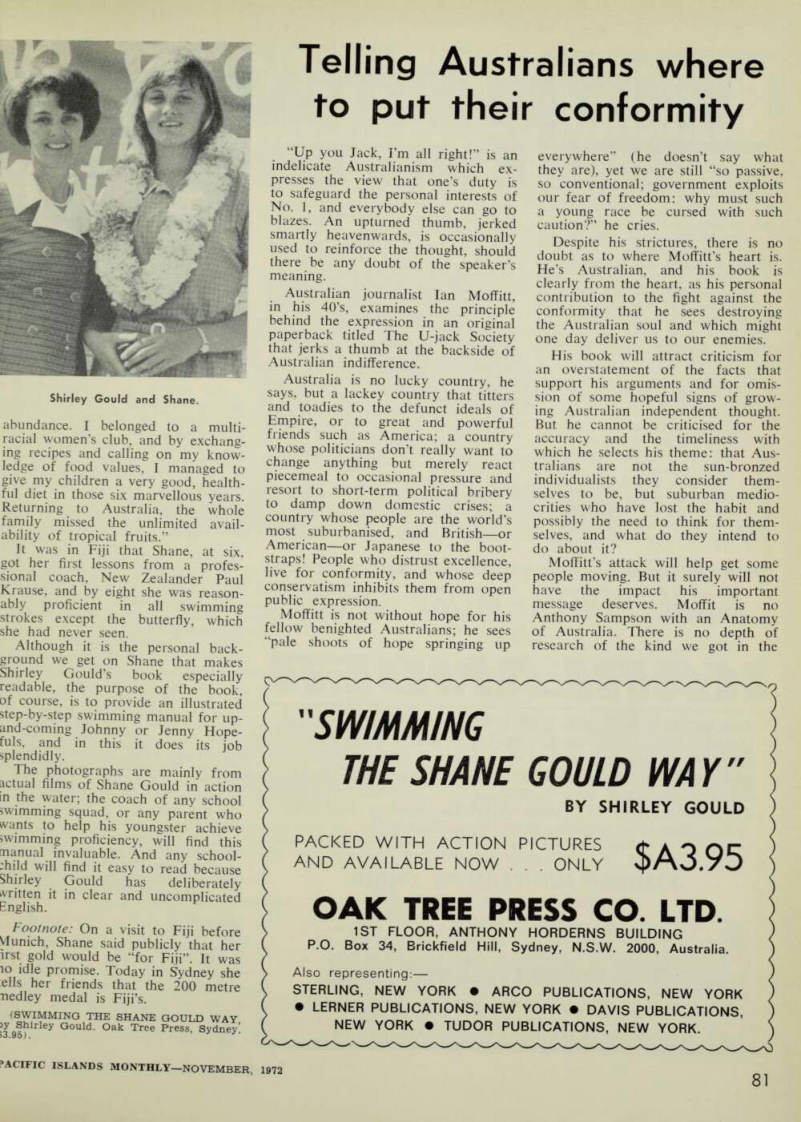
Shirley Gould and Shane.