Bougainville secessionists
p. 53 · Read in the full issue
join the establishment
Prom a Bougainville correspondent
The Napidakoe Navitu organisation started in Bougainville early in 1969 to articulate the grievances of Nassioi people who had lost their land to allow the development of the huge copper project on the island. Unable to restore the villagers’ land to its former owners, the Navitu during the next year began to concentrate its activities on promoting secessionist ideas.
At best, the Navitu’s advocacy of secession could be said to be luke warm rhetoric. At worst, it could be said to be a political ploy to keep the attention of Papua New Guinea firmly directed on Bougainville.
The Bougainvilleans, not an un intelligent people, found out early what other groups of Papua New Guineans have found out since the more you kick and scream and act the political prodigal, the more solicitous central government will be in giving you what you want.
But the past year has seen Papuans, Highlanders and others, all calling for secession —and the empty threat has been exposed as being just that.
Secessionism on Bougainville is not a new idea. It has been around for at least 20 years. The development of the copper mine at Panguna gave the idea more impetus and perhaps in creased its acceptability among Bougainvilleans.
But few peoole on the island could define with any precision exactly what they mean by secession, and fewer still would have any practical idea about how it could be achieved. Logic and pragmatism have not been strong aoints of the secession debate. Prob ably, to the Bougainvilleans, demand ng secession was just one way of >aying that they were less than happy -vith the status quo.
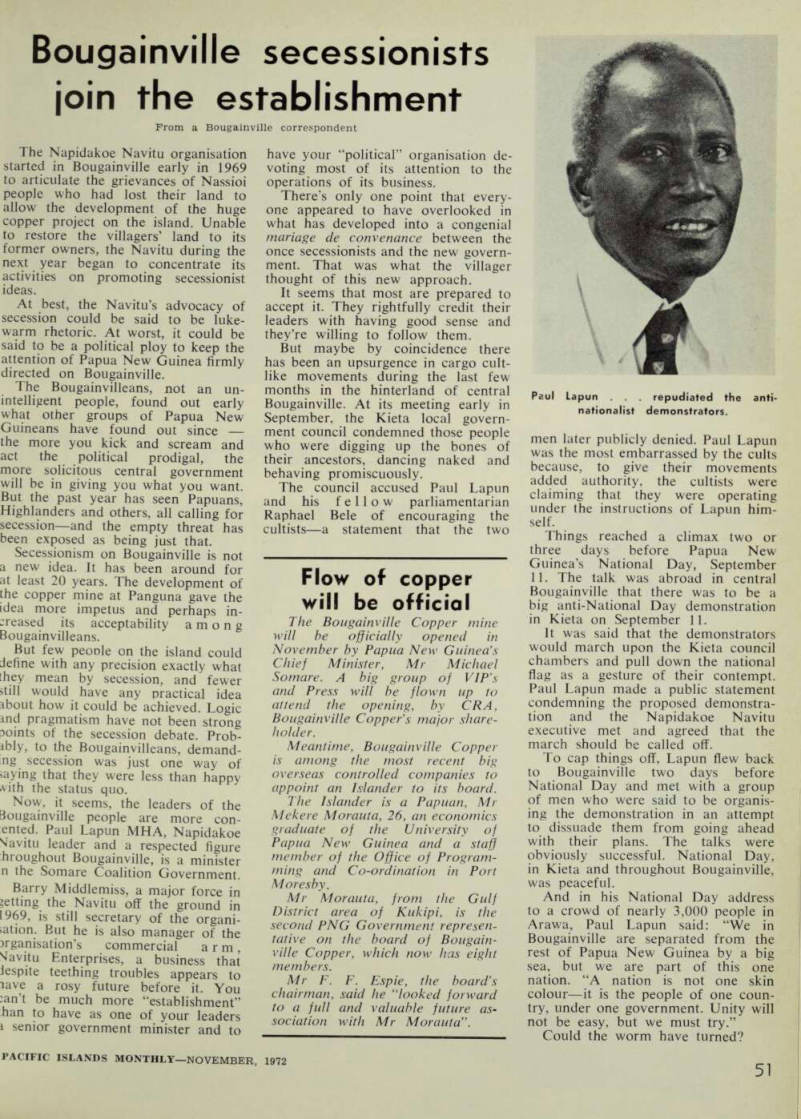
Now, it seems, the leaders of the Bougainville people are more con ented. Paul Lapun MHA, Napidakoe Vavitu leader and a respected figure hroughout Bougainville, is a minister n the Somare Coalition Government.
Barry Middlemiss, a major force in getting the Navitu off the ground in 1969, is still secretary of the organi sation. But he is also manager of the organisation’s commercial arm, Navitu Enterprises, a business that lespite teething troubles appears to lave a rosy future before it. You :an’t be much more “establishment” han to have as one of your leaders \ senior government minister and to
have your “political” organisation de voting most of its attention to the operations of its business.
There’s only one point that every one appeared to have overlooked in what has developed into a congenial manage de convenance between the once secessionists and the new govern ment. That was what the villager thought of this new approach.
It seems that most are prepared to accept it. They rightfully credit their leaders with having good sense and they’re willing to follow them.
But maybe by coincidence there has been an upsurgence in cargo cult like movements during the last few months in the hinterland of central Bougainville. At its meeting early in September, the Kieta local govern ment council condemned those people who were digging up the bones of their ancestors, dancing naked and behaving promiscuously.
The council accused Paul Lapun and his fellow parliamentarian Raphael Bele of encouraging the cultists—a statement that the two
men later publicly denied. Paul Lapun was the most embarrassed by the cults because, to give their movements added authority, the cultists were claiming that they were operating under the instructions of Lapun him self.
Things reached a climax two or three days before Papua New Guinea’s National Day, September 11. The talk was abroad in central Bougainville that there was to be a big anti-National Day demonstration in Kieta on September 11.
It was said that the demonstrators would march upon the Kieta council chambers and pull down the national flag as a gesture of their contempt.
Paul Lapun made a public statement condemning the proposed demonstra tion and the Napidakoe Navitu executive met and agreed that the march should be called off.
To cap things off, Lapun flew back to Bougainville two days before National Day and met with a group of men who were said to be organis ing the demonstration in an attempt to dissuade them from going ahead with their plans. The talks were obviously successful. National Day, in Kieta and throughout Bougainville, was peaceful.
And in his National Day address to a crowd of nearly 3,000 people in Arawa, Paul Lapun said: “We in Bougainville are separated from the rest of Papua New Guinea by a big sea, but we are part of this one nation. “A nation is not one skin colour—it is the people of one coun try, under one government. Unity will not be easy, but we must try.”
Could the worm have turned?
Paul Lapun . . . repudiated the anti nationalist demonstrators.