Footnotes
pp. 45-47 · Read in the full issue
Urban Dwellers
Of The Fourth
Generation
DILI AUA was born in the Purari Delta village of lari, in Papua’s Gulf District, and raised 3n a diet of sago and crabs.
As a young man he joined the Royal Papuan Constabulary, and served successively at Kairuku, Samarai and Baniara. It was while he was at Kairuku, on Yule Island, that he met and married Koloka, from the Nara village of Oroi.
At the outbreak of the Pacific war his unit vas recalled to Port Moresby, and he has lived lere ever since.
After the war was over Bili left the police orce and worked for several contractors, finally )ecoming a contractor in a small way himself.
Quite shortly after the war he became asso rted with the late Tommy Kabu, about whom o much has been written. It still remains a noot point whether Tommy Kabu should be [escribed as a cargo cult leader, an entrepreneur ,r a Papuan nationalist. Perhaps he was a little fit of each.
1 feel sure that all his life he lung to the hope that there was cargo secret to be discovered, ndeed, I suspect that at one eriod he credited me with being i possession of it and hoped that would share it with him. If he ad stopped to think about it he '°uld have realised that I would ardly have remained so non ffluent for so long had I pos ted it.
However, Tommy Kabu did not sit around waiting for the secret to be revealed. He rganised his people to put aside their old ways nd plunge into the ways of the white man. imong the many enterprises which he promoted as the harvesting of sago, with which the Purari »elta abounds, for sale in Port Moresby. This reject brought him into contact with Bili Aua.
In the late 1940 s Kilakila was still a village n the outskirts of Port Moresby, not yet vallowed up by the expanding town. A Kilakila tan who had married a woman from the Purari 'elta heard of the proposed sago marketing •heme, and suggested that Bili and other Purari elta men already in Port Moresby should estab ;h a settlement on Kilakila land and use it as a
centre for the sale of sago to be shipped by the organisation being built up in the Purari Delta by Tommy Kabu.
So was established “Rabia Camp”—‘Tabia” is the Motu word for sago—a shanty settlement a mile or so on the town side of Kilakila village.
Bili Aua and his confreres settled down there and continued with their wage earning jobs while carrying on the sago marketing venture in their spare time. For a while it must have been a
With Percy Chatterton
in Port Moresby
success, since at one stage they had their own truck for handling the sago. But, like most of Tommy Kabu’s commercial ventures this one petered out in a bog of finan cial chaos.
His was a tragic case. Full of energy and initiative, and inspired by a genuine desire to better the way of life of his people, he lacked the managerial know-how and the understanding of the workings of a cash economy which were
needed to make his ambitious schemes successful.
However, the little nucleus of Purari Delta people stayed on at Rabia Camp and were joined by others from the home villages. Tommy Kabu himself commuted between Rabia Camp and the Purari in his efforts to keep his varied enterprises afloat.
During the last two or three years Rabia Camp has been getting a face lift. It has become the Administration’s pilot project for a new kind of suburb—the no-covenant suburb. Belatedly it has been realised that this is the only way to tackle the shanty settlement problem in a city in which a substantial proportion of the work
force cannot afford even the cheapest of the Housing Commission’s mini-homes.
So the Administration has bought the land occupied by the old Rabia camp and an extensive area adjoining it from its Kilakila owners, and has divided it up into blocks which have been allotted to Rabia Camp householders. It is hoped that with the encouragement of security of title they will put up dwellings of better quality than they have done in the past.
And they have, too. As I look out of my window 1 can see Rabia spreading up the hill side from the tightly packed camp of earlier days.
And some of the new homes being built up there reflect great credit on their builder-owners. Bili Aua, with help from the local Community Centre, has built himself a very nice little brick home.
Roads have been laid out. Water is being laid on to stand pipes. Storm water drainage is under construction. “Camp” is no longer a suitable de scription of the place, but its inhabitants like the old, familiar name.
Apart from the early morning cup of tea brewed on a Primus stove, most of the cooking is done in the traditional Papuan manner—over an open fire on the ground. No mode of cooking nore economical of fuel exists; and no food tastes aetter than that cooked in a home-made, unearthenware pot over such a fire especially f accompanied by yams baked in the hot ashes. \n elderly Papuan friend of mine once com >lained to me plaintively that he hadn’t had a lecent meal since his wife threw away her cook ng pot and started cooking his food in an alu
ninium saucepan.
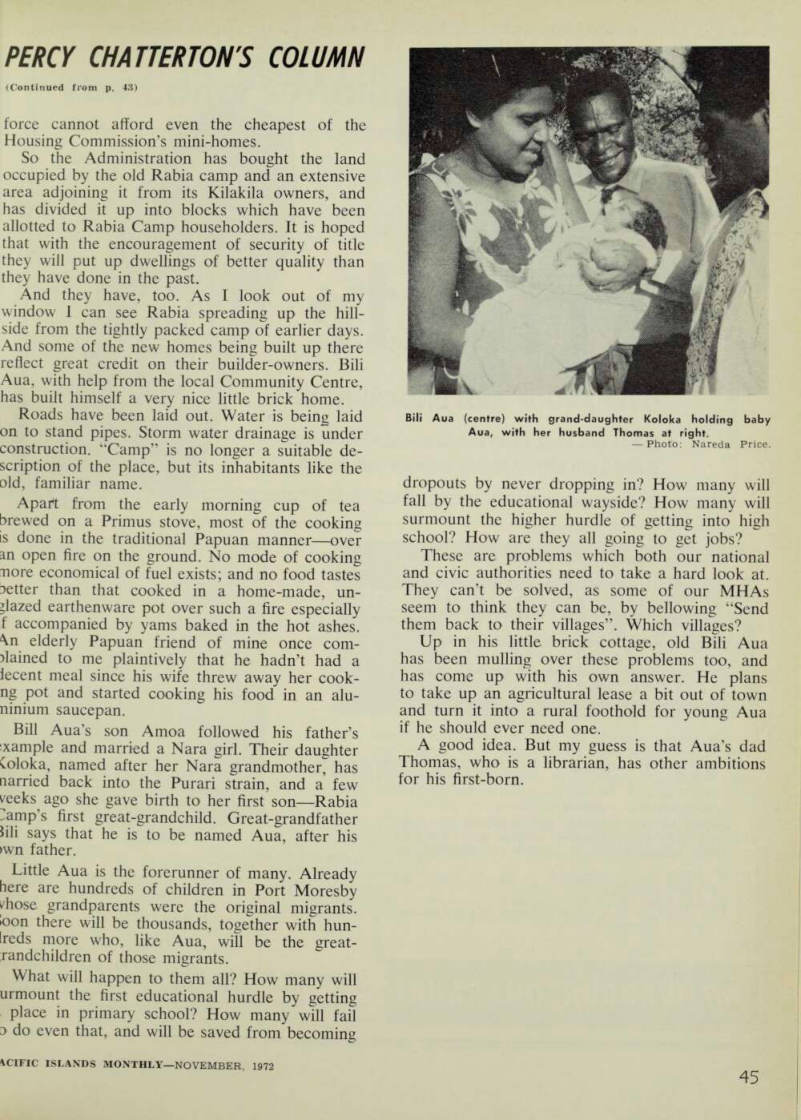
Bill Aua’s son Amoa followed his father’s example and married a Nara girl. Their daughter Coloka, named after her Nara grandmother, has named back into the Purari strain, and a few ago she gave birth to her first son—Rabia .amp’s first great-grandchild. Great-grandfather fili says that he is to be named Aua, after his ►wn father.
Little Aua is the forerunner of many. Already here are hundreds of children in Port Moresby diose grandparents were the original migrants, loon there will be thousands, together with hun- Ireds more who, like Aua, will be the great randchildren of those migrants.
What will happen to them all? How many will urmount the first educational hurdle by getting place in primary school? How many will fail 3 do even that, and will be saved from becoming
dropouts by never dropping in? How many will fall by the educational wayside? How many will surmount the higher hurdle of getting into high school? How are they all going to get jobs?
These are problems which both our national and civic authorities need to take a hard look at.
They can’t be solved, as some of our MHAs seem to think they can be, by bellowing “Send them back to their villages”. Which villages?
Up in his little brick cottage, old Bili Aua has been mulling over these problems too, and has come up with his own answer. He plans to take up an agricultural lease a bit out of town and turn it into a rural foothold for young Aua if he should ever need one.
A good idea. But my guess is that Aua’s dad Thomas, who is a librarian, has other ambitions for his first-born.
Bill Aua (centre) with grand-daughter Koloka holding baby Aua, with her husband Thomas at right.
Photo; Nareda Price.