The world comes to Vavau
pp. 32-39 · Read in the full issue
SEVERAL months ago the Tongans of Vavau saw their first electric sweeper, their first electric food mixer and their first gas stove- They saw bricklaying for the first time and a hundred and one other modern operalions. Now, a select band of 40 of them, men women, girls and youths, sweep, cook and work with all these things, some nonchalantly, some all thumbs but always with a smile.
The modern world has come to Vavau through the portals of the luxury Port of Refuge International Hotel. and welcomed by King Taufa’ahau Tupou IV, who ceremoniously opened the new $BOO,OOO resort complex on October 2.
The hotel has its knockers, the Jeremiahs who see it as Vavau’s ruination, but the islanders see it as a great chance to upgrade their own living standards. That's how chairman of directors Bob Moin and
directors builders Don Sindan and accountant John Moon, New South Welshmen, all see it.
As a youth Don sindan lived on V avau for four years with his roving seaman father and made m friends . He fired Boh Moin and John Moon with his enthusiasm and the three> along with local directors Ra , ph and Herbert Sanft, who occupied the j anc j now j easec j f or 45 years to the new company, Tonga Tourist and Development Ltd, are working hard to ens Lire that the Vavauans and the hotel march into a prosperous future.
Vavau is 170 miles from Nukua lofa and everything that wasn’t already growing there had to come from overseas. There were only six imported Europeans. The rest, 300 of them, were Tongans. There are 30 units with fate- type roofs like the rest of the hotel, with the exception of the swimming pools, two of them,
and the tiled patio. There's a dining room, cocktail bar, a roomy recep tion block, which also houses a duty free shop boutique, beauty salon, and underneath a whacking great wine cellar, already the best stocked cellar in the Islands It can do service as a Humean shelter as it has been built like a concrete redoubt, Ail that mle of buildings took some really refined logistics. When the three Sydney men got together more than two years ago and began to build castles in the South Pacific air, some acquaintances of theirs thought they were mad. a b U H as a " d B ° b * a h n J , Jl “ J vLI™ 66 NSW hotel and catering ventures b ld * remote as Vavau was something else, As much local material as possible
•vas used but in addition, 800 tons }f cement, curtaining, machinery, in :luding power generators, tiles, housands of them, cutlery, crockery, lophisticated kitchen and cooking )lant and much more had to be ;hipped in.
Normal shipping services took care )f it and, although most of it had to ome well over 2,000 miles, and be ransferred from the foreign-going hips to the inter-island ones, there
vas, surprisingly little loss.
“We were really amazed how easily verything was managed,” said Bob doin. “Right from the start, with he negotiations for the land and all he red tape tied around this sort of nport, everything went well. The 'onga Government was with us from
he beginning.
“One of our best champions was
Mr Mahe Tupouniua, the Finance Minister. He gave us all the co operation he could and encouraged the whole thing, and with the backing of the king, the ministers and the government, the whole exercise added up to a very smooth operation.
“There were some frustrations from our point of view. There was Tongan time’ and Island custom to take into account. Decision-making was slow by our reckoning and nobody wants to hurry in Tonga.
“Our work force and the hotel staff had never seen most of the articles before but they were eager and now they are all trained. We wanted to get the local people involved from the start and I think we’ve managed it. They don’t talk about the Port of Refuge Hotel. They call it ‘Vavau’s hotel . (over)
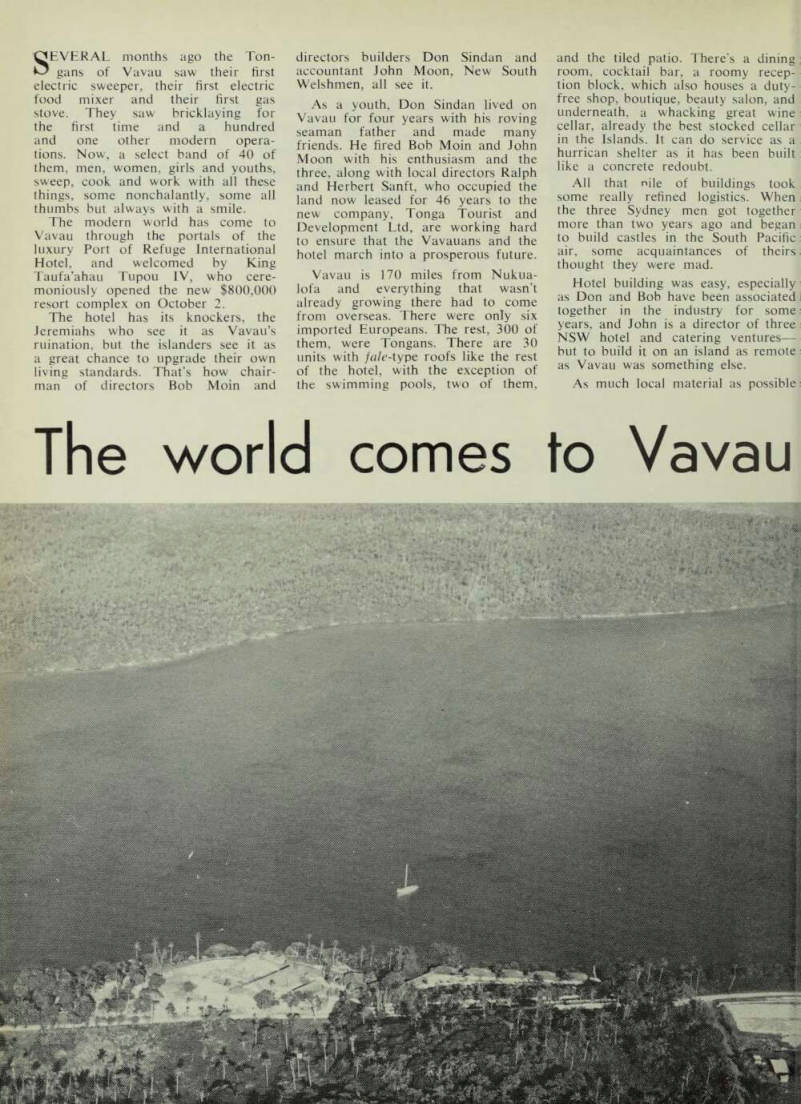
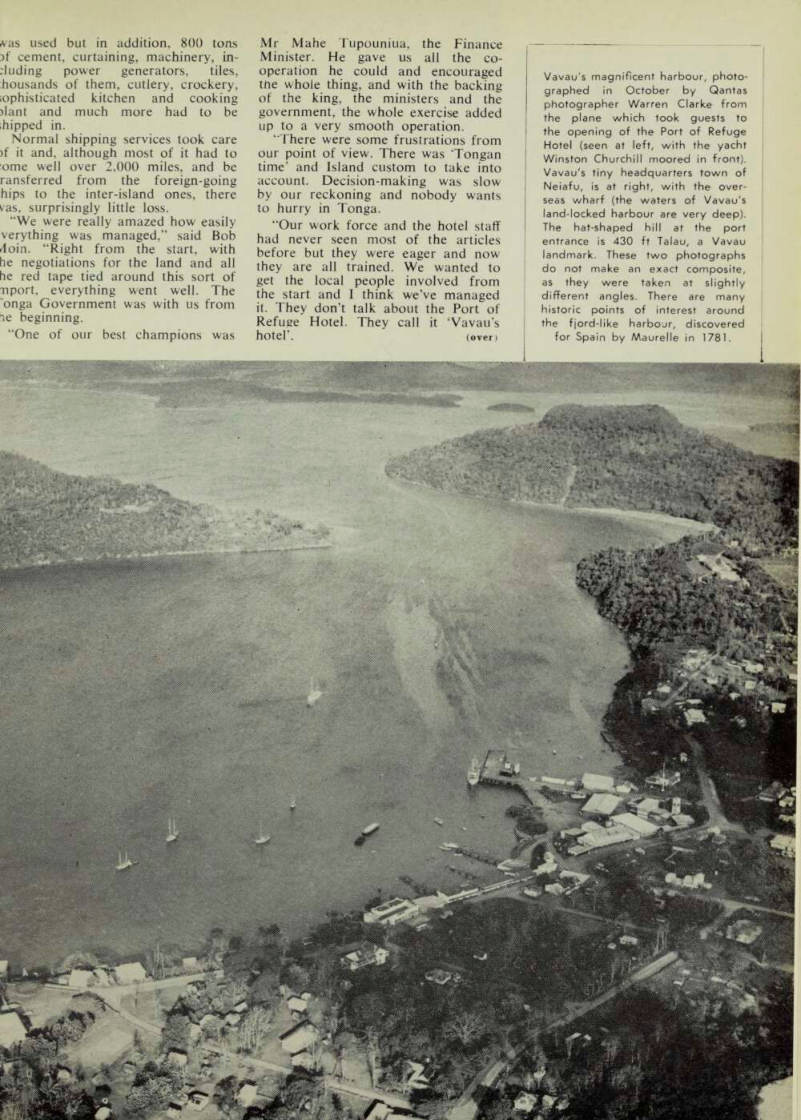
Vavau's magnificent harbour, photo graphed in October by Qantas photographer Warren Clarke from the plane which took guests to the opening of the Port of Refuge Hotel (seen at left, with the yacht Winston Churchill moored in front).
Vavau's tiny headquarters town of Neiafu, is at right, with the over seas wharf (the waters of Vavau's land-locked harbour are very deep).
The hat-shaped hill at the port entrance is 430 ft Talau, a Vavau landmark. These two photographs do not make an exact composite, as they were taken at slightly different angles. There are many historic points of interest around the fjord-like harbour, discovered for Spain by Maurelle in 1781.
“We don’t want their customs and their lives spoiled so we’ll go ahead cautiously. “After all, we want the people who come here to see the Vavau people as they are; not as a copy of the world outside.”
The hotel’s coming has done more than most new hotels have achieved.
It has started a new air service which, using a chartered Britten Norman Islander, began its career on a Sunday, the day before the opening, when the government specially sanctioned flights from Nukualofa’s airport at Fua’amotu. Mayne McKern, seconded from Air Melanesiae, New Hebrides, along with his plane, made the proving flight the previous day to the new airstrip which has been hacked and bulldozed out of a coconut plantation six miles from the hotel.
There’s already a well-made airstrip on the island, constructed several years ago by British engineers, but it has never been used. It was built in the wrong place; faces the wrong direction; is on a cliff top with updraughts, and was condemned before it was opened.
Qantas and Air Pacific have watched the new developments carefully through the eyes of one of Qantas’s experts, ex-Fiji Airways manager Chris Ritchie. Air Pacific will operate the service, which indicates the excellent chances Air Pacific has of operating Tonga’s new internal air services for which there are several comnetitors.
Chris Ritchie was at the hotel opening arranging the schedules for “Air Port Refuge”. It was a family affair. Chris’s youngest son, Logan, who is following in his ex-pilot father’s tailstream, flew as relief pilot for Mayne McKern.
The airstrip, at present something over 1,300 ft of crushed coral, will be extended to more than 2,100 ft and, eventually will take the HS 7485, berns destined as a half-way house between Apia and Nukualofa.
That’s something else which will bring benefits to the Vavauans.
Two weeks from its opening the hotel was slated to have a bar staff experienced in all the latest cocktail mixes. During that two weeks the staff was being taught by Eddie Tirado, a New Yorker, who went to Australia 12 years ago for a short holiday and, married to an Australian, hasn’t been back home since, Eddie is head bartender at Sydney’s Chevron Hotel, president of the Aus tralian Bartenders’ Guild and author of a soon-to-be-published book on cocktails, Bob Moin borrowed him for a two-week working holiday during which time he taught the staff. And they taught him. Said Eddie, “They gave me a new drink, an Otai, strictly Island and soft. It’s made from fruit juices including pineapple, and con tains coconut milk and grated water melon. I’ll take it back to Sydney, add rum and I’ll have a new cocktail, King’s Otai.”
Now that the hotel is opened and the first paying guests have been, enjoved the whole thing including sea trips among the incomparable islands of the group—not to mention the view from each unit window—Tonga Tourist and Development Company, with holding company Pacific Re sorts Pty Ltd, is turning its attention to a second venture, a hotel resort at Ha’atafu beach, 12 miles from Nukualofa.
Building that one should be easier.
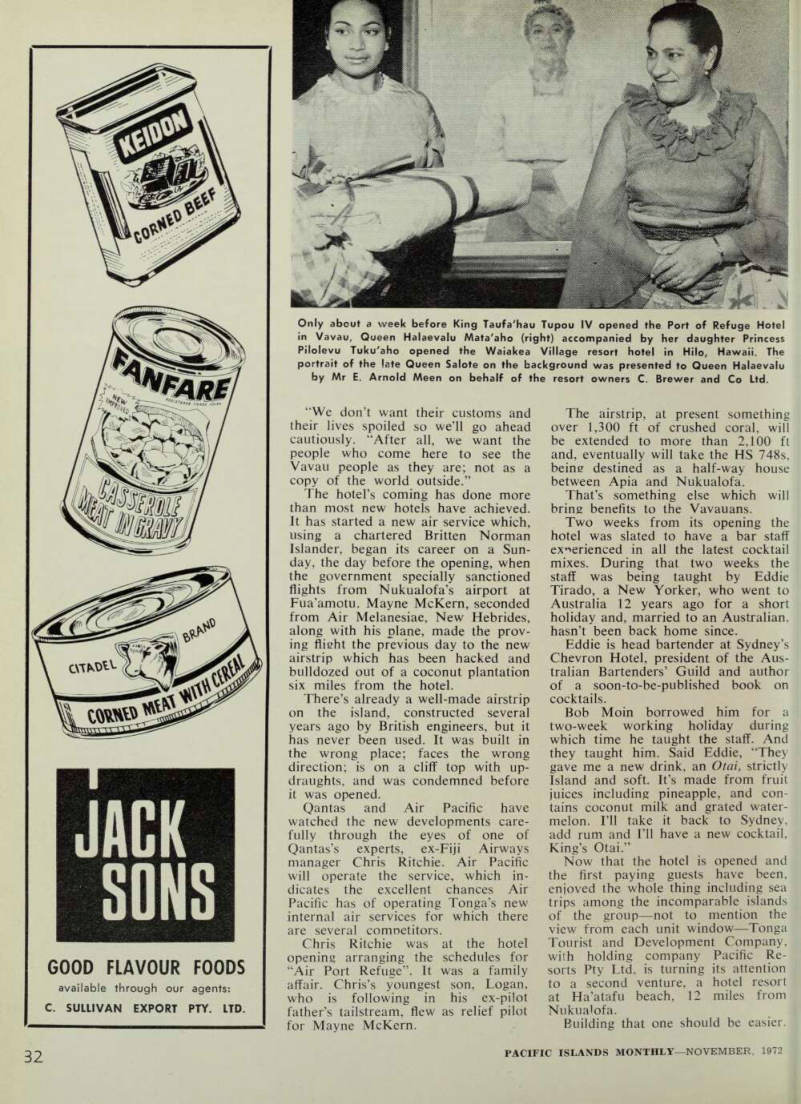
Only about a week before King Taufa'hau Tupou IV opened the Port of Refuge Hotel in Vavau, Queen Halaevalu Mata'aho (right) accompanied by her daughter Princess Pilolevu Tuku'aho opened the Waiakea Village resort hotel in Hilo, Hawaii. The portrait of the late Queen Salote on the background was presented to Queen Halaevalu by Mr E. Arnold Meen on behalf of the resort owners C. Brewer and Co Ltd.
Islands
Lithographer
American artist and cartoonist Bill lates, now living in Fiji, is using the ujians and Fiji village life in the iuter islands as models for litho raphs in his own style.
Firstly, he prepares a Masonite card with five coats of acrylic, to lake the surface coating very thick, le then sketches his subject onto le board, using finely sharpened encils. When this sketch is com leted, he takes a penknife, and, sing the scratchboard technique, matches out the highlights.
At this stage, the drawing is photo raphed and Bates retouches the egative to match the original by paquing the highlights. This step lone may take as much as a day to Dmplete. From this negative, the thograph plate is made and the icture reproduced either as a large rint or as a notecard.
Bates “discovered” the South acific in 1968 when he asked the inner Matson Lines—now Pacific ar East Lines—if he could make iricatures of the passengers in ex lange for passage. For the next /o years he regularly did just that, it in 1970, Bates left the ship in arotonga, the Cook Islands, to make oser contact with Islands life, and •ent several months sketching and tinting water colours in Rarotonga id the outer islands of Aitutaki, tiu and Mitiaro.
In 1971 he went to Fiji, where he :cided on the lithograph technique ;cause he felt he could obtain with a greater degree of contrast and hieve more depth and detail in his ctures.
Bates’ other side is cartooning. His tlitical cartoons appear weekly in le Fiji Times, keeping him in touch th the “outside” world. A collec >n of cartoons done aboard the
Mariposa and Monterey will be pub lished this year. Born in Texas, Bates’ home before moving to Fiji was San Francisco, where his comic strip “Ping” ran daily in The San Fran cisco Examiner.
He plans to sketch the peoples of the other South Pacific islands, using friendly Fiji as his base.
Adventuring in
paradise
The explorer Marco Polo would have been proud. The 9,000-ton Dominion Far East ship bearing his name has just completed a cruise along the Papua New Guinea coast which, if not exactly a voyage of discovery, was nevertheless undertaken in a spirit of adventure.
The vessel was chartered by the Anglican church to show 370 Aus tralian sympathisers something of the life and work of the church in Papua New Guinea. The itinerary included calls at places which have never seen a cruise ship before.
The nautical fun began after a three-day stay in Port Moresby, where the Marco Polo picked up Captain Ray Taylor, a sea dog of 30 years’ experience in Papua New Guinea, to< guide her through the reefs and other hazards of the north east coast. “It is unusual to say the least,” he observed drily, “for a ship this size to go gallivanting up through the reefs like this,”
First stop was at East Cape, in response to a request from the United church mission there, whose inhabi tants wanted the chance to stare at such an unusual phenomenon as a large and lovely liner. The Marco Polo’s captain, Peter Carlson, whose readiness to oblige was a key factor in the success of the cruise, brought his ship close inshore.
A flock of canoes came out to the vessel and eventually some of
the occupants were persuaded to come alongside, mount the gangway and chat with the tourists.
Next morning saw the Marco Polo hove to off Dogura, the “mother” station of the Anglican church in Papua New Guinea. Passengers were ferried to and fro in the ship’s life boats, while she cruised slowly up and down all day because the water was too deep for her to anchor.
It was a big day for everyone— most of the tourists had never seen anything like Dogura and Dogura had never seen anything like the Marco Polo, nor been visited by so l many white people at once.
The next stop was at Oro Bay, the new deep water port for the Northern District. Here, too, the Marco Polo was the first cruise ship to come calling and the largest vessel to be seen there since World War 11.
So it was another fascinating day for all concerned: while the tourists were busy seeing the sights, local residents were pouring in from miles
Bill Bates attracts a lively crowd of Fijian youngsters when he gets down to work with his special style of graphic art.
The meeting of cultures: Mrs. Anna Martin, Marco Polo passenger from Adelaide, in summer frock, jungle boots and grass skirt eats her Papuan-style food at Dogura off a banana leaf with the aid of fingers and sharpened stick.