Pacific Islands Monthly
p. 11 · Read in the full issue
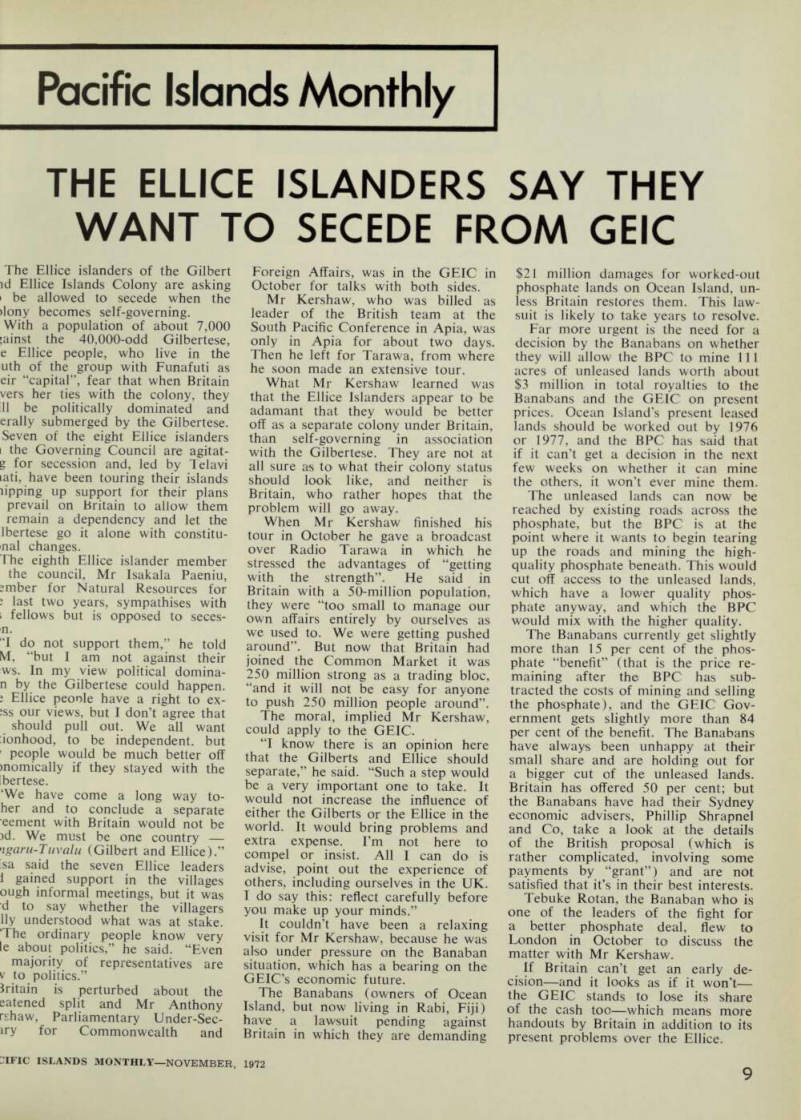
The Ellice Islanders Say They
Want To Secede From Geic
The Ellice islanders of the Gilbert id Ellice Islands Colony are asking • be allowed to secede when the >lony becomes self-governing.
With a population of about 7,000 ;ainst the 40,000-odd Gilbertese, e Ellice people, who live in the uth of the group with Funafuti as eir “capital”, fear that when Britain vers her ties with the colony, they 11 be politically dominated and erally submerged by the Gilbertese.
Seven of the eight Ellice islanders i the Governing Council are agitat g for secession and, led by Telavi lati, have been touring their islands lipping up support for their plans prevail on Britain to allow them remain a dependency and let the Ibertese go it alone with constitu nal changes.
The eighth Ellice islander member the council, Mr Isakala Paeniu, smber for Natural Resources for ; last two years, sympathises with i fellows but is opposed to seces n.
“I do not support them,” he told M, “but I am not against their ws. In my view political domina n by the Gilbertese could happen, j Ellice peonle have a right to ex ;ss our views, but I don’t agree that should pull out. We all want :ionhood, to be independent, but ' people would be much better off momically if they stayed with the Ibertese. ‘We have come a long way to iler and to conclude a separate •cement with Britain would not be )d. We must be one country ngaru-Tuvalu (Gilbert and Ellice).” :sa said the seven Ellice leaders 1 gained support in the villages ough informal meetings, but it was d to say whether the villagers lly understood what was at stake.
The ordinary people know very le about politics,” he said. “Even majority of representatives are v to politics.”
Britain is perturbed about the eatened split and Mr Anthony rshaw, Parliamentary Under-Sec iry for Commonwealth and
Foreign Affairs, was in the GEIC in October for talks with both sides.
Mr Kershaw, who was billed as leader of the British team at the South Pacific Conference in Apia, was only in Apia for about two days.
Then he left for Tarawa, from where he soon made an extensive tour.
What Mr Kershaw learned was that the Ellice Islanders appear to be adamant that they would be better off as a separate colony under Britain, than self-governing in association with the Gilbertese. They are not at all sure as to what their colony status should look like, and neither is Britain, who rather hopes that the problem will go away.
When Mr Kershaw finished his tour in October he gave a broadcast over Radio Tarawa in which he stressed the advantages of “getting with the strength”. He said in Britain with a 50-million population, they were “too small to manage our own affairs entirely by ourselves as we used to. We were getting pushed around”. But now that Britain had joined the Common Market it was 250 million strong as a trading bloc, “and it will not be easy for anyone to push 250 million people around”.
The moral, implied Mr Kershaw, could apply to the GEIC.
“I know there is an opinion here that the Gilberts and Ellice should separate,” he said. “Such a step would be a very important one to take. It would not increase the influence of either the Gilberts or the Ellice in the world. It would bring problems and extra expense. I’m not here to compel or insist. All I can do is advise, point out the experience of others, including ourselves in the UK.
I do say this: reflect carefully before you make up your minds.”
It couldn’t have been a relaxing visit for Mr Kershaw, because he was also under pressure on the Banaban situation, which has a bearing on the GEIC’s economic future.
The Banabans (owners of Ocean Island, but now living in Rabi, Fiji) have a lawsuit pending against Britain in which they are demanding
$2l million damages for worked-out phosphate lands on Ocean Island, un less Britain restores them. This law suit is likely to take years to resolve.
Far more urgent is the need for a decision by the Banabans on whether they will allow the BPC to mine 111 acres of unleased lands worth about $3 million in total royalties to the Banabans and the GEIC on present prices. Ocean Island’s present leased lands should be worked out by 1976 or 1977, and the BPC has said that if it can’t get a decision in the next few weeks on whether it can mine the others, it won’t ever mine them.
The unleased lands can now be reached by existing roads across the phosphate, but the BPC is at the point where it wants to begin tearing up the roads and mining the high quality phosphate beneath. This would cut off access to the unleased lands, which have a lower quality phos phate anyway, and which the BPC would mix with the higher quality.
The Banabans currently get slightly more than 15 per cent of the phos phate “benefit” (that is the price re maining after the BPC has sub tracted the costs of mining and selling the phosphate), and the GEIC Gov ernment gets slightly more than 84 per cent of the benefit. The Banabans have always been unhappy at their small share and are holding out for a bigger cut of the unleased lands.
Britain has offered 50 per cent; but the Banabans have had their Sydney economic advisers, Phillip Shrapnel and Co, take a look at the details of the British proposal (which is rather complicated, involving some payments by “grant”) and are not satisfied that it’s in their best interests.
Tebuke Rotan, the Banaban who is one of the leaders of the fight for a better phosphate deal, flew to London in October to discuss the matter with Mr Kershaw.
If Britain can’t get an early de cision—and it looks as if it won’t— the GEIC stands to lose its share of the cash too—which means more handouts by Britain in addition to its present problems over the Ellice.