Business and Development
pp. 103-106 · Read in the full issue
FIJI HAS THE LION'S SHARE OF THE
Neighbourhood's Business
Prom a Suva correspondent
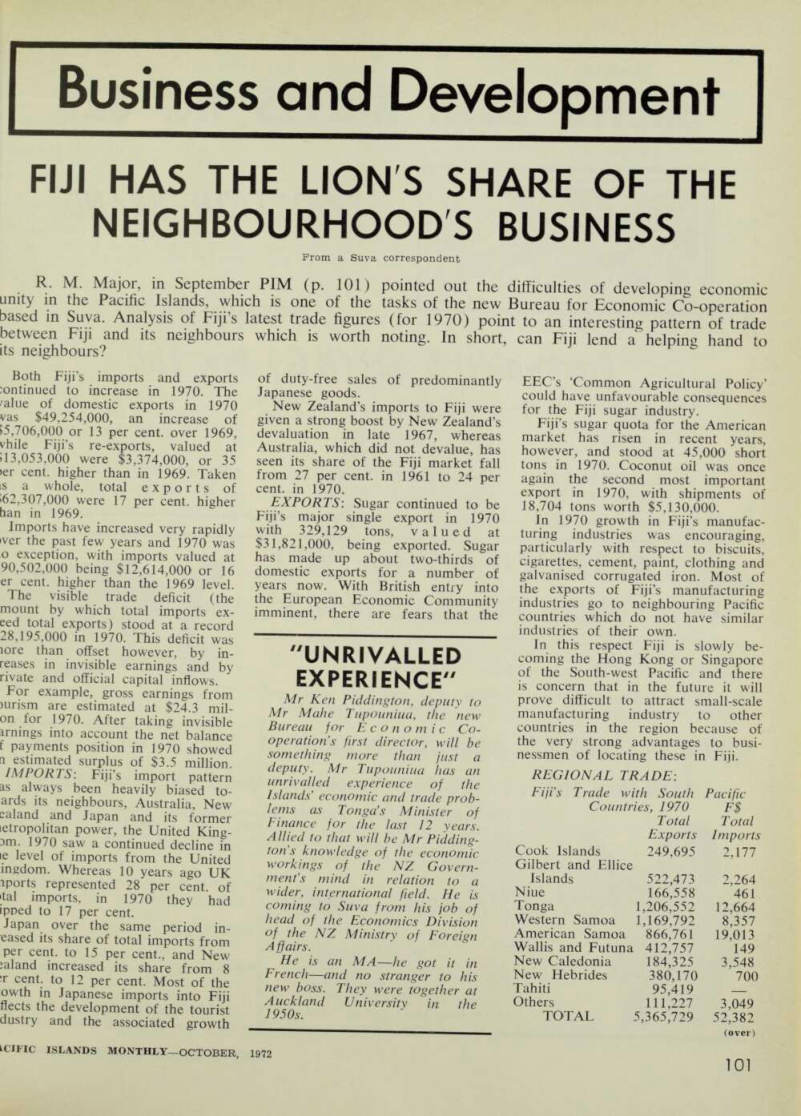
R. M. Major, in September PIM (p. 101) pointed out the difficulties of developing economic unity in the Pacific Islands, which is one of the tasks of the new Bureau for Economic Co-operation based in Suva. Analysis of Fiji’s latest trade figures (for 1970) point to an interesting pattern of trade between Fiji and its neighbours which is worth noting. In short, can Fiji lend a helping hand to its neighbours?
Both Fiji’s imports and exports continued to increase in 1970. The falue of domestic exports in 1970 vas $49,254,000, an increase of 55.706.000 or 13 per cent, over 1969, vhile Fiji’s re-exports, valued at :i3,053,000 were $3,374,000, or 35 >er cent, higher than in 1969. Taken is a whole, total exports of 162.307.000 were 17 per cent, higher ban in 1969.
Imports have increased very rapidly 'ver the past few years and 1970 was o exception, with imports valued at 90.502.000 being $12,614,000 or 16 er cent, higher than the 1969 level.
The visible trade deficit (the mount by which total imports ex eed total exports) stood at a record 28.195.000 in 1970. This deficit was lore than offset however, by in cases in invisible earnings and by rivate and official capital inflows.
For example, gross earnings from )urism are estimated at $24.3 mil on for 1970. After taking invisible arnings into account the net balance f payments position in 1970 showed n estimated surplus of $3.5 million.
IMPORTS: Fiji’s import pattern as always been heavily biased to ards its neighbours, Australia, New ealand and Japan and its former letropolitan power, the United King am. 1970 saw a continued decline in ie level of imports from the United ingdom. Whereas 10 years ago UK iports represented 28 per cent of *tal imports, in 1970 they had ipped to 17 per cent.
Japan over the same period in eased its share of total imports from per cent, to 15 per cent., and New ealand increased its share from 8 t cent, to 12 per cent. Most of the owth in Japanese imports into Fiji fleets the development of the tourist dustry and the associated growth
of duty-free sales of predominantly Japanese goods.
New Zealand’s imports to Fiji were given a strong boost by New Zealand’s devaluation in late 1967, whereas Australia, which did not devalue, has seen its share of the Fiji market fall from 27 per cent, in 1961 to 24 per cent, in 1970.
EXPORTS: Sugar continued to be Fiji’s major single export in 1970 with 329,129 tons, valued at $31,821,000, being exported. Sugar has made up about two-thirds of domestic exports for a number of years now. With British entry into the European Economic Community imminent, there are fears that the
EEC’s ‘Common Agricultural Policy’ could have unfavourable consequences for the Fiji sugar industry.
Fiji’s sugar quota for the American market has risen in recent years, however, and stood at 45,000 short tons in 1970. Coconut oil was once again the second most important export in 1970, with shipments of 18,704 tons worth $5,130,000.
In 1970 growth in Fiji’s manufac turing industries was encouraging, particularly with respect to biscuits, cigarettes, cement, paint, clothing and galvanised corrugated iron. Most of the exports of Fiji’s manufacturing industries go to neighbouring Pacific countries which do not have similar industries of their own.
In this respect Fiji is slowly be coming the Hong Kong or Singapore of the South-west Pacific and there is concern that in the future it will prove difficult to attract small-scale manufacturing industry to other countries in the region because of the very strong advantages to busi nessmen of locating these in Fiji.
(over)
Regional Trade ;
Fiji’s Trade with South Pacific Countries, 1970 F$ Total Total Exports Imports Cook Islands 249,695 2,177 Gilbert and Ellice Islands 522,473 2,264 Niue 166,558 461 Tonga 1,206,552 12,664 Western Samoa 1,169,792 8,357 American Samoa 866,761 19,013 Wallis and Futuna 412,757 149 New Caledonia 184,325 3,548 New Hebrides 380,170 700 Tahiti 95,419 Others 111,227 3,049
Total 5,365,729
52,382
In 1970 Fiji’s exports to countries in the SW Pacific region were worth $5,255,000 (representing 8.6 per cent, of total exports). By comparison, imports into Fiji from the same coun tries were worth a mere $52,000 (representing only 0.1 per cent, of total imports). Fiji is fortunate therefore in having a favourable trade balance of $5,200,000 with its regional neighbours.
A third of Fiji’s exports to the region ($1,794,000) are domestic ex ports while the other two-thirds ($3,461,000) are re-exports. The two main destinations of the domestic exports are Tonga and Western Samoa.
With Fiji’s exports to the region being a hundred times greater than its imports from the region it seems to be high time that Fiji took steps to encourage imports. Fiji can hardly complain about its adverse balance of trade with Australia while its near neighbours have an even greater ad verse balance of trade with Fiji.
Import duties on handicrafts enter ing Fiji and the harsh enforcement of quarantine regulations do little to encourage imports into Fiji from the region.
Perhaps we might see Fiji starting an aid programme to assist its less developed neighbours? Certainly if its buoyant foreign trade position is any thing to go by, it may well find itself doing this in the future.
Air Nauru to
return to consortium?
While the Pacific leaders were neeting in Suva and then in Apia, )ther —and maybe more important alks—were going on outside the main irena.
Member governments of the Air Pacific consortium were attempting to ure back to the fold their erstwhile jartners Air Nauru, which broke iway in March to fly it alone. The alks. President Hammer Deßoburt et drop, were at “ministerial level” md were aimed at persuading Nauru hat its future lay within a regional irline.
“I have been approached to go »ack and there are possibilities” said he president to PIM, “but the most can say is that I will listen very arefully to what they have to say.
Ve always think there is room for o-operation.”
Then, referring to the heated ex hanges during the February Can erra Forum which led to Nauru reaking away from the regional air rrangement, the president said: “The lash came because, I think, there /as unfriendliness. I think they found s inconvenient; that the existence of
Air Nauru was an inconvenience.”
The break, the president stressed, was not the beginning of a wider division. Any suggestion that Nauru wanted to draw closer to its Micro nesian relations at the expense of its other South Pacific ties (such as the SPC and Forum) was wrong.
“We are not turning away from the South Pacific,” he said. “We must make that quite clear. We feel we are part of both worlds. We have ties with Micronesia which will develop but we also have close ties with the South Pacific. We are part of the South Pacific whereas our relations with Micronesia are not firmly in existence yet.”
Japanese "wont
no control"
In Suva in September, the Japanese Ambassador to Australia, Mr Shizuo Saito, was most emphatic that Fiji need have no fears about foreign control by Japanese investors.
“It is not true that Japanese busi nessmen prefer to have the major shareholding when they invest in a country,” he stressed. “I know Fiji would welcome Japanese investment —and we have no idea of going any further than a 50 per cent, share holding in any venture.”
Mr Saito said so far as Japanese
investment in Fiji was concerned, tourism had first priority. A consor tium of Japanese companies had already bought a major share in the Mana Island resort and the massive real estate company, Nomura Real Estate Cos., of Tokyo, had bought $300,000 worth of sites at the Pacific Harbour resort development, for re sale to Japanese investors. Other areas for Japanese involvement in tourism were being considered.
Mr Saito said it was possible that Japan Air Lines would eventually fly into Fiji—“but there was nothing concrete yet.” He doubted whether the airline had yet approached the Japanese Government on the question.
“My government sent a three-man team to Fiji for a feasibility study on investment opportunities here and areas of possible co-operation. The conclusions will be made known soon,” he said.
Mr Saito mentioned agriculture and fishery as two other areas for co operation. There might be some pos sibility of lessening the trade im balance between the two countries— but he couldn’t be more specific at this stage.
He saw no possibility yet of estab lishing assembly plants in Fiji for Japanese electronic goods—“but this might develop”. The exchange of students and technicians was being considered.
Mr Saito said that in addition to economic and trade co-operation be tween Fiji and Japan, he would like to see closer cultural links, and would be asking Japanese cultural missions to visit Fiji, “in a spirit of enlighten ment”.
Mr Saito said he could not foresee the development of a Pacific free trade area involving Asia and the South Pacific in the immediate future.
Economic development in each coun try was so different that such a bloc could not be maintained. “We have to have this idea as a target but it is too hard a practical problem to solve at present,” he said.