English
pp. 100-101 · Read in the full issue
The Inn Thing
Take an English pub tour
Shropshire is a slice of medieval England. The lonely splendour of its sheep-dotted hills is interrupted sparsely by venerable villages and towns where black-and-white timber framed houses date back to Tudor times and beyond.
It is as if history had been absent minded and left something behind.
Among its oldest and best preserved buildings are its inns—so what better area for a pub tour than the hills and valleys of Shropshire?
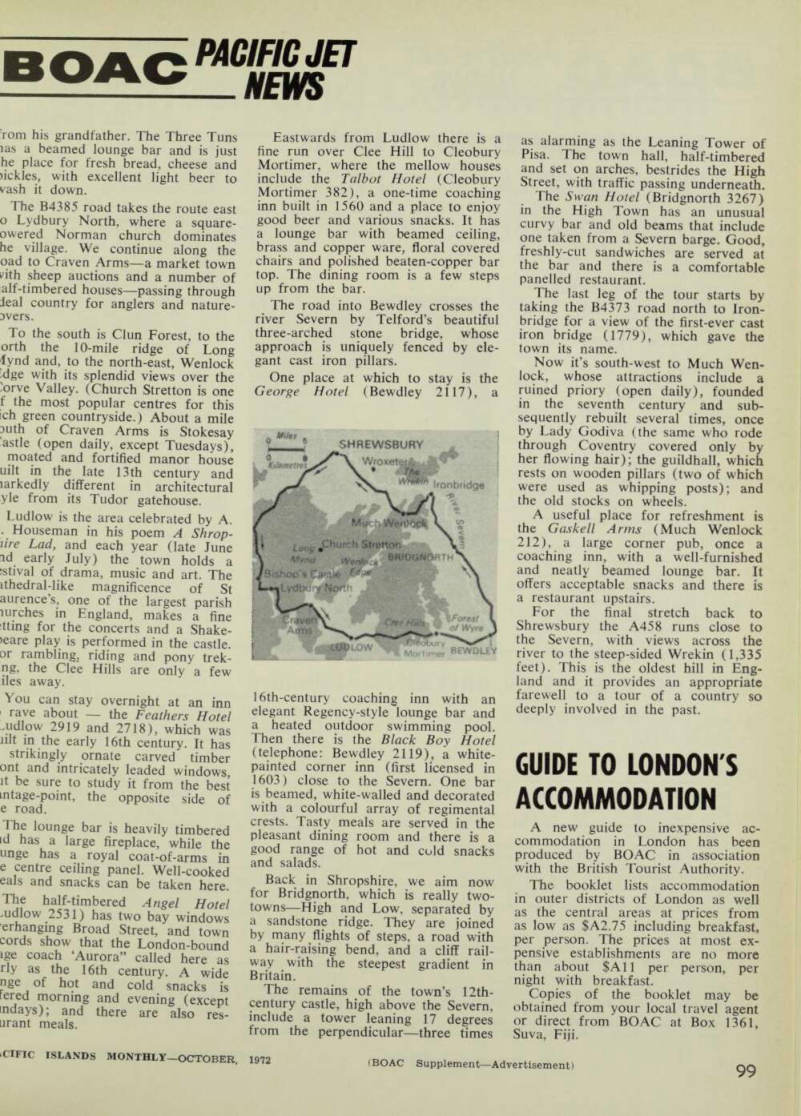
In this suggested tour of Shrop shire, the route begins and ends at the country capital, Shrewsbury (pronounced “Shrozebury”), and for most of the way it keeps west of the river Severn.
Few towns can match Shrewsbury in the well-kept charm of its black and-white houses and the narrow streets with odd names such as Butcher Row, Grope Lane, Wyle Cop, Dogpole and Fish Street.
Among the many beautiful houses are Ireland’s Mansion, a four-gabled Elizabethan masterpiece with oriel windows, and the 17th-century Rowley’s House, which contains ex hibits excavated from the nearby Roman town of Viroconium (now Wroxeter).
The Norman castle was refurbished as a private house in 1790 by Thomas Telford, the famous engineer and architect, while one of the pupils at the original Shrewsbury School (now the town’s museum and art gallery) was the 19th-century naturalist Charles Darwin.
The spire of St Mary’s Church (built about 1200) is one of the highest in the country; and standing above the river Severn, which winds
round the town in a horseshoe loop, is St Chad’s, a round church whose minaret-shaped tower is crowned with a dome. The beautiful park known as the Quarry is the setting of the Shrewsbury Musical and Floral Fete, which is held annually in August.
It is not surprising that Shrewsbury has a number of interesting pubs also.
Right in the centre of the town is the King’s Head, built in 1480 with in tricate timbering and overhanging eaves, where good snacks are served at lunchtime.
A gem of a pub is Ye Olde York shire Arms, which dates from 1679 and all the original beams, as well! as some beautiful ship’s panelling, ar© still there. The enthusiastic landlord) and his friendly staff offer fresh baps< and rolls with a wide choice ot< fillings.
For an overnight stay there is th©' Lion Hotel (telephone: Shrewsbury 53107), a 16th-century inn situated) in Wyle Cop. Once 17 stagecoaches ran from here and it had stabling fort 100 horses. There is a richly panelle6 bar with Wedgwood blue cornice: work and, in addition to the restaun ant fare, there is an appetising range; of hot and cold snacks.
Another place to stay is the Prince: Rupert Hotel (Shrewsbury 52461), s 15th-century inn half-timbered out! side, but now much renovated insides which is named after the dashing/ Cavalier general of the 17th-century* Civil War.
From Shrewsbury we drive southri west (A 488) through some of Shropq shire’s wildest and loneliest side, with the Stiperstones and Lonjr Mynd hills rising over 1,000 feet one either side.
A run of 20 miles brings us to th/r quaint town of Bishop’s Castle. AL that is left of the 13th-century castlJ: is a wall skirting the bowling greem but still standing is a Tudor house aptly named the House on Crutches: Look out for the 17th-century Thres Tuns Inn (Bishop’s Castle 289), onn of only six pubs in the country which brews its own beer —and perhaps thd only one which brews both mild an»n bitter.
The brewery is at the back of thd pub, and owner-landlord Mr Roberth carries on a tradition handed dowiv
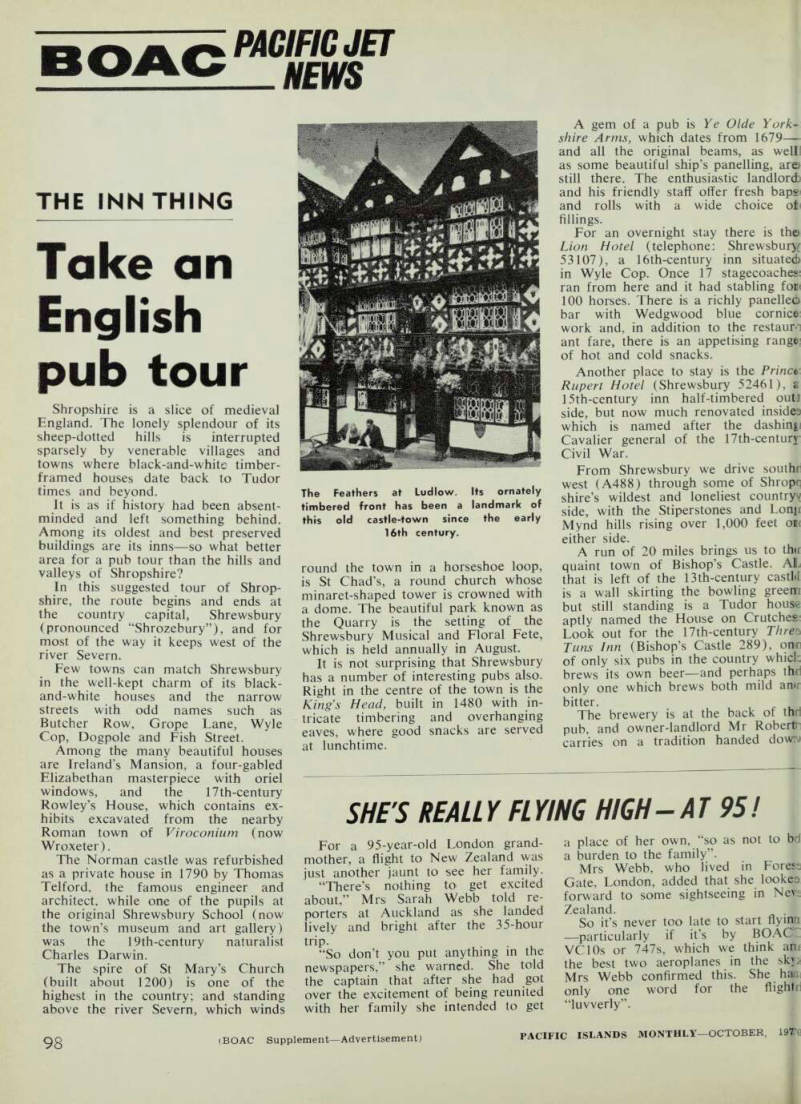
The Feathers at Ludlow. Its ornately timbered front has been a landmark of this old castle-town since the early 16th century.
fom his grandfather. The Three Tuns las a beamed lounge bar and is just he place for fresh bread, cheese and fickles, with excellent light beer to vash it down.
The 84385 road takes the route east o Lydbury North, where a square owered Norman church dominates he village. We continue along the oad to Craven Arms—a market town idth sheep auctions and a number of alf-timbered houses—passing through leal country for anglers and nature- Dvers.
To the south is Clun Forest, to the orth the 10-mile ridge of Long lynd and, to the north-east, Wenlock 'dge with its splendid views over the '°rve Valley. (Church Stretton is one f the most popular centres for this ich green countryside.) About a mile puth of Craven Arms is Stokesay astle (open daily, except Tuesdays), moated and fortified manor house uilt in the late 13 th century and larkedly different in architectural yle from its Tudor gatehouse.
Ludlow is the area celebrated by A. • Houseman in his poem A Shrop ure Lad, and each year (late June id early July) the town holds a :stival of drama, music and art. The ithedral-like magnificence of St aurence’s, one of the largest parish lurches in England, makes a fine ttmg for the concerts and a Shake >eare play is performed in the castle, or rambling, riding and pony trek ng, the Clee Hills are only a few iles away.
You can stay overnight at an inn rave about the Feathers Hotel .udlow 2919 and 2718), which was ult in the early 16th century. It has strikingly ornate carved timber ont and intricately leaded windows, it be sure to study it from the best mtage-point, the opposite side of e road.
The lounge bar is heavily timbered id has a large fireplace, while the unge has a royal coat-of-arms in e centre ceiling panel. Well-cooked eals and snacks can be taken here.
The half-timbered Angel Hotel mdlow 2531) has two bay windows erhangmg Broad Street, and town cords show that the London-bound ige coach ‘Aurora” called here as rly as the 16th century. A wide hot and cold snacks is tered morning and evening (except indays); and there are also res arant meals.
Eastwards from Ludlow there is a fine run over Clee Hill to Cleobury Mortimer, where the mellow houses include the Talbot Hotel (Cleobury Mortimer 382), a one-time coaching inn built in 1560 and a place to enjoy good beer and various snacks. It has a lounge bar with beamed ceiling, brass and copper ware, floral covered chairs and polished beaten-copper bar top. The dining room is a few steps up from the bar.
The road into Bewdley crosses the river Severn by Telford’s beautiful three-arched stone bridge, whose approach is uniquely fenced by ele gant cast iron pillars.
One place at which to stay is the George Hotel (Bewdley 2117), a
16th-century coaching inn with an elegant Regency-style lounge bar and a heated outdoor swimming pool.
Then there is the Black Boy Hotel (telephone: Bewdley 2119), a white painted corner inn (first licensed in 1603) close to the Severn. One bar is beamed, white-walled and decorated with a colourful array of regimental crests. Tasty meals are served in the pleasant dining room and there is a good range of hot and cold snacks and salads.
Back in Shropshire, we aim now for Bridgnorth, which is really two towns —High and Low, separated by a sandstone ridge. They are joined by many flights of steps, a road with a hair-raising bend, and a cliff rail way with the steepest gradient in Britain.
The remains of the town’s 12th century castle, high above the Severn, include a tower leaning 17 degrees from the perpendicular—three times
as alarming as the Leaning Tower of Pisa. The town hall, half-timbered and set on arches, bestrides the High Street, with traffic passing underneath.
The Swan Hotel (Bridgnorth 3267) in the High Town has an unusual curvy bar and old beams that include one taken from a Severn barge. Good, freshly-cut sandwiches are served at the bar and there is a comfortable panelled restaurant.
The last leg of the tour starts by taking the 84373 road north to Iron bridge for a view of the first-ever cast iron bridge (1779), which gave the town its name.
Now it’s south-west to Much Wen lock, whose attractions include a ruined priory (open daily), founded in the seventh century and sub sequently rebuilt several times, once by Lady Godiva (the same who rode through Coventry covered only by her flowing hair); the guildhall, which rests on wooden pillars (two of which were used as whipping posts); and the old stocks on wheels.
A useful place for refreshment is the Gaskell Arms (Much Wenlock 212), a large corner pub, once a coaching inn, with a well-furnished and neatly beamed lounge bar. It offers acceptable snacks and there is a restaurant upstairs.
For the final stretch back to Shrewsbury the A 458 runs close to the Severn, with views across the river to the steep-sided Wrekin (1,335 feet). This is the oldest hill in Eng land and it provides an appropriate farewell to a tour of a country so deeply involved in the past.
Guide To London's
Accommodation
A new guide to inexpensive ac commodation in London has been produced by BO AC in association with the British Tourist Authority.
The booklet lists accommodation in outer districts of London as well as the central areas at prices from as low as $A2.75 including breakfast, per person. The prices at most ex pensive establishments are no more than about SAII per person, per night with breakfast.
Copies of the booklet may be obtained from your local travel agent or direct from BOAC at Box 1361, Suva, Fiji.