Yesterday
p. 77 · Read in the full issue
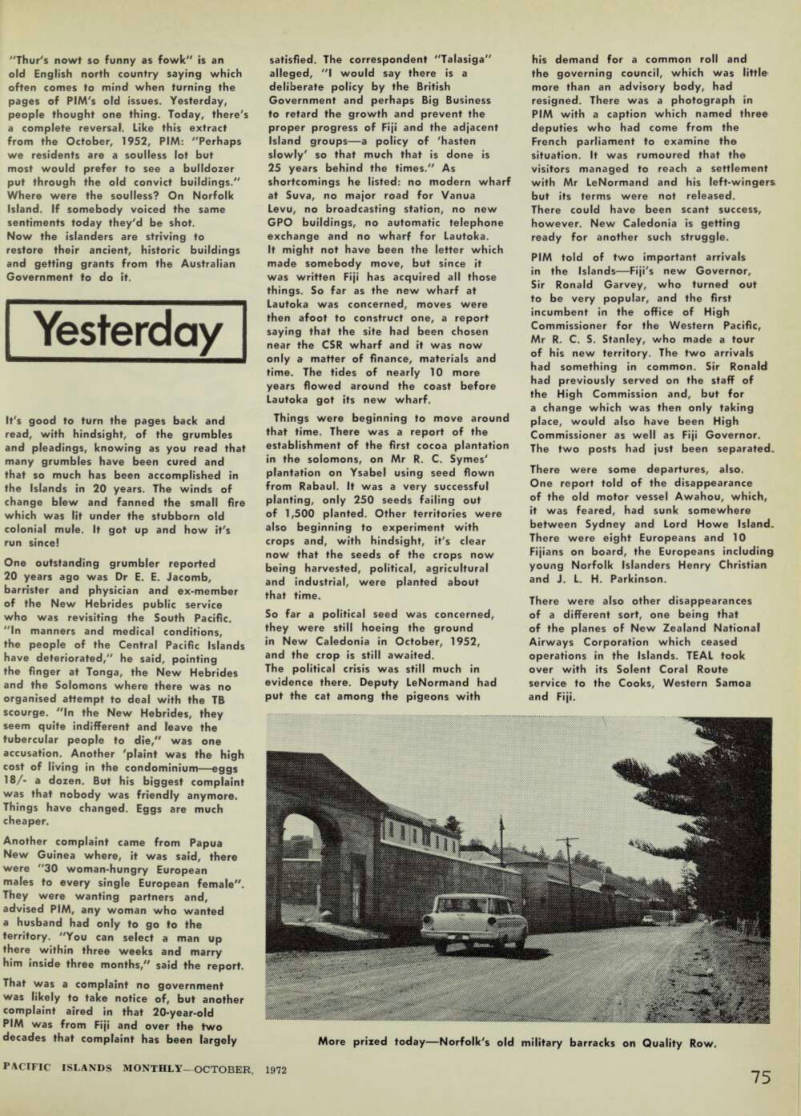
"Thor's nowt so funny as fowk" is an old English north country saying which often comes to mind when turning the pages of PlM's old issues. Yesterday, people thought one thing. Today, there's a complete reversal. Like this extract from the October, 1952, PIM: "Perhaps we residents are a soulless lot but most would prefer to see a bulldozer put through the old convict buildings."
Where were the soulless? On Norfolk Island. If somebody voiced the same sentiments today they'd be shot.
Now the islanders are striving to restore their ancient, historic buildings and getting grants from the Australian Government to do it.
It's good to turn the pages back and read, with hindsight, of the grumbles and pleadings, knowing as you read that many grumbles have been cured and that so much has been accomplished in the Islands in 20 years. The winds of change blew and fanned the small fire which was lit under the stubborn old colonial mule. It got up and how it's run since!
One outstanding grumbler reported 20 years ago was Dr E. E. Jacomb, barrister and physician and ex-member of the New Hebrides public service who was revisiting the South Pacific.
"In manners and medical conditions, the people of the Central Pacific Islands have deteriorated," he said, pointing the finger at Tonga, the New Hebrides and the Solomons where there was no organised attempt to deal with the TB scourge. "In the New Hebrides, they seem quite indifferent and leave the tubercular people to die," was one accusation. Another 'plaint was the high cost of living in the condominium—eggs 18/- a dozen. But his biggest complaint was that nobody was friendly anymore.
Things have changed. Eggs are much cheaper.
Another complaint came from Papua New Guinea where, it was said, there were "30 woman-hungry European males to every single European female".
They were wanting partners and, advised PIM, any woman who wanted a husband had only to go to the territory. "You can select a man up there within three weeks and marry him inside three months," said the report.
That was a complaint no government was likely to take notice of, but another complaint aired in that 20-year-old PIM was from Fiji and over the two decades that complaint has been largely
satisfied. The correspondent "Talasiga" alleged, "I would say there is a deliberate policy by the British Government and perhaps Big Business to retard the growth and prevent the proper progress of Fiji and the adjacent Island groups —a policy of 'hasten slowly' so that much that is done is 25 years behind the times." As shortcomings he listed: no modern wharf at Suva, no major road for Vanua Levu, no broadcasting station, no new GPO buildings, no automatic telephone exchange and no wharf for Lautoka.
It might not have been the letter which made somebody move, but since it was written Fiji has acquired all those things. So far as the new wharf at Lautoka was concerned, moves were then afoot to construct one, a report saying that the site had been chosen near the CSR wharf and it was now only a matter of finance, materials and time. The tides of nearly 10 more years flowed around the coast before Lautoka got its new wharf.
Things were beginning to move around that time. There was a report of the establishment of the first cocoa plantation in the solomons, on Mr R. C. Symes' plantation on Ysabel using seed flown from Rabaul. It was a very successful planting, only 250 seeds failing out of 1,500 planted. Other territories were also beginning to experiment with crops and, with hindsight, it's clear now that the seeds of the crops now being harvested, political, agricultural and industrial, were planted about that time.
So far a political seed was concerned, they were still hoeing the ground in New Caledonia in October, 1952, and the crop is still awaited.
The political crisis was still much in evidence there. Deputy LeNormand had put the cat among the pigeons with
his demand for a common roll and the governing council, which was little more than an advisory body, had resigned. There was a photograph in PIM with a caption which named three deputies who had come from the French parliament to examine the situation. It was rumoured that the visitors managed to reach a settlement with Mr LeNormand and his left-wingers but its terms were not released.
There could have been scant success, however. New Caledonia is getting ready for another such struggle.
PIM told of two important arrivals in the Islands—Fiji's new Governor, Sir Ronald Garvey, who turned out to be very popular, and the first incumbent in the office of High Commissioner for the Western Pacific, Mr R. C. S. Stanley, who made a tour of his new territory. The two arrivals had something in common. Sir Ronald had previously served on the staff of the High Commission and, but for a change which was then only taking place, would also have been High Commissioner as well as Fiji Governor.
The two posts had just been separated.
There were some departures, also.
One report told of the disappearance of the old motor vessel Awahou, which, it was feared, had sunk somewhere between Sydney and Lord Howe Island.
There were eight Europeans and 10 Fijians on board, the Europeans including young Norfolk Islanders Henry Christian and J. L. H. Parkinson.
There were also other disappearances of a different sort, one being that of the planes of New Zealand National Airways Corporation which ceased operations in the Islands. TEAL took over with its Solent Coral Route service to the Cooks, Western Samoa and Fiji.
More prized today—Norfolk's old military barracks on Quality Row,