Magazine Section
pp. 71-75 · Read in the full issue
A Not-So-Modest Member Of A Past
Cook Islands Parliament
By W. H. Percival
f f th f*i mOS B colourful characters to settle in Rarotonga in S 0 ®* Is S nd f. m the c 9th cent^ry HiSnchi Mortimer Salmon who, , . m f his 37 years residence, elevated of an™ ,nfl ader t- i ag t?V 0 hus : ofairmL nf >£»£!! , ch ' ef f? s and Chairman of the Federal Parliament. have bestowed a rwi P f h T e i Wh f n ih^ arlian ?^ t ’ hut alfpf “ h d the aa h ties .°f a P r ok i*? !? an a: he 18 chiefly thnitinn* 5?°?? 1 n d T e y el ° p Fp!i C 11on of the Cook Islands * o , thp°^ a n^n e rt S f a xh that S j| mon f+ was sea J h 8 t Du nnett, a Sf P . ta i n of Ramsgate, England, L Tv?!* ent . m ® st , °f h!s youth n 1874 an< tu aTr u m Ra J? ton g, a “an nc^nt hC nf Ch tVT^ ner ' nX enus ’ p 8 J agei V the well-known Papeete merchant, John Brander. r' RamtonL th fnM tI IS \S 0I S U m Salmon an 4 uv ha ? known pfthTr a and that he T believed T he was either an Aberdeen Jew or a London
Jew. Eric Exham, then in his seventies, had known Salmon when he lived in Arorangi village and described him as a clean-shaven, balding man who walked with a pron °u n , ced stoop in his latter years.
Salmon arrived in Rarotonga as a good-looking man in his mid-twenties.
The island was ruled by the high chiefess Makea Takau Ariki, who was supported by the British Governrocnt and was probably advised by the resident missionaries of the Jr° nd ? n Missionary Society. She was fiercely jealous of her royal prerogatlves and quick to punish those who attempted to question them.
John Salmon met and fell in love with Mereana, a member of Arorangi’s chiefly Tinomana family.
Mereana was a pretty girl with long black ha,r ’ lar S e soft br own eyes, and a complexion little darker than a southern Italian’s. She was also the favourite niece of Queen Makea.
T Mereana was strongly attracted to I° hn Salmon and they asked the Rev.
James Chalmers of the LMS to marry them. Chalmers refused, be-
lieving that nothing but trouble could come from such a match Makea Ariki would not hear of the marriage, and the Arorangi people resented the idea of a foreigner marrying in o their high chiefs family and thus gaining a measure of control over their affairs.
Still determined to marry Mereana, Salmon realised that he’d have to wait. They met often in secret, aided by Mereana’s close friend, Pokoina, a girl about her own age.
Salmon saw his opportunity when one of Brander’s schooners, “Hum bolt”, called at Avarua in 1874 to load a cargo of cotton. The master, Captain Harris, was a friend of his and he agreed to help.
Salmon and Mereana launched a canoe at night and took a supply of palm frond torches with them so that observers would think they were going fishing.
The schooner “Coronet”, com manded by Captain Rose, was also in harbour and Rose was also against the marriage, but they passed the vessel without being detected and
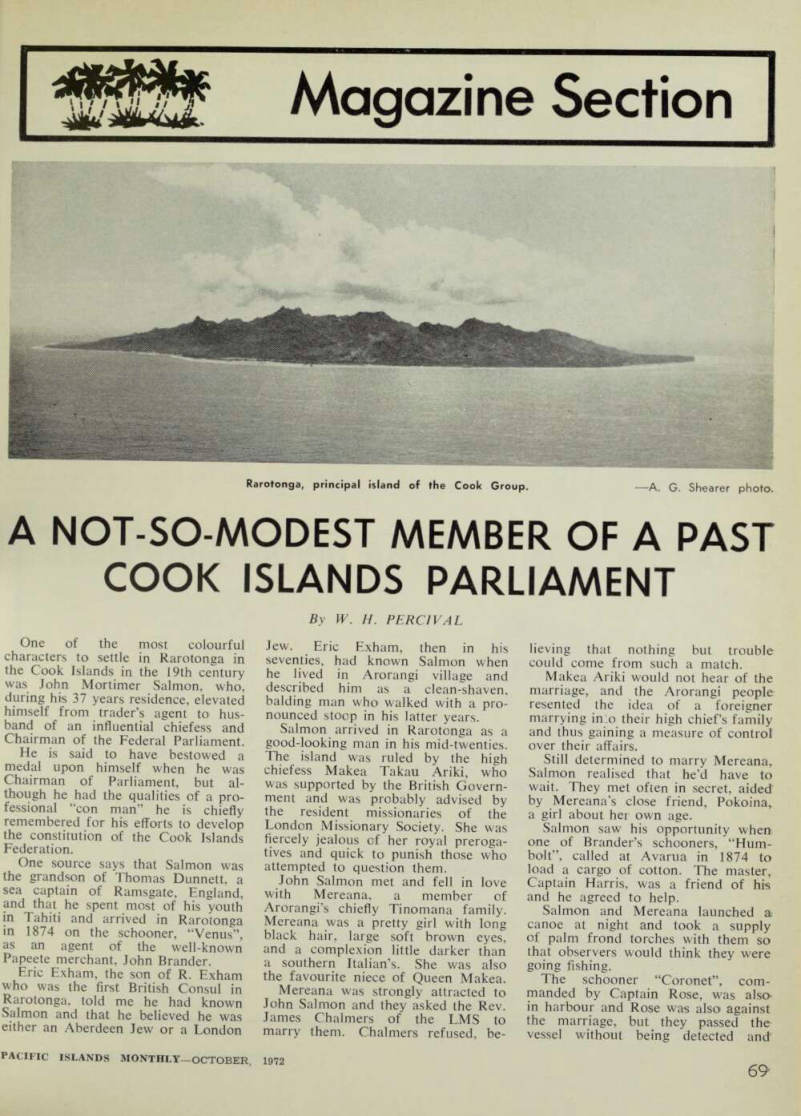
Rarotonga, principal island of the Cook Group.
—A. G. Shearer photo.
Elopement Falls But Marriage Follows
reached the “Humbolt” which sailed for Mangaia immediately.
The elopement was discovered the following day and a furious Makea sent men off in the “Coronet” to bring the lovers back. The two schooners reached Mangaia about the same time and a boatload of men was sent over to the “Humbolt”.
“I’ll shoot any man who attempts to board my vessel,” Captain Harris warned them grimly.
But Captain Rose had an answer to that. The “Humbolt’s” cotton cargo was still lying on Avarua wharf, and the “Coronet” was the faster of the two vessels. Rose said that if Mereana was not handed over he would return to Rarotonga and burn the cotton. Knowing that Rose would carry out his threat, Harris and Salmon had to give in, and the two schooners returned to Rarotonga.
For some months after this Salmon lived in various islands including Raiatea, Flint and Mauke. He re ceived occasional letters from Mereana and sent replies by friendly schooner captains. Then he learnt that Makea was no longer opposed
to the marriage and returned to Rarotonga on the small schooner, “Atalanta”, in 1875.
Makea was away in Atiu Island visiting her consort, Ngamaru Ariki.
She sent the “Venus” from Atiu with orders to bring John Salmon and Mereana to Atiu where they would be married. Chalmers was still set against the match.
But the Rarotongans refused to let John Salmon leave. He pretended to give in to them but had himself smuggled on board hidden in a pile of mats. The vessel was searched by the suspicious islanders but Salmon was not discovered.
Still suspicious, the Rarotongans followed the “Venus” in their own schooner, “Ngamaru Ariki”, but when they arrived at Atiu Makea ordered them to leave. This they did and John Salmon and Mereana finally became man and wife.
For several years Salmon managed Brander’s store at Avatiu, a settle ment on Rarotonga’s northern coast with a small harbour used by local and overseas vessels. Then, in 1888, one of Mereana’s uncles died and she
inherited the title of Tinomana Ariki.
John Salmon had still not been accepted by the Arorangi people who described him as “the fifth wheel of the carriage”, but he used his wife’s influence to finally get one of his ideas across. This was for them to buy their own vessel and use it for trading between the Cook Islands, other island groups and New Zealand.
There were about 80 shareholders, Mereana among them. Through his contacts in Tahiti, Salmon bought a schooner of about 80 tons, “Poe”, for £405. She was a fast vessel with beautiful lines, built as a yacht by Mr Ben Chapman of Tahiti. The “Poe” arrived in Rarotonga in December, 1891, was careened on the beach, caulked and made ready for sea. She had two masts and an “iron keel”.
Salmon renamed the vessel “City of Arorangi”. The name was painted in bold letters on bow and stern, although Arorangi was no more than a village, as it is still. He began to fancy himself as a sea captain and practised navigation, taking sights on land, and having himself examined and passed as a capable navigator by local schooner skippers Harris and Emil Piltz. Then he made his first and only voyage as a ship’s
master, a voyage that almost ended in complete disaster.
He embarked 48 passengers, eight of whom were children, for a voyage to the southern Cook Islands of Mitiaro, Mauke and Mangaia. The crew consisted of a mate, supercargo, a cook and four seamen.
One informant said that soon after John Salmon went on board he became violently seasick and thereafter spent a great deal of his time in his bunk. Another informant who had also known John Salmon when he was an old man, said that on this voyage the schooner lacked a chronometer and no local charts were on board.
Providentially, the cargo included 12 pigs, six of which belonged to Mereana, and four ducks. There were also the normal ship’s stores.
The Polynesian voyagers travelled deck, taking enough food to last them for the anticipated two-day voyage. There was also a plentiful supply of drinking water, carried in Casks ' Skipper John Salmon maintained strict discipline. Every evening all hands were mustered for a religious atC'n C d e: after en he th had h e a 1 <h S 'd a th *l° attend alter he had lashed the wheel. !k° vetches were kept because
S^p^^^c^f^^^h^CoPk^s^anH 11
and Salmon followed Sfnll! i
board hk fhin Thf rlnit f.u
(maim nroit results ° f able 1 P d eat sea were P redict ’ * Un the fourth day, two days after
they should have made their first landfall, somebody dared to ask the seasick captain where they were. John Salmon, who didn’t know either, tried to bluff it °ut.
“I believe that my sextant is unreliable. It doesn’t read the same here as it did in Rarotonga. And I was 80 busy on the second night out thut I forgot to wind my watch,” he is reported to have said. He told them that they would reach land by following the seabirds which returned to nearby land at dusk. And from then on they followed the birds.
The air grew colder as they proceeded further south. The food gave out a nd the ducks were killed and eaten with the ship’s rice. By the eud of the second week two of the P*B S had been eaten and two more were killed a few days later.
There was angry and mutinous talk among the shivering islanders and Salmon, sick at heart as well as physically, had to reverse his course.
Three weeks and four days after their departure from Rarotonga, they sighted land. By a freak of fate it proved to be Rarotonga. fi The lt news s Pr ea d faster than a bush fire. It was decided at indignation meetings that John Salmon would no longer addressed as “ captain ”- The schooner was renamed “Maungaroa ”’ by which name she is commonl V remembered today. The Banks’
Diaries show that the “Maungaroa” was used as an interisland trader in the Cooks, also making calls at
Auckland, Tahiti, Niue and Rurutu between 1891 and 1903, and that sometimes she was chartered by the Cook Islands Trading Company, John Salmon and Tinomana Mere u^ a continued to live in Arorangi village. They adopted a son of Tahitian-Chinese parentage, named Taripo Ah Foo, who arrived in Raro tonga from Tahiti in 1895 at about the age of 20. Taripo later owned ai *d operated a store and bakery at Avatiu.
When I interviewed him several years ago, old Taripo was aged about 90 > but was still mentally alert, with go< ? d sight and hearing. When he ?J r l ved J- n , said Taripo, i^ akea , T ? kau was the ruling Queen of Rarotonga, Rev. Hutchms as T resident missionary, and J -. Moss was the British Resident replaced by Resident ►mmissionerj. a time Tan P° hyed with a oMhe A^a™?dttric'fca'lled Maraj l st orVand bakery nextdoor to^on^d
Cook w£S!
branch at Avatiu Not lons after completing his business premises and residence a hurricane destroyed the lot He married Tauvira of the Uriarau family, by whom he had five children, and some of their descen dants are well known in Rarotonga today. * About 1898 John Salmon conceived the idea of using the limes that grew prolifically on his wife’s land to start
Watered Lime Juke Disaster
a lime juice industry. He talked Mereana into the idea and sent a sample cask of Rarotonga lime juice to San Francisco. He received a highly satisfactory report on the pro duct and a substantial order for more.
He plunged into his new project with enthusiasm and by July, 1898, he was being described in Rarotonga’s only newspaper, “loi Karanga”, as “J. M. Salmon Lime juice manu facturer and Manufacturer’s Agent”.
By this time he had also become the “Chairman of the Cook Islands Parliament”.
An editorial in the March 17, 1900, issue of “loi Karanga”, owned and printed by Oscar Owen, said: “The lime juice trade is being boosted of late and several new machine presses are coming in. The old system was to tread limes out with bare feet in canoes, etc. CITC (Cook Islands Trading Company) has recently made a contract to take the total output of machine-made lime juice from Arorangi—possibly 75 per cent, of the total produced in Rarotonga . . . under the personal supervision of Mr J. M. Salmon, and the limes are the property of his wife.”
Salmon wrote to a large carriage company in California saying that he had been “instructed by Her Majesty, Queen Tinomana, to request that 11 buggies be forwarded to her through the Rarotonga branch of Donald and Edenborough”. He stipulated that the invoices be sent with the buggies and that the invoices would be sent to the firm’s head office in Auckland, where they would be paid.
In due course, the carriages arrived and were assembled in Rarotonga, and one each was presented to the leading chiefs of the island. The buggies were the latest models, two seaters with rubber-tyred wheels, candle-burning side lanterns and lace curtains.
However, Salmon’s newly - won prosperity came to a sudden end when his Californian clients dis covered that many of the casks of supposed lime juice contained nothing but salt water.
Donald and Edenborough had to pay for the carriages, nearly £7OO worth—and they never succeeded in recovering the money from Salmon.
Tinomana Mereana seems to have been a devoted wife, for she con tinued to live with Salmon for the
remainder of her life, in Arorangi village.
Charles Wells Banks, a contempo rary of Salmon, who lived in Raro tonga after reputedly stealing more than $20,000 from the Wells, Fargo Company in the United States (PIM, Feb., 1971, p. 71), made a few references to Salmon in a diary he kept.
On September 23, 1900, Banks wrote that he was “surprised at Salmon’s debts to natives”. On November 11, 1903, he noted that Tinomana and Salmon visited the “store and spent about £1 in after noon”. (This would have been Donald and Edenborough’s store at Avatiu where Banks was employed as accountant.) Salmon is also mentioned in “Rt.
Hon. R. J. Seddon’s Visit to the South Sea Islands” (Wellington, 1900). It is there stated that Seddon’s party passed some “long well-kept streets (in Arorangi) on which pleasant homes abutted” until they came to “the residence of Mr.
Salmon, Speaker of the local Parlia ment, and . . . Tinomana, the high born lady who had assisted to receive us at the levee the day before”.
“The large house,” the account continues, “is well furnished in the European style, and in one of the rooms stands an organ on which Mr Salmon played selections of music for us in a finished and masterly manner.”
As he grew older, Salmon’s hair receded and he used reading glasses.
He usually wore a locally-made pan danus hat, jacket and long trousers.
When Tinomana died on September 2, 1908, her relatives hustled Salmon out of the Arorangi ‘palace’ and took away his lands. But they allowed him to live in a small house he had built opposite the ‘palace’.
By this time he was a bent old man, but his knowledge of the Cook Islands Maori language enabled him to eke out a miserable existence as a Gov ernment interpreter.
The bitter blow of Mereana’s death had robbed him of all will to live and he followed her to the grave two or three years later.
Those who knew Salmon during his later years said he was about 70 when he died and “looked half starved, just a bag of skin and bones”.
His grave was obliterated when the site was made into a playground for Arorangi School.