Islands
pp. 55-57 · Read in the full issue


Growing
Pains Of
Cities
From Seona Martin,
in Suva
The growth of cities has almost always brought deprivation and suffer ing to some, while it has brought comfort and ease to others, both, if you look at it disinterestedly, as almost accidental results of the move ment towards development of a country. Two centres of population in PIM territory, Suva and Port Moresby, are currently hearing about Jieir particular problems of poverty caused by their rapid expansion.
In Suva a compassionate pro gramme of home building for those m the fringe, culturally and physic illy, has been launched, and in Port Moresby, the plight of those struggling 0 live on the minimum wage of $8 1 week has been highlighted in vidence before a wage inquiry (see tory p. 55).
A little grass hut beneath a waving aim looks pretty on a travel rochure. There is nothing wrong dth most of them in reality either, is many Fijians will say, living is leasant in a well-constructed bure dth a thriving vegetable garden earby and probably a school not too it away for the children.
Behind these picturesque scenes ide Fiji s major problems, poverty pd poor housing. The average isitor, or resident for that matter, is nlikely to see the scores of shack wellers who are multiplying around iji’s main urban areas. They are cing pushed further and further out ito the bush, out of sight and sually out of mind.
But recently they were being :membered through a campaign lunched by Hart (Housing Assistance id Relief Trust), an organisation jonsored by the Fiji Council of hurches to build low-cost housing )r the destitute and needy.
With $50,000, the price of a luxury Suva home, Hart could build up to 50 houses for about 300 people.
With $26,000 a Hart appeal raised in 1970, 26 houses have already been built. More are urgently needed.
Just how urgently is described by an Anglican nurse-evangelist, Sister Betty Slader, who has worked for many years among the desperately poor and needy. She said more and more land was being required for blocks of flats and luxurious houses with acres of flower gardens.
Housing units for low wage earners were mushrooming, but they were unavailable to those who earned nothing, or subsisted on charity rations and government family relief of a few dollars a month. These people had to pull up the shacks and shelters which served as homes to make way for the new buildings.
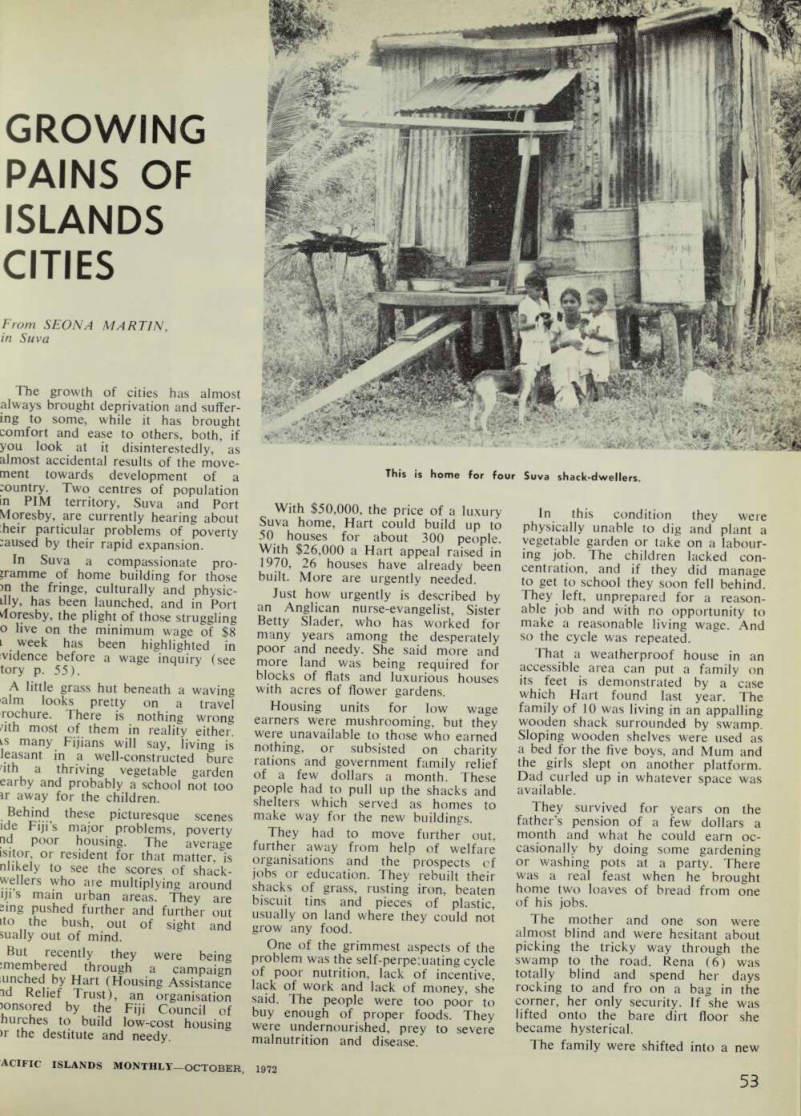
They had to move further out, further away from help of welfare organisations and the prospects of jobs or education. They rebuilt their shacks of grass, rusting iron, beaten biscuit tins and pieces of plastic, usually on land where they could not grow any food.
One of the grimmest aspects of the problem was the self-perpe:uating cycle of poor nutrition, lack of incentive, lack of work and lack of money, she said. The people were too poor to buy enough of proper foods. They were undernourished, prey to severe malnutrition and disease.
In this condition they were physically unable to dig and plant a vegetable garden or take on a labour ing job. The children lacked con centration, and if they did manage to get to school they soon fell behind.
They left, unprepared for a reason able job and with no opportunity to make a reasonable living wage. And so the cycle was repeated.
That a weatherproof house in an accessible area can put a family on its feet is demonstrated by a case which Hart found last year. The family of 10 was living in an appalling wooden shack surrounded by swamp.
Sloping wooden shelves were used as a bed for the five boys, and Mum and the girls slept on another platform.
Dad curled up in whatever space was available.
They survived for years on the father’s pension of a few dollars a month and what he could earn oc casionally by doing some gardening or washing pots at a party. There was a real feast when he brought home two loaves of bread from one of his jobs.
The mother and one son were almost blind and were hesitant about picking the tricky way through the swamp to the road. Rena (6) was totally blind and spend her days rocking to and fro on a bag in the corner, her only security. If she was lifted onto the bare dirt floor she became hysterical.
The family were shifted into a new
This is home for four Suva shack-dwellers.
concretc-block house in a low cost settlement and a new way of life began. Sister Slader could reach them with rations and medical care.
A group of bank wives helped furnish the home and put up bright curtains.
Arrangements were made for the boys to go to school, one with the prospect of a job later this year. Dad found more gardening work to be done in the more populated area.
Best of all, Rena could go to the new school for intellectually handi capped children several miles away.
She is now walking with confidence and beginning to use her sense of touch.
Meanwhile, Sister Slader keeps un covering cases just as pitiful which need a new start just as badly. Pan Kuar, for example, who trudges many weary miles up and down steep gullies to get her weekly charity rations for a family of six—five cups of sharps, three cups of sugar, five cups of milk powder, two cups of dhall, three cups of rice and two small tins of fish.
Her husband is sick and cannot work, the family has no income at all and the children do not go to school. There is only one bed in their tiny grass shack patched with plastic.
Or there is Janki, her two young
sons and chronically ill and debilitated husband who live in a tiny tumble down iron shack which floods when it rains.
The one bed in the house is for her husband. She and her children sleep on the floor on sacks. She walks
11 miles for her weekly charity rations and $4.50 monthly Government family relief.
This is the plight of hundreds. At the end of August the appeal had raised $ll,OOO in Suva—enough for 11 houses.