Discovered at last: Tonga's by-passed Paradise
pp. 34-129 · Read in the full issue
From a Tonga correspondent
“ . . . a happier island, much more productive of every article of con venience and luxury.” —a chiefs description of Vavau, c. 1808.
The Port of Refuge International Hotel opens officially in October, near Neiafu, Vavau, the casual capital of a quiet, spacious island in the Kingdom of Tonga. The debut of the privately owned resort hotel comes while local enthusiasm is blossoming and local
tourist plans are just beginning to bud.
In the 18 months since the Port of Refuge project was announced by the Tonga Tourist and Development Company, Vavau has been an island filled with almost contagious anticipa tion. Apart from its air-conditioning, the hotel has brought an unmistakable air of change to the big northern island and its 13,000 people.
School children have been stopping overseas visitors with questions about the hotel—ls it a beautiful one? Is it as
good as the one in Nukualofa? Will tourists like the Tongan-style falesl Although they will tell you that they are very lazy, the people of Vavau have not watched and waited idly as the hotel rose from rumours to rooms.
They have been quick to equate the hotel’s certain success with a better future for their families. The comple tion of the first stage of the hotel con struction and the arrival of the first guests in October finds Vavauans pre paring to be good hosts.
Although publicists are describing Vavau as an undiscovered Polynesian paradise, it might better be described as a by-passed one. Historically, all the more important explorers missed Vavau and—until now—the economi cally important tourists have also failed to find it.
That early, eminent European visitor, Captain James Cook, never saw Vavau although he stopped in nearby Ha’apai, where a cunning chief told him Vavau had no harbour. In 1781 the Spaniard Francisco Antonio Maurelle discovered the deep, almost land-locked habour, which he named Port Refuge, and the high island which he named Majorca. Twelve years later, Vavauans stood by and even saluted when another navigator, Alejandro Malaspina, claimed their island for Spain. Apparently neither the Vavauans nor the Spaniards took the annexation seriously.
Vavauans are regarded by other Tongans as proud, faithful, generous people. Living 170 miles from the Continued on p. 126
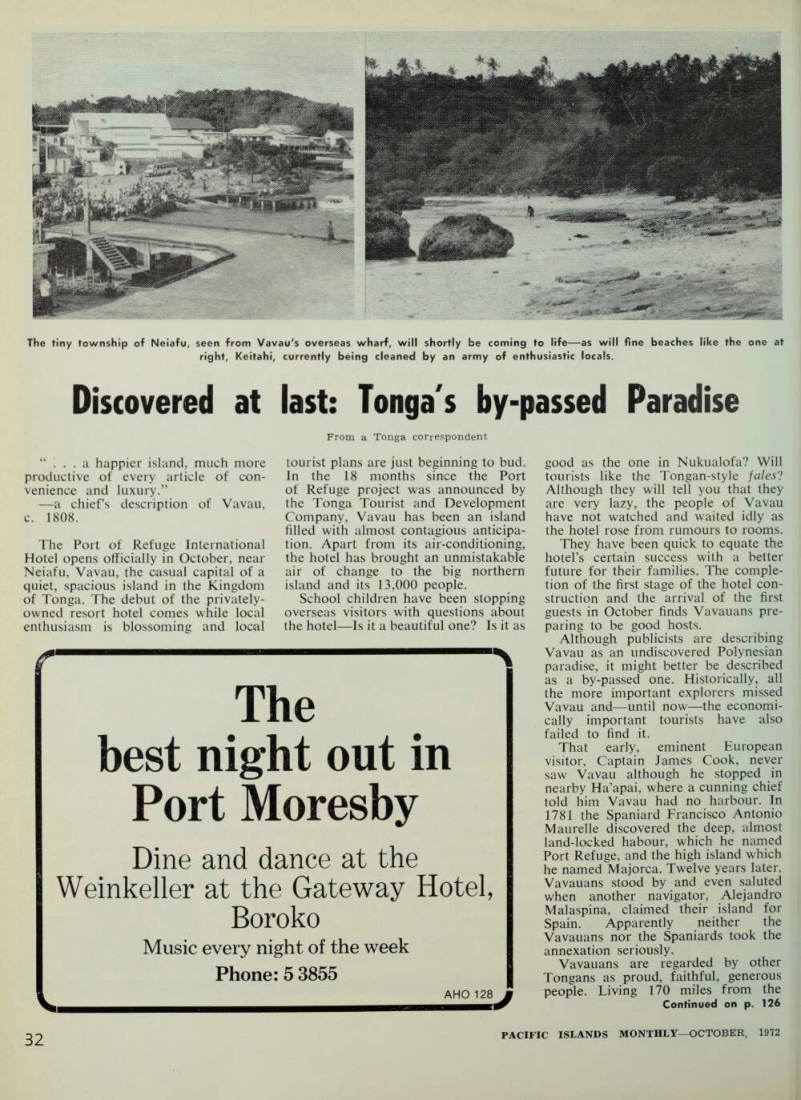
The tiny township of Neiafu, seen from Vavau's overseas wharf, will shortly be coming to life—as will fine beaches like the one at right, Keitahi, currently being cleaned by an army of enthusiastic locals.
capital and the Tongan mainland and separated from them by Ha’apai, another sub-group, Vavauans are often last in line. However, they are not surprised that their island is be coming the prime tourist attraction of the kingdom, for they feel it should be so.
“Foreigners must surely be tired of seeing Nukualofa which is not beautiful and Tonga (island) which is flat and has no trees,” they argue.
Where Tongatapu and Nukualofa are flat, Vavau and Neiafu are high, with undulating wooded hills and fertile soil. The magnificent island studded harbour which the hotel over looks, is generally regarded as the most outstanding scenic feature of the kingdom. Although they them selves may never have seen them, the people add that the Vavau group features famous caves which have interested foreigners for 150 years.
They believe they will be able to lure tourists from the hotel refuge and guide them into the interior, across the island to the best beaches, and
among the many smaller islands in the harbour. They are leasing market space for tour offices and clearing the bush to enhance natural beaches.
Unlike Nukualofa, Neiafu has few tourist amenities other than the hotel itself. There are branch offices of the major trading houses, a few other shops and weekend cinema. There is no taxi office, only one bus, and no place to eat or drink. There is much to be done, Vavauans agree.
They have little money to do it with.
In 1938, the Union Company ship “Matua” began making regular calls at Neiafu, a custom now carried on since 1951 by the “Tofua”. The first shipboard groups of tourists did not stay long in port, but they taught Vavauans the ropes which must now be handled more efficiently. The cruiseships “Chusan” and “West Star” will call five times at Neiafu before the end of the year.
Other communications were sorely lacking until the twice-weekly “Olo vaha” ferry service was begun last
year. Because of this relative isola tion. In fact, up till now, visiting foreigners were always assumed to be yachtsmen. Those who had no yacht had to have patience. The airport a Leimatua, expected to begin operation in October, is the third to be plannee and the second to be built in Vavau without the advent of the intendeo internal air service. But times are changing.
With the assistance of Vavau Governor Ma’afu Tupou, certain stretches of beach are being developed privately by Vavauans. How can ; local man with little or no capita) build a tourist attraction of inter national standard? He must be ; special kind of dreamer and mus have a labour force willing to worl for nothing. In short, he must be i Tongan with a large family.
Uiliami Saulala, with his fathe; and his relatives, has already begui such a project at Keitahi, widel; recognised as one of the best beache in the kingdom. Mr Saulala plan to build a model Tongan villag; where future tourists may spend thi night and where presently hotel guest) can spend the day. An army a labourers, all in the family am all unsalaried, have been at work fc
lonths clearing, cleaning, and build ig at Keitahi.
Toward their dream, the family as made an important purchase— vo flush toilets. But more note orthy than that is the “first-stage” pening feast they held last month )r Vavauan guests.
“I don’t think this work will bring loney,” says Saulala, “but it is a )od future I can give my sons.”
Leading Neiafu merchant, Fanga’a aea, is also said to be planning a ly-outing beach resort at Vaka’eitu land, about 10 miles from Neiafu. nother Vavauan, Siua Moa, was fering “alternative accommodation” en before the principal hotel was gun. His motel at Tahi is a land ark of Vavauan enterprise located ually near the wharf and the hotel.
Dt every man is fortunate enough have a beach upon which to build, Lough with 34 islands in the Vavau aup, it is not surprising how many While its fertile land has tradi nally been the source of Vavau’s ?alth, if one may call it that, ricultural schemes including citrus,
vanilla and tobacco have come and gone. Vavauans have seen hurricanes destroy their copra plantations.
Although the Agriculture Department reports that there is no great move toward increasing table vegetable production for tourist consumption, the people are looking to the hotel to increase the value of Vavau’s valuables.
Some are building vehicles from spare parts. The island has 44 miles of roads which are always under repair. Some are building boats.
Children are studying English with new enthusiasm so they might some day be in the elite of the hotel-em ployed.
Vavau women, who have realised the value of their weaving skill, are producing more of the five-foot uli baskets (hampers) which is their specialty. The baskets, which take two or three weeks to complete, are being made now for tourists who haven’t yet heard of the new hotel.
And in this way, each is doing his part to prepare Vavau for its new role as a port of refuge for the tourist.