at French-Polynesian polls
pp. 15-129 · Read in the full issue
Autonomists set back on their heels at French-Polynesian polls
The French Pacific territories went to the polls in September, and as a result the autonomy movement in both French Polynesia and New Caledonia received a setback. The Polynesian elections are reported below —for what happened in New Caledonia see Helen Rousseau's report on p. 27.
French Polynesia’s evolution toward self-government, “autonomic interne”, was halted on September 10 when the autonomist majority in the Ter ritorial Assembly lost five seats and its dominant position in the 30member body. Victorious were 16, perhaps 17, assemblymen who oppose any change in the political statute of this French overseas territory.
Almost 29,000 voters, 63.5 per cent, of the electorate, redirected the territory’s political future by voting 15,463 to 13,233 in favour of non autonomist candidates who should hold the new majority for the next five years.
The Territorial Assembly is French Polynesia’s unicameral legislature. Its political profile is the best available test of the territory’s political ambi tions.
Gaston Flosse, Mayor of the Pirae township, and his Tahitian Union UDR Gaullist party, were the biggest election winners. His party became the assembly’s largest single group when it picked up two seats for a total of nine.
National Assembly Deputy Francis Sanford’s T'e E’a Api (New Road Party), was the big loser. It dropped hree of 10 seats previously held, to become leader of the new opposition.
With six seats was the other half )f the former 18-member majority coalition, the Pupu Here Ai’a, led )y the 73-year-old veteran of auto lomist causes, French Senator Pou- A Oopa. The Here Ai’a (“The 3 arty which loves its country”) only et slip a single seat.
An important element in the new inti-autonomy coalition will be the fe Autahoeraa, labour leader Charles faufa’s (PIM, Dec., 71, p. 28) lynamic centrist party. Only pre enting candidates in the Leeward sland (Tahiti, Moorea, Bora Bora, laiatea, etc.), it nailed down three eats, one more than it held in the ►ld legislature.
Five independents, all of whom ampaigned against autonomists, won sland seats on local issues.
Post-election headlines have pro laimed a 17-13 balance in favor 'f anti-autonomist candidates, but Iready some of those in the hypothet ical minority have warned that ap-
pearances may deceive and that only the first assembly session will produce the new line-up. This session will be in October, at which time the all important executive Government Council will be elected by the assembly.
Opposition doubts to the contrary, back-stage power-brokers appear to be exchanging their wares as expected.
Gaullist Mayor Flosse, the new man of the hour and the Polynesian politician with the most direct line to Paris coffers, seems assured of Charles Taufa’s critical support.
Taufa, and his party’s spokesman Frantz Vanizette, told a news con ference the day after the election that coalition with the UT-UDR would be normal, on their terms. They pro claimed independence from the Paris Gaullism on which Mayor Flosse relies. They suggested that two or three of the five independents would prefer alliance with them in the centre, rather than dependency on either of the large parties to the left and right. Social Welfare Services Director Vanizette noted that Andre Porlier in the Tuamotus, and Guy Rauzy from the Marquesas, both fought off UT-UDR opposition.
Only one of the five independents might cast his lot with the autono mists, although his past performances show an unashamed inclination to side with the winner. Taratua “Toro”
Teriirere, whose Bora Bora con stituents always come first, won as
sembly election in 1967 under the wing of Alfred Poroi’s UTD group.
Shortly after the opening session he began to vote with the E’a Api side of the autonomist majority, much to Poroi’s chagrin. Some months before this last election he rean nounced his independence and defeated E’a Api opposition.
The day after the election, each party claimed him as one of its own.
He is obviously his own man.
Although the autonomists were surprisingly cheerful after the elec tion, there is no question that a new majority of Polynesian voters have opted for the tightening of ties to France.
The major accomplishment of the out-going autonomist assembly was the composition of an 88-article law which would give total control of domestic affairs to local politicians.
That law languishes this minute in a French National Assembly com mittee-room. Unless Spring elections in France unseat the Gaullist majority, that law will probably not be ratified.
The voters here expressed their dissatisfaction with the concept that a piece of paper in France would become the catch-all solution to their problems. They accepted anti-autono mist arguments that social and economic problems were being over looked in the repetitious presentation of the need for self-government over the past five years. (Continued on p. 127)
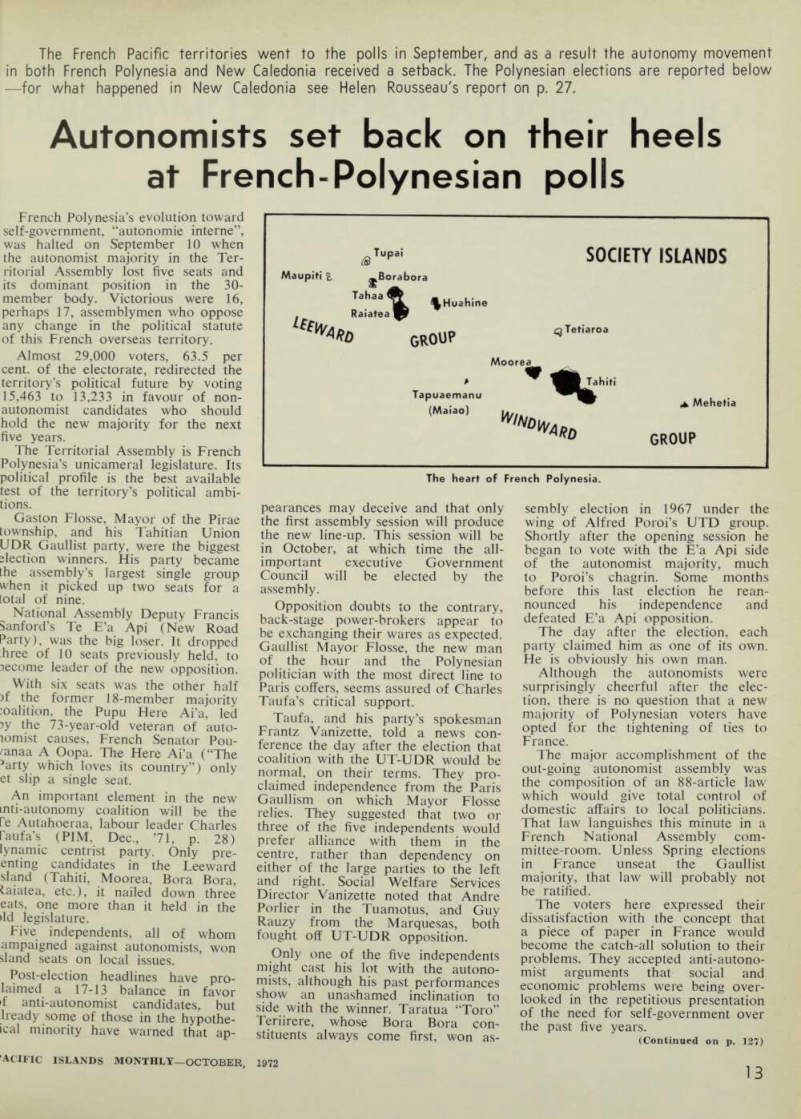
The heart of French Polynesia.
Fhey agreed, primarily with Gaston )sse, that funds, only obtainable m France, spent intelligently, were basis of any new political pro crimes for the territory’s well-being. ~or the first time in more than a ade, perhaps because the elec ate is younger and better educated, voters of French Polynesia turned le from nationalistic slogans and nanded realistic solutions. The v Territorial Assembly has five rs and Paris approbation to build the future.
Janies Boyack comments from Papeete Tirty years ago, during the war, ivanaa A Oopa decided that the nch governor was responsible for uly severe rationing of foodstuffs, vanaa, who until that moment in 2 was a leader of those here who itaneously joined General de file’s Free French Forces, drew up etition claiming there were food tages in the territory even though kpiles were rotting. A number of 3le from all over the island signed petition and Pouvanaa took it to governor.
Tiat the exact situation then was, I 5 no idea. What happened, how , was that Pouvanaa ended up in for a short time, and then he
found himself banished from Tahiti to the outer islands.
Thus began Pouvanaa A Oopa’s political career as a gadfly annoyingly buzzing in French ears. He has bounced back and forth from the political arena to gaol and exile.
For 30 years the old man has been leader, either in fact or in spirit, of those here who, until last month’s election, sought greater freedom from the binds of Paris centralism.
Now, after that election, for the first time in 30 years, Pouvanaa is no longer that important.
Somebody told me it was because he is old. My informant said that the Polynesians lose respect for the feeble old. Life here, to the extent that food gathering is still important, places heavy emphasis on the contribution of the young, strong male.
Gaston Flosse is 41. Charles Taufa is not yet 35. Jacky Teuira, Andre Porher, Louis Palmer, Guy Rauzy, Michel Law, are others of the rela tively young new Territorial Assembly.
Pouvanaa and the autonomists he has led for these 30 years have been pushed aside by the educated young in 1972. Because the young people are scared of a future sans economy.
The autonomists were defeated be cause elegant political Polynesian rhetoric does not fool the searching, suspicious intelligence of the young.
You could hear the crowds at pre election autonomist political gather ings saying, “So, what else is new?”
The autonomists claim that their
opponents picked up more than 1,000 votes from Metropolitan transients working for the atomic test centre.
Part of this claim is true.
But it is still too early to say for sure what tipped the election balance.
The autonomists, who had every reason before the election to believe that they would at least maintain their assembly majority, were completely mystified by the setback. The only way they could figure it was that they had lost contact with the population because they were too immersed in assembly business.
But Te Autaheoraa’s results in Papeete, where the best educated voters go to the polls, show me one major reason why Pouvanaa and com pany fell from disfavour. The auto nomists had two major campaign themes—they would obtain self government for French Polynesia and they would halt nuclear testing here.
Two volatile subjects tailor-made for rabble-rousers. You can whip up a crowd by telling them the other guys are colonialist pigs and that nuclear tests are poisoning fish, but can you give a man a job that way?
Te Autaheoraa, which presented a programme of ideas for social and economic progress, captured more votes in Papeete, 1,569, than any other single party.
I saw a political gathering organised by the Here Ai’a for the people of my district, Mahina. Former Assembly President John Teariki did most of the talking. He spoke in Tahitian, which I cannot get myself to understand.
Then up stood my friend Henri, the gas station attendant in Mahina, He was wearing a well-pressed blue shirt.
He had taken a leg-crossed seat under a breadfruit tree, approximately in the middle of the crowd and directly in front of the podium, behind which sat Pouvanaa and most of the Here Ai’a ticket.
When he began to speak he was very nervous. He would stare up at the sky and rock back and forth on his feet. His voice cracked occasion ally, and he didn’t seem to have con trol of his thoughts. He began very slowly. After 35 minutes of non stop talking, however, he was coasting.
The sing-song tone of his voice had hypnotised at least me. His hands moved with the modulating tones of his voice. John Teariki needed 20 minutes to answer him, point-by-point.
Henri Bouvier afterwards told me gas station attendant Henri, to whom I had once tried to explain the Detroit riot in 1967, had taken every auto nomist argument, and with minute logic had destroyed each one, one after the other. Henri is Tahitian and this Territorial Assembly election was decided by people like him.