Up Front
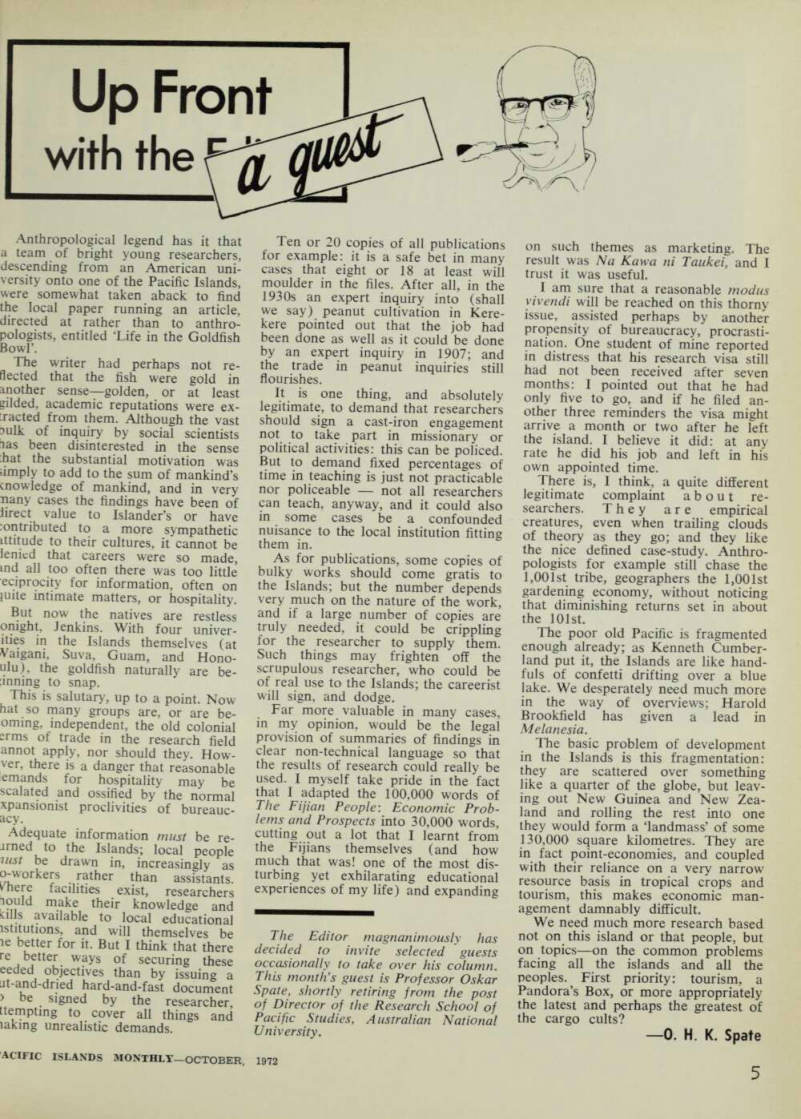
with the [?]
Anthropological legend has it that a team of bright young researchers, descending from an American uni versity onto one of the Pacific Islands, were somewhat taken aback to find the local paper running an article, directed at rather than to anthro pologists, entitled ‘Life in the Goldfish Bowl’.
The writer had perhaps not re flected that the fish were gold in another sense—golden, or at least gilded, academic reputations were ex :racted from them. Although the vast aulk of inquiry by social scientists ias been disinterested in the sense hat the substantial motivation was iimply to add to the sum of mankind’s knowledge of mankind, and in very nany cases the findings have been of lirect value to Islander’s or have :ontributed to a more sympathetic ittitude to their cultures, it cannot be lenicd that careers were so made, ind all too often there was too little eciprocity for information, often on luite intimate matters, or hospitality.
But now the natives are restless onight, Jenkins, With four univer ities in the Islands themselves (at Vaigani, Suva, Guam, and Hono ulu), the goldfish naturally are be :inning to snap.
This is salutary, up to a point. Now hat so many groups are, or are be ommg, independent, the old colonial srms of trade in the research field annot apply, nor should they. How ver, there is a danger that reasonable emands for hospitality may be scalated and ossified by the normal xpansionist proclivities of bureauc acy.
Adequate information must be re amed to the Islands; local people iust be drawn in, increasingly as o-workers rather than assistants, yhere facilities exist, researchers lould make their knowledge and rills available to local educational istitutions, and will themselves be ie better for it. But I think that there fe better ways of securing these ceded objectives than by issuing a Lit-and-dried hard-and-fast document > be signed by the researcher, [tempting to cover all things and taking unrealistic demands.
Ten or 20 copies of all publications for example: it is a safe bet in many cases that eight or 18 at least will moulder in the files. After all, in the 1930s an expert inquiry into (shall we say) peanut cultivation in Kere kere pointed out that the job had been done as well as it could be done by an expert inquiry in 1907; and the trade in peanut inquiries still flourishes.
It is one thing, and absolutely legitimate, to demand that researchers should sign a cast-iron engagement not to take part in missionary or political activities: this can be policed.
But to demand fixed percentages of time in teaching is just not practicable nor policeable — not all researchers can teach, anyway, and it could also in some cases be a confounded nuisance to the local institution fitting them in.
As for publications, some copies of bulky works should come gratis to the Islands; but the number depends very much on the nature of the work, and if a large number of copies are truly needed, it could be crippling for the researcher to supply them.
Such things may frighten off the scrupulous researcher, who could be of real use to the Islands; the careerist will sign, and dodge.
Far more valuable in many cases, in my opinion, would be the legal provision of summaries of findings in clear non-technical language so that the results of research could really be used. I myself take pride in the fact that I adapted the 100,000 words of The Fijian People : Economic Prob lems and Prospects into 30,000 words, cutting out a lot that I learnt from the Fijians themselves (and how much that was! one of the most dis turbing yet exhilarating educational experiences of my life) and expanding The Editor magnanimously has decided to invite selected guests occasionally to take over his column.
This month’s guest is Professor Oskar Spate, shortly retiring from the post of Director of the Research School of Pacific Studies, Australian National University.
on such themes as marketing. The result was Na Kawa ni Taukei, and I trust it was useful.
I am sure that a reasonable modus yivendi will be reached on this thorny issue, assisted perhaps by another propensity of bureaucracy, procrasti nation. One student of mine reported in distress that his research visa still had not been received after seven months: I pointed out that he had only five to go, and if he filed an other three reminders the visa might arrive a month or two after he left the island. I believe it did: at any rate he did his job and left in his own appointed time.
There is, I think, a quite different legitimate complaint about re searchers. They are empirical creatures, even when trailing clouds of theory as they go; and they like the nice defined case-study. Anthro pologists for example still chase the I,oolst tribe, geographers the I,oolst gardening economy, without noticing that diminishing returns set in about the 101st.
The poor old Pacific is fragmented enough already; as Kenneth Cumber land put it, the Islands are like hand fuls of confetti drifting over a blue lake. We desperately need much more in the way of overviews; Harold Brookfield has given a lead in Melanesia .
The basic problem of development in the Islands is this fragmentation: they are scattered over something like a quarter of the globe, but leav ing out New Guinea and New Zea land and rolling the rest into one they would form a ‘landmass’ of some 130,000 square kilometres. They are in fact point-economies, and coupled with their reliance on a very narrow resource basis in tropical crops and tourism, this makes economic man agement damnably difficult.
We need much more research based not on this island or that people, but on topics—on the common problems facing all the islands and all the peoples. First priority: tourism, a Pandora’s Box, or more appropriately the latest and perhaps the greatest of the cargo cults?
O. H. K. Spate