Governor Dons Sporting Gear For
pp. 23-24 · Read in the full issue
New Caledonia's Election Game
From a NOUMEA correspondent
The Caledonian press has been ex ;eptionally mobile this past month, vith journalists busy racing from one :nd of the island to the other, from :ast coast to west, from mainland to >uter islands: all this to follow the >re-electoral movements of the French Administration and some nine political groups. The latter range in name rom the “Entente Democratique et Jociale” to what may be translated is the “Association of the Oceanic discontents”.
Caledonian political groups raditionally trade along the line of ousin-uncle contacts, while local minting machines work around the lock, producing no less than 11 »apers of political inspiration before he elections.
The administration is also paddling lard, with the advantage of state ontrol over the TV and radio in ddition to sympathetic treatment rom certain newspapers. But one spect the Caledonians have found •articularly fascinating during this ire-electoral period has been the bout-turn in pictures and language mployed.
Among the political groups them elves, the words do not differ really. In the outgoing Territorial Assembly, the camps are divided bout equally into autonomist and nti-autonomist groups. All eight xisting parties claim they are dif erent from the others and yet all re using similar catchwords— 'ecentralisation, autonomic interne, eforme.
The greatest divergence seems to ccur between those of the Establish aent and accepted allies, who are aore content to negotiate with the Tench Administration in power, and hose of the fast emerged newly-rich, /ho would like to be more influential hemselves.
Both sides have to appeal for upport from the less financially ortunate. The split then seems to •ccur over “metropolitan French” ersus “Caledonian” sympathy and dentity.
Among the outsiders, are some everal thousand voters recently rrived from France and other zones )f French influence. There are 35 eats to be contested, divided between bur electorates. Lists of candidates lad to be submitted by August 20.
Mr Pierre Messmer, while visiting Noumea as Minister for Overseas
Territories in May, before becoming French Prime Minister, was widely quoted as saying there was never a sweeping swing in Caledonian elec tions, and if there were just a few hundred votes changing sides, the government would not change its attitude (of opposing autonomy).
However, it must be remembered that those advocating autonomy won 23 out of 35 seats at the last ter ritorial elections, in July, 1967, while splits in allegiance occurred in 1971. New Caledonia’s Governor obviously wants a favourable As sembly, partly because autonomists have taken the fight outside the territory and are trying to attract French public opinion.
Governor Louis Verger, who as President of the Advisory Council (Conseil de Gouvernement) is the island’s executive head, is also High Commissioner for France in the Pacific. A public servant appointed by Paris, the governor thus exercises three roles in New Caledonia.
Since his arrival in October, 1969, Governor Louis Verger has made frequent official visits throughout the territory. These have traditionally been colourful affairs, with the governor wearing white official uniform and escorted by gendarmes, while French tricolore flags flutter from public buildings and school children accompany official speeches with a chorus of the Marseillaise.
The first notable departure from this trend was announced mid-July by the Noumea press when Governor Verger appeared “in pullover”, driving a jazzy Mehari open car, to inspect on the town’s outskirts a new, problematic by-pass, whose completion is now several months overdue.
From this unexpected visit, the press next transferred to another problem zone, the local water shortage, to show the governor “in boots and helmet”, inspecting ex tensions to the dam supplying Noumea. About the same time, the governor called up local importers and shopkeepers, urging them to ex pose their problems and grievances.
And then, less than two months before the territorial elections, a staggering series of visits began on July 26, when the governor arrived on the East Coast, to tour six towns in three days. This time, the com mentators insisted, they were
informal visits, “no flag, no Marseillaise, no official speeches”, with the governor wearing slacks and pullover.
The following week, August 1, the governor was back on the West Coast for two days, to meet graziers and inaugurate a new town hall at Moindou. Addressing local townsfolk, the governor called for solidarity in three directions: solidarity between races (European and Melanesian), solidarity on the territorial plane, which should override personal interests, and national solidarity, which the governor related back to the early metropolitan French settlers who had pioneered the country.
In what the locals identified as a warning against the autonomists.
Continued on p. 18
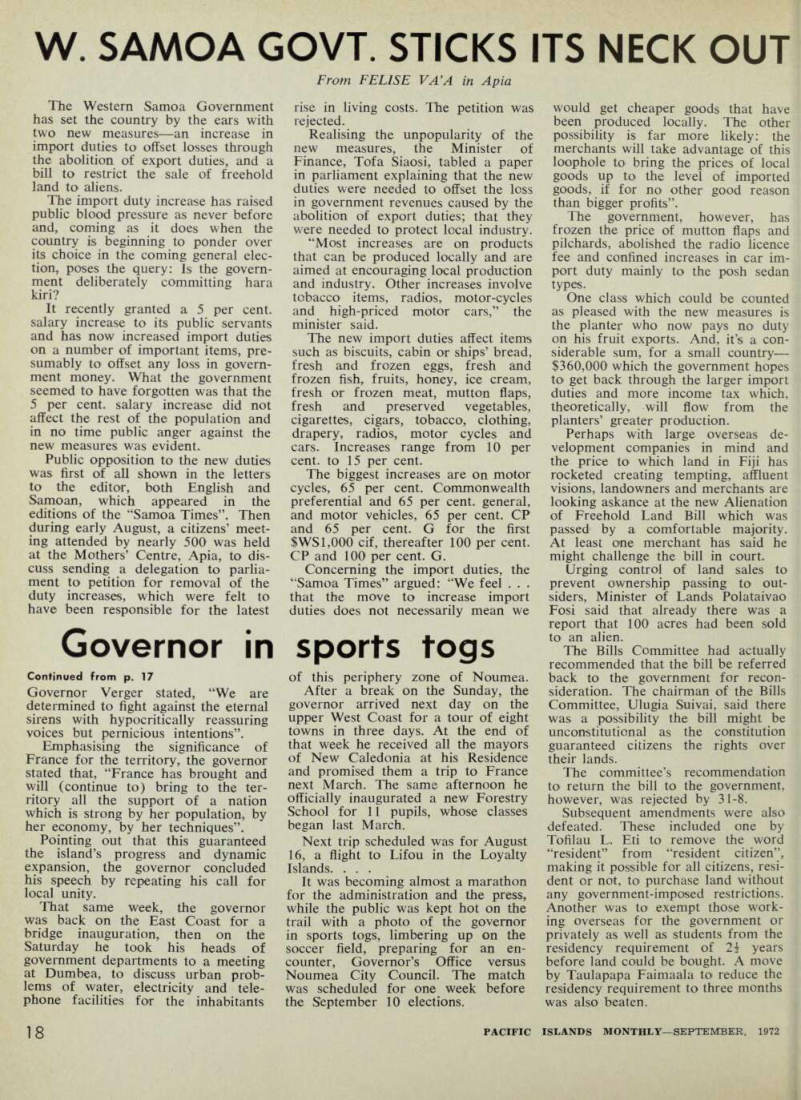
In the New Hebrides the release of a new definitive set of postage stamps featuring the traditional culture of Mela nesia has been linked with the demolition of the old post office.
Governor Verger stated, “We are determined to fight against the eternal sirens with hypocritically reassuring voices but pernicious intentions”.
Emphasising the significance of France for the territory, the governor stated that, “France has brought and will (continue to) bring to the ter ritory all the support of a nation which is strong by her population, by her economy, by her techniques”.
Pointing out that this guaranteed the island’s progress and dynamic expansion, the governor concluded his speech by repeating his call for local unity.
That same week, the governor was back on the East Coast for a bridge inauguration, then on the Saturday he took his heads of government departments to a meeting at Dumbea, to discuss urban prob lems of water, electricity and tele phone facilities for the inhabitants
of this periphery zone of Noumea.
After a break on the Sunday, the governor arrived next day on the upper West Coast for a tour of eight towns in three days. At the end of that week he received all the mayors of New Caledonia at his Residence and promised them a trip to France next March. The same afternoon he officially inaugurated a new Forestry School for 11 pupils, whose classes began last March.
Next trip scheduled was for August 16, a flight to Lifou in the Loyalty Islands. . . .
It was becoming almost a marathon for the administration and the press, while the public was kept hot on the trail with a photo of the governor in sports togs, limbering up on the soccer field, preparing for an en counter, Governor’s Office versus Noumea City Council. The match was scheduled for one week before the September 10 elections.