Of The Political Scene
p. 17 · Read in the full issue
Autopsy on the Cooks
Dr Tom Davis Gives His Diagnosis
During 1971, I was requested to eturn to the Cook Islands to lead a (olitical party against the Cook slands Party Government led by Mr Übert Henry. At the time I was an xecutive of the well-known research onsulting firm of Arthur D. Little nc., in Cambridge, Massachusetts,
Jsa.
Before making my decision, I felt t necessary to make a visit to my lomeland to assess the necessity or he desirability of opposing the Henry jovernment, which had for approxi mately seven years enjoyed a strong majority of popular support. This isit, made in August, 1971, led me o sum up the political situation as ollows: 1. There was increasing dissatisfac ion with the Henry Government ased chiefly on strong evidence of ictatorial behaviour and the abuse f power which usually accompanies uch behaviour. 2. Although there were major ad ances in social amenities and services mch as housing, beautification, educa 'on and health, there was little or no dvance in economic development dmich would allow these amenities nd services to be placed on a firmer ase. 3. There was political control or ifluence over just about every phase f human interest, as evidenced by nancial support of the Church, the Women’s Federation, youth groups nd local societies by government.
Tie radio and newspaper were olitically controlled. 4. More disturbing, there was a eneral air of fear of opposing the ovemment in any way. This fear fas evident in Europeans and ex atriate government servants who had rst-hand knowledge of arbitrary eportation of their friends and col ;agues. Among the islanders them slves, there was fear of loss of jobs r housing loans and of victimisation n the basis that support of the 'ook Islands Party was equivalent y support of government as laid own by the constitution. Since bout 50 per cent, of the labour mrce was employed in the public srvice, this had a strong effect on me political freedom of public ervants who, as will be seen later, ebelled and strongly supported the
opposition party as a group at the 1972 general elections. 5. The existing opposition party was disorganised and important issues were being overlooked. 6. There was evidence of financial difficulties, with large owings to local and overseas firms in addition to borrowings for projects which had little or no possibility of monetary return. 7. Little advantage was being taken of the new international airport to develop a tourist industry. No tourist accommodation had been built and there seemed to be reluctance on the part of hoteliers to invest money in the Cook Islands. There appeared to be no policy regarding tourism, apart from a relatively expensive Tourist Authority which arranged for dance groups to entertain visitors on board when tourist ships call. 8. There was victimisation of con stituencies which voted for members of the opposing party. This took the form of denying support for equip ment to assist agriculture or for amenities such as electric power or water supply. These constituencies are all outer islands which have had the highest agricultural production for export over the years.
9. Relationships with New Zealand, which provides a subsidy of about 50 per cent, of the total appropriation for running the country, were strained as a result of uneconomic spending and overbearing demands for in creases in financial assistance. 10. Expert advice on projects and techniques for reducing expenditure had been generally ignored or contra vened.
After reviewing the situation, it seemed that, as a Cook Islander, I had little choice but to return and do what I could. I had no illusions as to what 1 was up against. A strongly organised political machine was in operation. In the last two elections, it had gained 68 per cent, of the votes. Campaigning in the past was largely based on personalities rather than issues, and both camps were firmly entrenched in their re spective political affiliations.
A new party with a new approach had to be formed. This was achieved in due course but not without the expected difficulties. The new party was presented on the basis that it was one which the former opposition party and dissatisfied members of the Cook Islands Party could join without the inhibition of old personal hatreds, A 50 page platform and policy was prepared and released approximately two months before the elections.
However, the problem of intimida tion and fear was always there and probably cost the newly-formed Democratic Party the government by a margin of seven members to 15, but by only a small margin of votes: 46 per cent, of votes throughout the Cook Islands, 48 per cent, of votes in Rarotonga (nine seats) and better than 49 per cent, of votes in Te-Au- O-Tonga, the largest single con stituency (four seats).
Thus a considerable gain was achieved over the 1965 and 1968 elections in which the Opposition Party received only 32 per cent, of overall votes for the Cook Islands and much less for Rarotonga. In the final count many of the scrutineers estimated that a substantial number of supporters of the Democratic Party did not vote, presumably because of fear that their votes would be known and recriminations would follow, as
Continued on p. 123
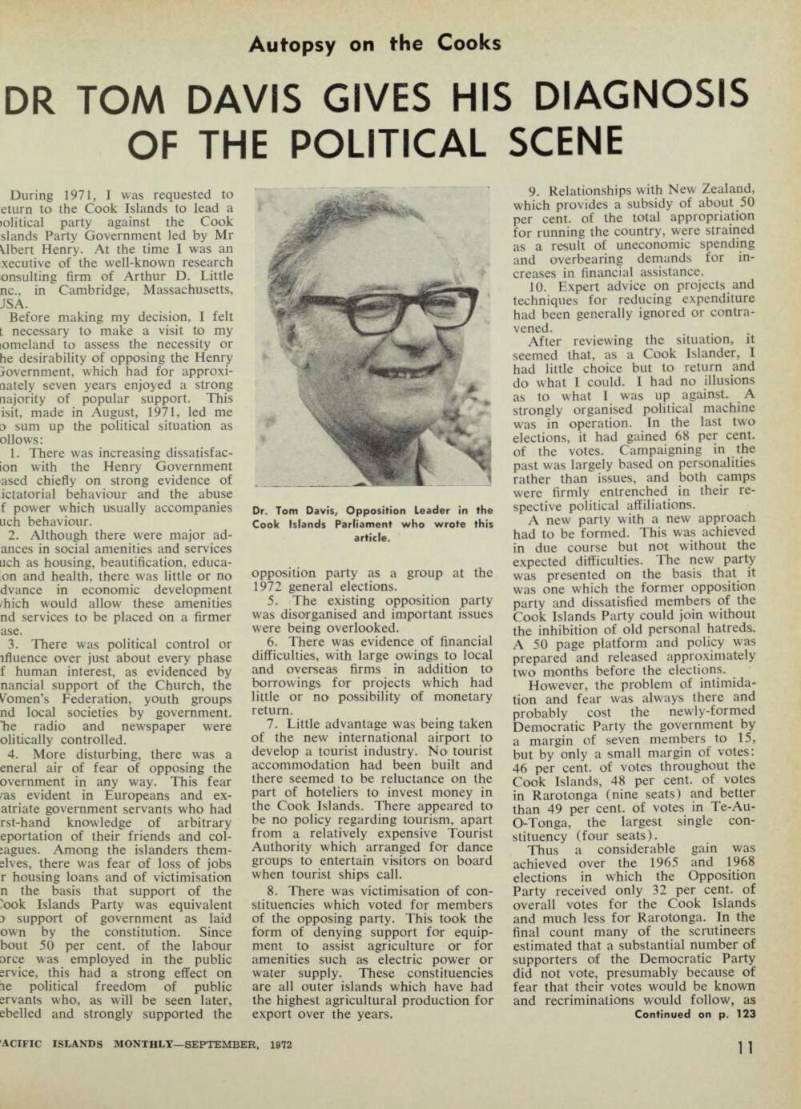
Dr. Tom Davis, Opposition Leader in the Cook Islands Parliament who wrote this article.