approach to
pp. 14-15 · Read in the full issue
Realistic approach to PNG power swapping
From Percy Chatterton
During Mr C. E. Barnes’ long occupancy of the post of Minister for External Territories in the Aus tralian Government, we were blandly assured from time to time that we could have self-government when ever we wanted it; but little was done to investigate just what legislative and administrative procedures would be involved in our progress towards it.
A few powers have been handed over by Canberra to Port Moresby during the last few years; but one suspects that they have been selected partly because they were powers which it was procedurally easy to hand over, and partly because their transfer would not materially weaken Canberra’s control, rather than for their significance as steps toward meaningful self-government.
Our new minister, Mr Andrew Peacock, has attacked the problem more realistically, and it may be suspected that that is what he was given his portfolio to do. If this is the case, he must have been greatly encouraged by the goal set by PNG’s ruling National Coalition, December 1, 1973, “or as soon thereafter as may be practicable,” for the attain ment of complete internal self government.
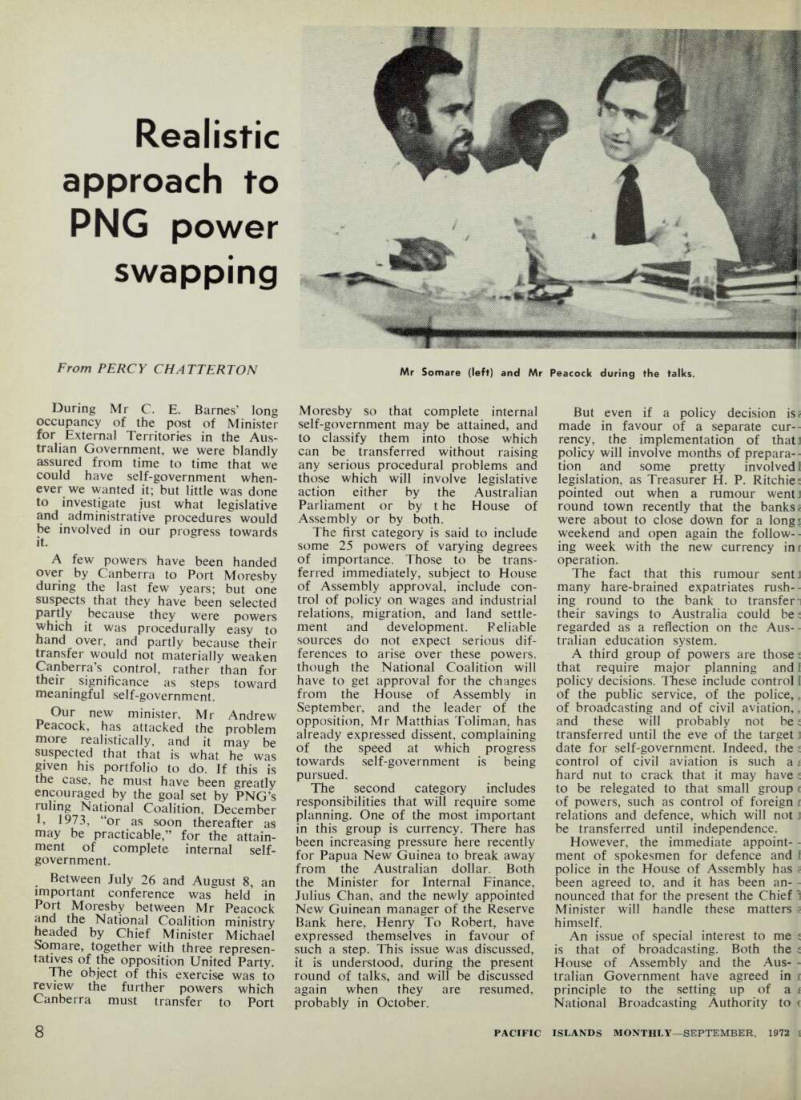
Between July 26 and August 8, an important conference was held in Port Moresby between Mr Peacock and the National Coalition ministry headed by Chief Minister Michael Somare, together with three represen tatives of the opposition United Party.
The object of this exercise was to review the further powers which Canberra must transfer to Port
Moresby so that complete internal self-government may be attained, and to classify them into those which can be transferred without raising any serious procedural problems and those which will involve legislative action either by the Australian Parliament or by the House of Assembly or by both.
The first category is said to include some 25 powers of varying degrees of importance. Those to be transferred immediately, subject to House of Assembly approval, include control of policy on wages and industrial relations, migration, and land settlement and development. Reliable sources do not expect serious differences to arise over these powers, though the National Coalition will have to get approval for the changes from the House of Assembly in September, and the leader of the opposition, Mr Matthias Toliman, has already expressed dissent, complaining of the speed at which progress towards self-government is being pursued.
The second category includes responsibilities that will require some planning. One of the most important in this group is currency. There has been increasing pressure here recently for Papua New Guinea to break away from the Australian dollar. Both the Minister for Internal Finance, Julius Chan, and the newly appointed New Guinean manager of the Reserve Bank here, Henry To Robert, have expressed themselves in favour of such a step. This issue was discussed, it is understood, during the present round of talks, and will be discussed again when they are resumed, probably in October.
But even if a policy decision is; made in favour of a separate cur rency, the implementation of that: policy will involve months of prepara tion and some pretty involved legislation, as Treasurer H. P. Ritchie; pointed out when a rumour went; round town recently that the banks: were about to close down for a long: weekend and open again the follow ing week with the new currency ini operation.
The fact that this rumour sent; many hare-brained expatriates rush ing round to the bank to transfer their savings to Australia could be i regarded as a reflection on the Aus tralian education system.
A third group of powers are those; that require major planning and 1 policy decisions. These include control 1 of the public service, of the police,, of broadcasting and of civil aviation,, and these will probably not be; transferred until the eve of the target; date for self-government. Indeed, the; control of civil aviation is such a j hard nut to crack that it may have; to be relegated to that small group ( of powers, such as control of foreign i relations and defence, which will not; be transferred until independence.
However, the immediate appoint ment of spokesmen for defence and police in the House of Assembly has ; been agreed to, and it has been an nounced that for the present the Chief !
Minister will handle these matters ; himself.
An issue of special interest to me ; is that of broadcasting. Both the ; House of Assembly and the Aus- ■ tralian Government have agreed in i principle to the setting up of a i National Broadcasting Authority to <
Mr Somare (left) and Mr Peacock during the talks
ake over the services currently ►perated by the Australian Broad asting Commission at national level ind by the Department of Informa ion and Extension Services at egional and local levels.
However, in the spate of legislation /hich will inevitably be called for luring the passage to self-govern nent, there is a danger that that equired for the setting up of the National Broadcasting Authority may ie relegated to a low priority.
If this is the present line of think tig, I believe that Messrs. Peacock nd Somare would do well to think gain.
The present arrangement by which tie ABC looks after national level roadcasting while the PNG Admini tration takes care of broadcasting t regional and local levels has worked /ell for a number of years. But if ; were to be carried over into the ew era of self-government, a ituation could easily arise in which iere would be a head-on collision etween a national government touchy bout criticism and an ABC touchy bout its traditional independence rom government interference.
This should be avoided at all costs, nd, as I see it, it is most desirable lat a blueprint for the future of roadcasting in PNG, and in parti ular a clear delineation of the leasure of its freedom from control y the government of the day, should e prepared before internal self overnment is attained.
Papua New Guinea’s National ’oalition Government has shown Misiderable vigour and initiative in s efforts to solve the problems of le Gazelle Peninsula. Both Chief linister Michael Somare and Lands linister Albert Maori Kiki have isited Tolailand to discuss the prob rns of the Tolai on the spot. Mr omare has also had private talks ith rival faction leaders Matthias To man and John Kaputin, and has ibsequently sent three members of ie staff of the Chief Minister’s department to Rabaul for further ilks.
Their assignment has been a tough ae.
Mr Somare’s unfortunate clash with fr Joseph Talam, a teacher in the ational Teaching Service and the 'esident of the Gazelle Branch of ie United Party, will have made icir task more difficult; and it is iderstandable that the “council” iction among the Tolai should sus ;ct Mr Somare’s government of dng biassed in favour of the fataungan faction, since the three lataungan MHAs are among its ipporters in the House.