Business and Development
pp. 107-109 · Read in the full issue
Png Buys Into Burns Philp:
Doesn't Fiji Want To Be In?
By John Carter
“Somebody’s head should have rolled over this” grumbled a Fiji businessman in July. He was talking of the time, in 1970, when the Fiji Government looked a gift horse in the mouth by turning down the offer of 200,000 shares in Burns Philp (South Sea) Co. Ltd.
The shares were offered at $2.50, which was 50c above par, and at the time they were quoted on exchange at $2.90, a depressed price. Normally they were around $3 and more. It was an “advantageous offer,” said Bums Philp, as an independence gift, but the government, through two of its agencies, the Development Bank and the National Provident Fund, said “Nothing doing”.
The government, which even today has not formally rejected the offer, suggested the shares should be offered to Fiji individuals. Burns Philp, through its general manager in Fiji, Mr J. A. Baker, explained the dif ficulties of such a move. For one thing a company could hardly differentiate between buyers on the share market, offering shares at a lower price to favoured investors.
Transferring a block of shares to a government was another thing altogether.
And there the matter rested until a few weeks ago when Burns Philp’s head office in Sydney announced, along with the Papua New Guinea Investment Corporation, that the corporation had agreed to buy from Bums Philp 1,500,000 fully paid shares of $1 each at par in Burns Philp (New Guinea) Ltd. The shares represented 12i per cent, of the capital and two corporation nominees, representing the people of PNG, would sit on the board. The Invest ment Corporation was jubilant over the offer. A long-term earnings yield of 20 per cent, a year would land in the corporation’s coffers and, even tually, into the pockets of the Papuans and New Guineans through a unit trust which the corporation is setting up.
To encourage local management
and operation of the company’s plantation properties in PNG, Burns Philp had also agreed to grant Burns Philp (New Guinea) Ltd—and, hence, PNG investors—an option to buy shares in all of Burns Philp’s six plantations.
“A satisfying agreement,” com mented Mr E. S. Owens, Investment Corporation chairman, of the whole transaction. The PNG House of Assembly and ministers thought so too.
In fact, the corporation, now with the bit between its teeth, has acquired local equity in four big companies. In the first four months of its operations it will end the financial year with total assets of almost S 6 million, based on capital funds of $2.2 mil lion—not bad going.
In its share wallet are Burns Philp (New Guinea) Ltd, Commonwealth New Guinea Timbers Ltd of Bulolo and Lae (a 35 per cent, share), Watkins Property and Investment Corporation Pty Ltd, a joint venture with Watkins Consolidated Ltd which will acquire Watkins Consolidated’s subsidiary, Territory Building Supplies Ltd (45 per cent, share), and, the latest, one million $1 shares at par in Bougainville Copper Pty Ltd.
Fiji ministers headed by the Prime Minister, Ratu Sir Kamisese Mara, have lately been sounding off about the big overseas companies in Fiji dragging their feet over offering shares in their companies to Fiji investors. It looked as if they’d forgotten about Burns Philp’s offer.
There was a speedy response from W. R. Carpenter Holdings Australia, managing director Mr Randolph Carpenter announcing on July 13 that a special offer, open to Fiji citizens only, would be made of shares in the Carpenter and Carlton- United brewery at Walu Bay in Suva and in the Dominion high-rise build ing which Carpenters is building with Barclays Bank.
Shares of a special class designed to prevent the “allocated equity from being acquired outside the dominion of Fiji” will be offered at their par value to the Fiji public. The shares will represent up to 15 per cent, of the capital of a new company being formed to acquire Carlton Brewery (Fiji) Ltd. But Carpenters hastened to add that the decision to offer shares was made at the start of the year.
Other shares would be offered in Dominion House, a 14-floor hotel, with a total equity requirement of $1 million.
What is the response likely to be?
A few years ago, South Pacific Sugar Mills Ltd offered five per cent, of its shares to the Fiji public. Only two per cent, was taken up.
Fiji Minister for Commerce and Industry, Mr Mohammed Khan, gave Carpenter’s offer a cautious welcome.
“It is good for Fiji, because it means that the benefits of develop ment go to local shareholders instead of to shareholders overseas,” he said. Then he added, “But, before 1 can make any further comments on this development, I would like to know the details of this so-called special class of shares designed for Fiji citizens.”
When Burns Philp reached agree ment with the PNG Investment
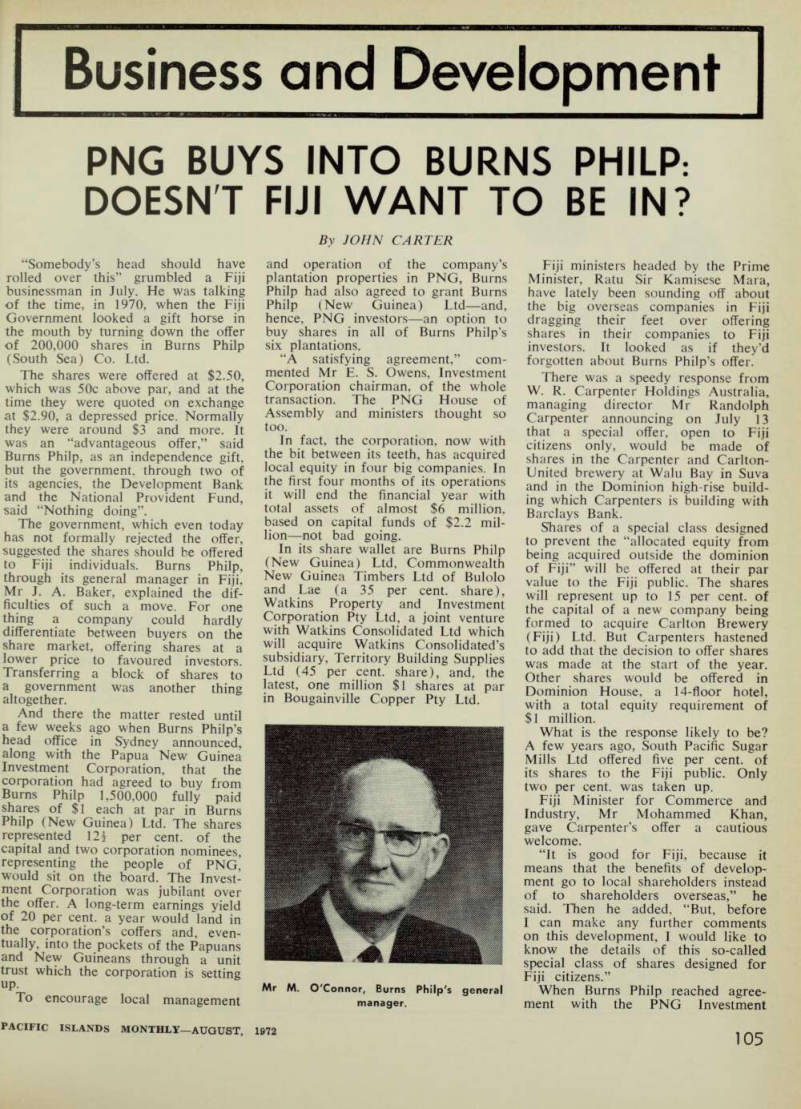
Mr M. O'Connor, Burns Philp's general manager.
Corporation PIM took the company’s original offer of shares in Burns Philp (South Sea) Co. Ltd out of the pigeon hole, dusted it off and what did it find?
That, had the Fiji Government accepted the offer, its original hold ing of $500,000, the value of 200,000 shares at $2.50 each, would now be worth $975,000 and the present yield on this investment is 12i per cent.—very much a gift horse.
Burns Philp has never been told why the offer—which is now shown to be even more generous than was thought when it was made—was rejected by the Fiji Government.
There was no legal barrier to the government taking up the offer through the Development Bank or through the Fiji National Provident Fund. In any case, the government could have created something like an investment corporation as has been done in PNG.
The gift element of Burns Philp’s original offer was $BO,OO0 —not to be sneezed at. Shortly after the offer was made, Burns Philp made a one for four bonus issue which would have given the Fiji Government an additional 50,000 shares, making the same dividend of 10 per cent., a consequential rise from the original eight per cent. On the basis of the value of the gift coupled with the bonus issue and the subsequent in crease in the market price, the value of the investment would have now been $975,000.
The Development Bank could have accepted the offer. In November, 1968 it accepted a placement of shares in Fiji Industries of 50,000 shares at 10/- for a premium of 10/-. They accepted Fiji Industries’ offer at a double premium. Then why reject Burns Philp’s offer at the very modest premium of 50c on a $2 share?
As Mr M. O’Connor, general manager of Burns Philp and Co. Ltd said to PIM in Sydney recently with regard to the government’s suggestion of what Burns Philp could do with their shares, “We were not very interested in following the suggestion that a special class of shares be issued to local residents because any special class of share could only be traded locally and would be a second class share.
“If you could only trade them between Fiji nationals, bearing in mind that the value of a commodity is governed by the demand, which m Fiji would be low, we would have been placing in the hands of the local people a second-class share as compared with the main body of shares which could be traded in
without restriction on overseas stock
exchanges.
“We wanted the people of Fiji to have an equity in the true sense of the word in our undertaking in Fiji. . .. A ... . * e F, J' Government can still st 11 J rCm Burns FF| P ® offer It ti open up to a point.
Said Mr O’Connor, “Our offer is still open in general terms. The specific terms would have to be looked at again. Remember, our original offer was made in November, 1970 when the market price was $2.90 a share. Today, the market price is $3.90. When we made the offer we were paying 10 per cent.
It is now 12k per cent, on the basis of the enlarged paid-up capital.
“ We are completely at a loss to understand why the Fiji Development Bank or the Fl P National Provident Fund—either of which would be most su i, e d—rejected the offer. The reason given by the National Pro vident Fund was that its articles at that time didn’t permit it to take up shares in such an enterprise as Burns Philp (South Sea) Co. Ltd, but it has been suggested that the offer could have been accepted quite rightly, quite easily, quite normally by making a simple amendment to the ordinance, had the will been there. Now the ball is in their court.”