Boac Pacific Jet
pp. 103-104 · Read in the full issue
News
Golden Miami calls you to come
(BOAC Supplement—Advertisement)
At the beginning of the century Miami Beach was largely a jungle scrubland. Most of it was owned by two partners who were struggling to operate a coconut plantation.
But things have changed. At the most recent count there were 441 hotels on the narrow (1J mile maxi mum) 7-mile long island and its 16 associated man-made islands, which together form the City of Miami Beach. If you could spare the time and money, you could stay in a dif ferent hotel room every night for 82 years.
The reason for all this develop ment? A temperature throughout the year well into the seventies even higher in the summer—and a swathe of sandy beach washed by the Gulf Stream-warmed breakers of the Atlantic. It is North America’s own natural sub-tropical refuge.
America’s rich were not slow in establishing themselves there, and now 173 millionaires have homes in Miami Beach. A square foot of land in the area is said to be worth £2,000, so you very nearly have to be a millionaire to be able to buy a house there at all. But not to stay on holi day.
With the influx of visitors the population of Miami Beach soars, reaching at the winter peak more than 750,000 ten times the resident population.
These visitors include an increas ing proportion from overseas and Miami Beach has adjusted itself accordingly. European or European trained chefs produce menus familiar to visitors from around the world and standards of service have come some way from that of the generally-
accepted image of the disinterested American waiter.
No doubt though, many visitors would be happy to go the entire length of their stay nourishing them selves on the thick, tender, juicy steaks on which, as far as consistency of quality is concerned, America seems almost to have a world monopoly. In few other parts of the world is it possible to be sure of get ting a good steak in virtually any respectable restaurant, and Miami upholds the American tradition.
To back up a good meal the bigger hotels have night clubs featuring international stars, so night life matches up to the standards expected of a major holiday city.
The hotels have a list of other facilities too. Many of the 250 or so hotels along the oceanfront have a couple of swimming pools (one heated), a sauna, an acre or two of terrace, cabanas for when the sun gets too much and the warm Atlantic if you feel you really must get sand between your toes.
Moored in Biscayne Bay just across Collins Avenue and opposite these monuments to luxury, are some of the private yachts which are a
feature of the Miami scene. Just a short boat ride out away from the islands and into the Bay proper is a vast expanse of calm water made-to measure for water-skiing.
In the peak season from December to March, a room in one of the plush hotels is certainly not cheap, by North American standards as well as by any other. But in the summer, prices plunge when hotels prefer to have their rooms used rather than to stay empty until the next high season.
And the competition is so intense that a little shopping around in ad vance could well nay dividends.
The hotels are virtually self contained even down to shops so it is possible to spend an entire holiday without venturing outside. Many guests appear to do just that but others may want more variety.
For those who want an active holiday, a drive out of the city pro vides the answer. Not far away are the Florida Keys, the string of islands stretching down to Key West, the southernmost point of the USA. They offer superb areas for skin and scuba diving in waters with the only living coral in the US.
A range of river boats in Indian
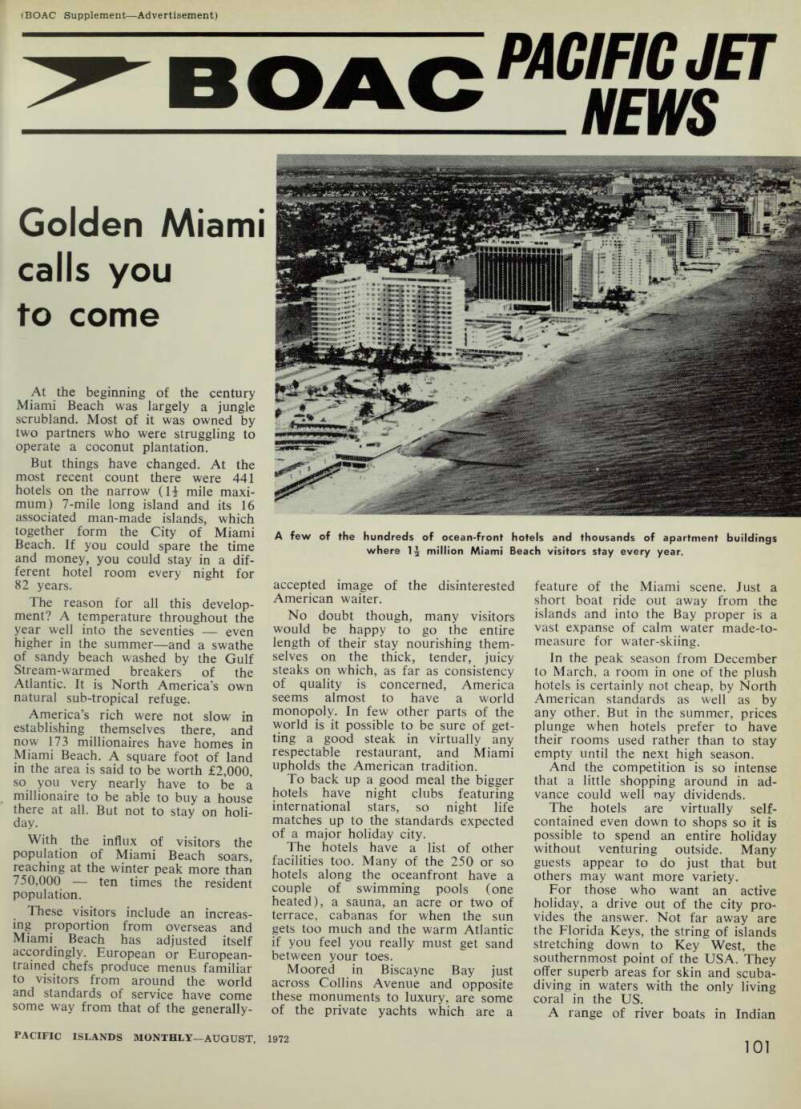
A few of the hundreds of ocean-front hotels and thousands of apartment buildings where 1½ million Miami Beach visitors stay every year.
Creek run regular trips around the islands in Biscayne Bay. The sail could go by Miracle Mill where Miami’s millionaires have settled.
For those interested in America’s cultural heritage there is the Bass museum of art and the Vizcaya col lection of paintings.
Other popular places to visit in clude the Seaquarium, the world’s largest tropical marine aquarium.
In contrast is the Monkey Jungle where the pathways have been en closed in stout wire and 500 monkeys swing and chatter freely in the trees.
The Everglades National Park provides another sort of natural attraction. A vast area of sub-tropical swampland with saw grass stretching in any direction as far as the eye can see, it is crossed with highways which make much of it accessible to the tourist.
Miami’s wide range of facilities makes it impossible to become bored.
The best way to get there —by BOAC of course!—is via New York.