Pacific Shipping
pp. 89-95 · Read in the full issue
Unions' Wage Demands May Wreck
Geic's Marine Training School
The future of the GEIC merchant marine training school at Tarawa is in jeopardy and the jobs of nearly 500 Gilbertese seamen are at stake following demands by Australian and New Zealand maritime unions that the Gilbertese working on ships serviced at Australian and NZ ports be given huge wage lifts or be replaced by Australians or New Zealanders.
Columbus Line, which supports the training school, supplying staff for the school and drawing crews from it, was having talks in mid-July with representatives of the International Transport Federation over the unions’ demands that the Gilbertese be paid a * ates ‘ Minimum ITF rates are about Siso a week. The Gilbertese are paid $4B a month for ordinary seamen and able seamen get about a month.
Mr H. W. Rdk, general manager of Columbus Line in Australia, which employs between 100 and 150 Gilbertese seamen who have been trained at the school, told PIM that insistence on big wage increases or
the replacement of the Gilbertese by others would “put paid” to the school in Tarawa.
The whole question, however, is being thrashed out in talks in London between the ITF and the British Foreign and Commonwealth Office.
In previous talks with the shipowners and others, the ITF was unable to make much impression but it is believed its hand has been strengthened by the Australian waterside workers’ threat of a black ban on ships which do not adhere to ITF standards of pay and conditions.
Discussions are also in train between the ITF and German and Australian maritime unions and there may also be talks in the next few months in Tarawa where the Gilbertese have now formed their Gilbert and Ellice Islands Overseas Seamen’s Union. Registered last December, the new union had enrolled 100 members by mid-June and will be represented on every overseas ship carrying more than four GEIC seamen.
The unions’ argument was put to
PIM by Mr T. Bull, federal organiser of the Australian Waterside Workers Federation and ITF representative in Australia. For some years, he said, the ITF had campaigned for mini mum wage standards and conditions for seamen and its attention had been called to a set-up arranged by about 20 German and British shipowners in the GEIC.
The unions were glad to see such training schools established and work provided for Island people but, at the same time, the school was providing the shipowners with a reservoir of cheap labour, to the detriment of the seamen concerned and the seamen of Australia and other nations.
Mr Bull quoted an example of what he described as a current set-up.
There were three ships of the Pacific America Direct Line. One, an Aus tralia roll-on, roll-off ship was manned by Australians at Australian wage rates of about $l5O a week, Another was manned by Swedish seamen at Swedish rates of about $lOO a week. The third ship was manned by Gilbertese getting $l5O a
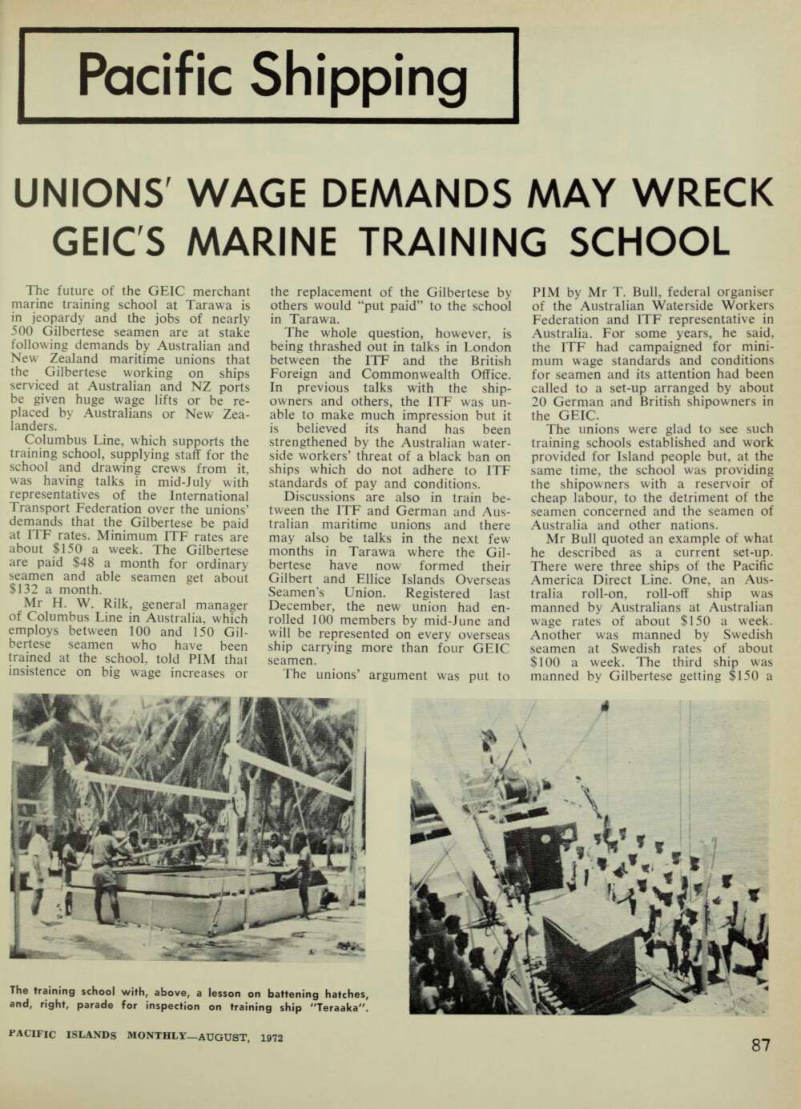
The training school with, above, a lesson on battening hatches, and, right, parade for inspection on training ship "Teraaka".
month. That ship was costing the owners about a quarter of what the other ships were costing.
“We have told the shipowners that they must meet the maritime unions to work out a complete formula gov erning the whole question of the employment of Gilbertese seamen,” said Mr Bull.
Columbus Line’s Mr Rilk explained that the agreement the company had with the GEIC Government, the British Government and the United Nations, which sponsored the school, was a long-standing one and the rates of pay were subject to a review next October.
“If we had to raise the wage rates, it would, first of all, be uneconomical for Columbus Line and others to employ Gilbertese because it is a much dearer job to get them on board ship and then to repatriate them than with German crews,” he said.
“Another factor to be considered is that these Gilbertese seamen, as far as Island standards are concerned, are very rich men and the sociological impact of their earning more than twice as much is quite impossible to assess but it would certainly not be good for the Islands. It would also trigger off demands in other Island territories.
“There is also one fresh factor to be considered. When the training scheme was first started there were no German seamen available because of the economic boom in Germany but there are plenty around right now.
“We hope all this will be acknow ledged by the ITF which has shown appreciation of the situation in the case of seamen belonging to the All-India Seamen’s Union and others who are working on ships of many nationalities at pay rates comparable with those of the Gilbertese.”
A bigger row is brewing, however, which threatens to create major strife on Australia’s and New Zealand’s waterfronts. The maritime unions of both countries have indicated that they will be making demands on overseas shipping companies cross trading in the liner freight trade.
The unions point out that these companies have no equity in Aus tralia or New Zealand but compete with Australian and NZ lines. They will demand that such ships should be manned by either Australians or New Zealanders. Columbus Line has already been approached in connec tion with its three container ships.
Pollution Peril
In The Carolines
Anxious eyes have been cast on a wreck fast on the reef at West Fayu near Truk in the Carolines.
It is the freighter Solar Trader which ran on the reef last December with a cargo of 350 Japanese-made cars. Her tanks contained 55,000 gallons of oil and it is this oil which is causing concern.
Heavy seas are pounding the ship which, however, is standing up well to the assault but it is feared that, in time, the tanks will be ruptured, releasing the oil to pollute the lagoon and damage marine life.
A thin film of oil can be seen near the bows at low tide but it is believed that this is merely flushed from the oily bilges. Those responsible for the wreck have been asked to remove the oil from the tanks.
"Enna G" Thinks It
Has Beaten Engine Woes
Nauru Pacific Line’s 9,340-ton gross “Enna G” required further work on her diesel engines while in the middle of her June-July South Pacific cruise from Sydney. The former Holland Amerika Line vessel (ex-“Prinses Margriet”) has been plagued with engine trouble, and her June cruise to the New Hebrides, Fiji and the two Samoas was delayed more than a fortnight in Sydney after fire broke out in the scavenger trunk ing (PIM, July, p. 85).
She finally got away (with more than 40 passengers), but was not able to operate at her top speed of 16 knots. When she put in to Suva it was decided to give the pistons a thorough going over, and a team of four Commonwealth Department of Supply engineers, under senior servic ing representative John Cumberland, flew to -Suva from Melbourne with specialised equipment. They worked with the ship’s engineers and with Suva marine engineers Millers Ltd and Bish Ltd for more than a week, reconditioning engine parts.
When “Erma G” continued her voyage to Apia and Pago, the Nauru Pacific Line was fairly confident that it had finally got to the bottom of her engine woes. “Enna G” can take 100 passengers, all in first-class cabins, and the line is hopeful of her making an impact on the Pacific cruise busi ness with regular 18 and 25 day voyages out of Sydney.
She is specially welcome in Fiji now that the Fiji-Australia Line’s “Taiyuan” has been withdrawn.
“Taiyuan” took 86 passengers and was always booked to 80 to 90 per cent, capacity. “Enna G” (with Euro pean officers, Tongan stewards and Fijian deck crew) has a higher stan dard of accommodation and service, and the Nauruans have a great oppor tunity with her if they decide to con tinue in the cruise business.
Banabans Buy A
Cargo-Passenger Ship
With their old home, Ocean Island, and its phosphates in mind, the Bana bans, of Rabi Island in Fiji, have re christened the “Coromandel”, the NZ fishing vessel which they have bought as a passenger-cargo ship for service between Rabi and other Fiji ports.
The new name, bestowed at a ceremony at Suva Wharf on July 3, is “Nei Kuana” which means Stone of Ocean Island.
Master of the “Nei Kuana” is Captain Charles Flood who has a crew of eight Banabans. She will work most of the ports on Yana Levu dur ing the run between Rabi and Suva, thus ending a hardship which Rabi Holdings managing director Mr Tekosi Rotan says Vanua Levu has suffered from —poor shipping services.
Well known around New Zealand coastal waters, the Nei Kuana” has had three separate careers. She was part of the old NZ cruiser “Philomel”,
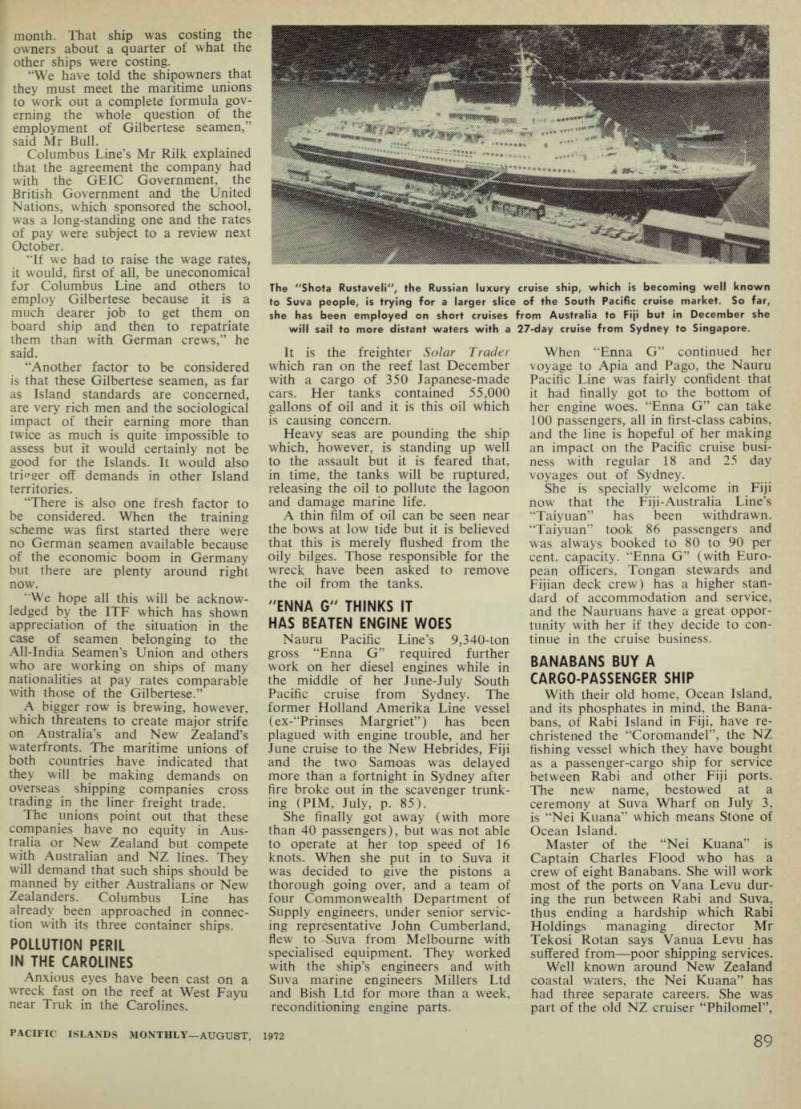
The "Shota Rustaveli", the Russian luxury cruise ship, which is becoming well known to Suva people, is trying for a larger slice of the South Pacific cruise market. So far, she has been employed on short cruises from Australia to Fiji but in December she will sail to more distant waters with a 27-day cruise from Sydney to Singapore.
being built out of material taken from the cruiser when she was scrapped. “Coromandel” was launched 24 years ago as a cargo-passenger ship and served the Auckland-Great Barrier Island service for the Strong man Shipping Company.
Then, in the 19505, she was bought by Juries, of Wellington, and con verted into a fish catcher to operate off the Chatham Islands. Later, the Chatham Islands Shipping Company took her over and she worked as a catcher and crayfish ship until her purchase by Rabi Holdings Ltd, the Banabans’ company which is working to create income-earners for the Banabans against the not-so-distant date when Ocean Island’s phosphate is worked out.
The ship has been refitted at Nelson in New Zealand’s South Island.
The Cost Of Being
"A Pattern Of Islands"
Rising freight charges are worrying the members of the GEIC Legislative Council who were told at their June meeting at Tarawa that the freight bill for imports last year was $375,000.
According to Mr Naboua Ratieta, Member for Communications, Works and Utilities, about 8,400 tons of general cargo was brought into the colony by the Columbus Line last year at $42.20 a ton, and 300 tons of refrigerated cargo at $64 a ton.
Members feared that this year the bill will be bigger but, Columbus Line told PIM in Sydney, it will only be bigger if imports are bigger, Columbus doesn’t intend putting up the rate.
Mr Sione Tui Kleis (Nui), who sought a cheaper way, asked if the colony could operate its own ship.
He was told by Financial Secretary Mr Douglas Freegard that the colony had its own ship a few years ago but it cost more than the freight bill from an outside shipping line.
Lord Howe And Norfolk
Seek Their Own Ship
Merchants and importers on Lord Howe and Norfolk Islands are plan ning to buy their own ship to ply between the two islands and the Aus tralian mainland. At present they are obtaining details of costing but there may be a delay in completing the report because one firm of shipping experts has queried costing figures supplied by another firm.
Forty-four local importers attended a meeting on Norfolk Island when the proposal got its first airing and all 44 supported the proposal “in principle”. Half did more than that.
They each agreed to put at least $l,OOO into the scheme, provided they
could get clarification of several points.
Two of the leading lights in the plan are Mr G. J, Bennett and Mr K. J. Nobbs, prominent Norfolk Island businessmen. They visited Sydney seeking a suitable ship for island trading and had discussions with ship brokers. As a result a Sydney firm of shipping agents out lined a scheme for forming a com pany and buying a ship.
It is estimated that $75,000 will be needed to buy a ship and provide working capital. The firm which out lined a scheme has offered to sub scribe $5,000 and provide another $20,000 as a loan at 8 per cent.
Fiji Shipyard Lost
$44,000 On Cruiser
Blue Lagoon Cruises Ltd., Lautoka based operators of the cruises to Fiji’s beautiful Yasawa Islands, have had a
ship built at less than cost by the Fiji Government Marine Department’s shipyard.
The yard built a 121 ft cruiser “Lycianda” for Blue Lagoon and lost $44,000 on the deal instead of making an expected $19,000 profit. The order was for a cruiser at $156,750. So pleased were Blue Lagoon that they ordered another, slightly bigger but otherwise identical.
The department has just been hauled over the coals by the public accounts committee of the Fiji House of Representatives for making what it describes as a “hidden subsidy” to the cruise company. The department, complains the committee, failed to prepare a bill of quantities before work started on the “Lycianda” and this caused difficulty in ordering materials for the job and in costing, with “disturbing” results.
The Marine Department, which is
new to commercial business —the “Lycianda” was its first commercial job—has been advised to get a costing of future orders from countries from which the prospective customer might otherwise import a ship.
The shipyard has two more jobs on its list, an 80 ft tug for Marine Pacific Ltd and a passenger-cargo ship for the Maritime Co-operative Shipping Association from the Lau Group.
Pleasure Cruise
Industry Expanding
Fiji’s expanding pleasure cruise industry is to add two new luxurious cruisers to its fleet.
The Blue Lagoon Cruises Ltd plans to launch their new 125-ft cruise vessel “Talei-anda” (sister ship to the “Lycianda”) on August 15. She’ll be commissioned in October, in prepara tion for the start of a regular three day cruise programme to the Yasawas next January.
“Talei-anda” is the second cruise vessel to be built for Blue Lagoon at the Marine Department’s shipyards in Suva. The first, the 121-ft “Lycianda”, has proved very success ful.
Like the “Lycianda”, the Talei anda” will be fully air-conditioned, with accommodation for 40 people in 20 cabins. The tariff for both vessels will be $95 per person in upper deck cabins and $B5 for lower deck cabins.
Scnooner Ferris Ltd—operator ol the cruise vessel “Seaspray”— has been reformed and renamed South Sea Islands Cruises Ltd, with the Nadi tour operator United Touring Com pany as a major shareholder.
The company has bought a former Singapore supply and geophysicial survey vessel called the “F. B.
Walker”, for transporting tourists to the Mana Island resort, due to open in the Mamanuca group in mid-Octo ber.