Business and Development
pp. 103-106 · Read in the full issue
It was more spine chilling for New Caledonians than Messmerisation
From HELEN ROUSSEAU, in Noumea
Mr. Pierre Messmer, French Minister for Overseas Territories, had the world’s finance capitals poised waiting for a sensational an nouncement when he came to address New Caledonia’s Territorial Assembly in late May.
The Caledonian Press had been beating the drum to herald the big event for days before the Minister’s arrival. This time it was expected there would be more than promises, over an issue that has occupied Cale donian and foreign nickel interests for over six years: would the giant International Nickel Company of Canada (INCO) finally get the green light of Paris approval to begin building a factory on the island?
The answer was no, not yet, “we’re still talking”.
On the other hand, the minister sent a shiver down local spines when he referred to the territory’s outdated tax system, thereby hinting at the possible introduction of income tax on the island.
In the meantime, on the mining front, the minister promised that the second half of this year would see the start of construction on a new project, a factory to produce 36,000 tons of nickel metal from garnieritic ore in the north of the island around Poum. This project was first an nounced in 1969 and scheduled to begin production in 1972. It is now sponsored by COFREMMI (involv ing Patino Mining Corporation) to gether with the French group, Pechmey - Ugine Kuhlmann. Mr.
Messmer also suggested that the Swedish group, Grangesberg, could be authorised to enter the project, if the Swedes’ other current plans do not materialise.
The minister’s announcement caused little excitement in the Cale donian Press and all the statements on the Poum project collected a knock when Maurice Lenormand, one of the leaders of the Caledonian autonomists, called the promises electoral bluff”.
Addressing a public meeting at La
Foa, during the minister’s visit, Lenormand admitted that some out lay could be expected, but claimed that the French interests did not have sufficient funds to see the project through. He also claimed that the venture had not assured itself of the necessary sales outlets, and pointed out that no date had been announced for the completion of the factory and entry into production.
Meanwhile, in view of the current recession on the world nickel market, the minister discussed Paris govern ment plans to finance a stockpile of 10,000 tons of nickel metal from New Caledonia. This metal will be stockpiled in France in a bid to keep up production at the SLN nickel company’s smelters in Noumea.
But all the glowing assurances that France was looking after New Cale donia’s economic development could not take the chill out of the tax threat.
The minister had told the Terri torial Assembly: “One must admit that, despite the system of tax exemp tions, the Caledonian fiscal system, based on outmoded ideas, is hardly attractive. Private enterprise fears a system of indirect taxes which, hitting the product, is applied with out taking profit and loss into ac count. A relic of the time when the Caledonian economy was just begin ning, this fiscal system had the ad vantage of assuring modest budgets from market fluctuations.
“But it is certain that no industrial or developing country could put up with it today. Amid the world com-
petition that you are involved in, this situation is a handicap which investors have become aware of dur ing recent times.”
Because there was some panic over the possible introduction of income tax, the minister discussed it further in a radio-TV interview, insisting that the whole matter depended upon the Territorial Assembly. However, the locals were quick to remember that by the Billotte Laws of 1970, Paris had already taken away from the Territorial Assembly certain taxing powers concerning big French companies investing in the island.
This Paris cutting of local tax powers had been done despite the majority opposition of the Territorial Assembly.
The threat of the metropolitan French income tax system thus now hangs heavy on the minds of Cale donians, and local bankers have reported a quick reaction with moves to transfer funds out of the territory.
Of course, the minister also spoke about the Caledonian movement which is urging greater local responsi bility and less stringent controls from Paris. In a radio-TV broadcast, the minister said there was “no question of France accepting a change of statute, so no question of what some call internal autonomy or what some hope for as independence”.
On another occasion, when asked what would be the Paris reaction if autonomists were to win the coming September elections, the minister was widely quoted as saying there is never a sweeping swing in Caledonian elections and if there were just a few hundred votes chang ing sides the government would not change its attitude.
Asked about the fear of disorder breaking out locally, the minister pointed out that the territory has a population of only 120,000 inhabi tants, while there are 51 million in metropolitan France. He stated that the “maintenance of public order with a small population in a relatively small area is not very difficult, and
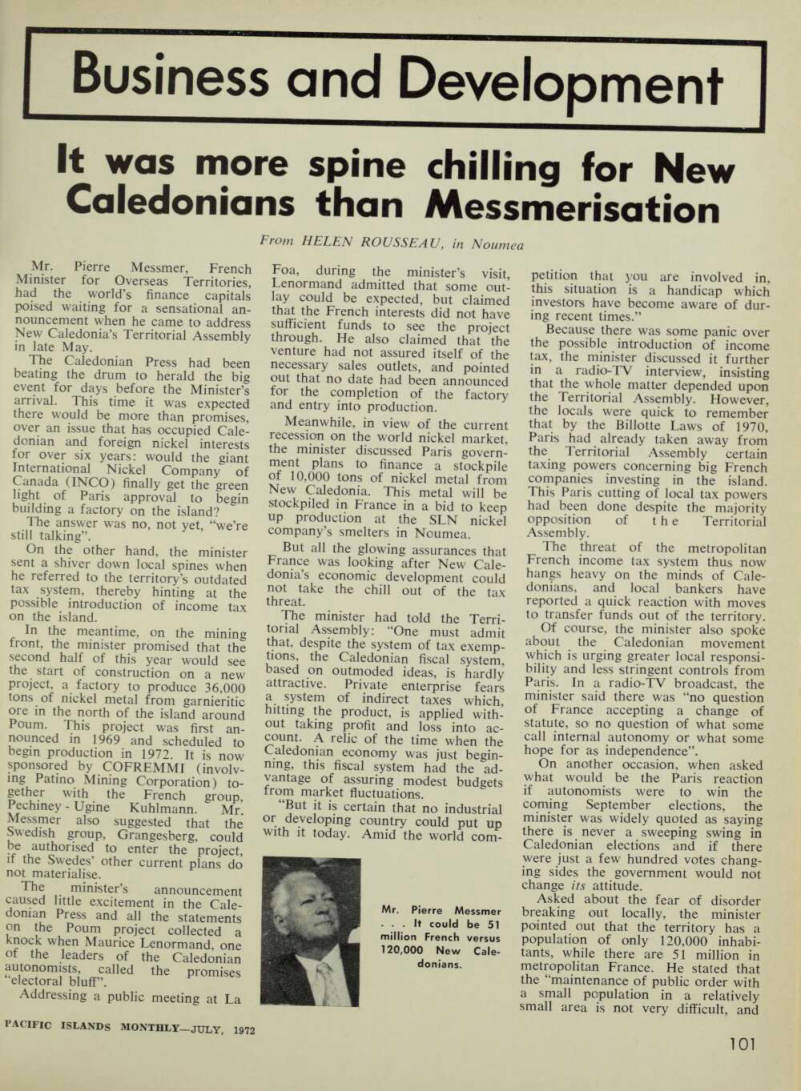
Mr. Pierre Messmer It could be 51 million French versus 120,000 New Cale donians.
certainly within the means we have at our disposal”.
In addition, the minister did not hold out much hope for the success of an Amnesty Bill that has been tabled in the French Parliament, to clear certain young Caledonians suf fering political charges. The Amnesty Bill has been tabled in Paris by Roch Pidjot, deputy for New Cale donia, Francis Sanford, deputy for French Polynesia and E. Claudius- Petit, vice-president of the French National Assembly.
The amnesty bid concerns young European students convicted for the April, 1969, painting of such wall slogans as “Free Caledonia” (“Cale donie Libre”—remember de Gaulle’s “Vive le Quebec fibre”). The Amnesty Bill also covers the tract distribution and arrests of September, 1969, and, more recently, the current six-month gaoling of young Mela nesian notable, Nidoishe Naisseline, for having insulted a French official.
The bill calls for the amnesty of those associated with these offences and the re-instatement in the public service of personnel having lost jobs over such incidents.
Mr. Messmer gave little hope of an amnesty for these young people con victed of political offences. At the same time, the minister did not fail to emphasise the importance of the French presence in New Caledonia to protect the island from a “foreign takeover”.
The Noumea Press saw little to re joice over in the minister’s state ments.
One daily reacted with front page headlines referring to the “Dis appointed Caledonians”, while the other daily had a front page editorial headed “Gloom”, describing the locals’ “grumbling, dissatisfaction and ill-temper”. This paper, while traditionally close to the French ad ministration, pointed out that “Mr.
Messmer can assert that New Cale donia could not be other than French; he can announce the launching of a (new, nickel) company in the north . . . and he is greeted only with scepticism”.
What both papers did not headline, however, was that the minister, in his official session with the Territorial Assembly, had been boycotted by 19 out of the 35 territorial councillors.
Only 16 elected men attended the minister’s official speech and while Mr. Messmer had informal talks with representatives of most political groups, the autonomist members of the assembly abstained from attend ing all official functions in Noumea during the ministerial visit. These facts were not published in the Press at all.
There was another point that the local pro-French administration Press did not mention during Mr. Mess mer’s visit, and that was the circula tion of an open letter addressed to the minister by the Caledonian Front for Autonomy. The six-page letter of grievances was signed by four leaders of the front, representing 13 territorial councillors. When the first 6,200 copies had been distributed throughout the island, a second edition was necessary.
The letter’s primary theme, which the minister later subtly introduced into one of his speeches, showing that he anyway had read the letter, was that France could not make a
success of New Caledonia unless it had the co-operation of the locals and was prepared to open a realistic dialogue. Another assertion, a reference to which was also carefully woven into the same ministerial speech, was that “one is never better looked after than by oneself”, The letter traced the failure of the graindiose nickel developments Paris had planned for the island, plans which, the letter said, had resulted in upsetting the Caledonian economy with excessive inflation, housing shortages and the elimination of certain Caledonian industries. The letter sought to enlighten the minister about certain activities of local
French administration and claimed, that the failure of the French plans pointed to the need to allow internal autonomy.
The letter named certain young Caledonians (both European and Melanesian) and wondered what had happened to them when, after suc cessful studies in France, they came back to the island only to be im prisoned or to have their careers shattered because of political charges against them.
The letter expressed admiration for the remote control of operations in outer space but urged that for the “satellite Nouvelle-Caledonie” such remote manoeuvring from Paris should be replaced by more local control. Among the distant Paris manoeuvres, it outlined the Billotte Laws and nickel export quotas, all affecting the territory’s main industry —mining.
The writers reflected no great en thusiasm for certain metropolitan French public servants and in regard to the relatively new laws on inland communes (municipalities) they claimed that “in exchange for the control of our mineral heritage you have given dummy communes, which only serve as training grounds in command exercises for the public servants in charge”.
Having heard that the minister would not be prepared to discuss any modification of the territory’s statutes, the autonomists suggested that maybe the minister would use “the carrot and the big stick”. The writers noted that paratroopers, mobile forces, gendarmes and various reinforcements were already, at least partially, in place as a “big stick”. As for the “carrot”, the autonomy leaders said the locals could hardly be expected to be interested any more in the flood of promises for new factories, capital inflow, etc.
Having entertained its readers with various other aspects of local history, the letter made five demands: • An end to the elimination of Caledonians from responsible positions; • A halt to the immigration of workers from overseas; • Abolition of the Billotte Laws; • Formation of true communes; • Internal autonomy.
The letter finally called for the opening of discussions with France to ensure that this Caledonian in ternal autonomy should be achieved within the framework of the French Republic. The printed letter was signed by four leaders of the Union Civique and Union Caledonienne parties.