Yesterday
p. 77 · Read in the full issue
Judging by the July, 1952 PIM, the Pacific Islanders were a contented lot around that time. In all the 136 page issue there was hardly a grumble recorded as coming from the Islanders themselves.
There was one grumble, a big one which threatened to create echoes but it didn't come from any Islander. It came from some top brass —the PNG retiring Administrator, Colonel J. K. Murray, no less. As we pointed out in YESTERDAY last month, there'd been some political jiggery pokery and accusations were flying thick and fast.
Under a Port Moresby, July 9, dateline, Col. Murray was reported as saying his regret at leaving was tempered by relief in escaping "the motives, methods and manners of the Minister and some of his senior departmental officers".
Sarcastically, he added, "It appears that Prime Minister (Menzies) and Mr. Hasluck (he was the Minister) believe Adminis tration will be best provided here by the appointment of a person highly experienced in organising success ful post-war election campaigns". He also charged Mr. Hasluck with "unpardonable delays" in getting on with important administration matters.
It was strong stuff, and there was more the following month but we won't jump the gun.
The people of Norfolk Island had a grumble too, or cause for grumble because, apparently, they accepted catas trophe with a certain amount of fortitude, probably singing that Aus tralian ditty about the pub with no beer.
The islanders had no beer but whose fault was that? It was this way.
The usual ship which brought their beer supplies from New Zealand, the "Vila Star", called at Wellington with an order for the usual 600 dozen bottles. The brewery said they couldn't have any.
The islanders hadn't sent back the empties. Later, the brewery relented and let Norfolk have part of the order on a promise to return all empties.
That wasn't all. There was a food shortage too. The ship which brought the groceries, the "Malaita", had run on a rock at Lord Howe Island. The acting Administrator, Mr. C. I. Buffet, sent an SOS to the Australian High Commissioner in Wellington and the result was the arrival on Norfolk from the skies of a RNZAF Bristol Freighter loaded with butter, eggs, etc.
There was a third grumble but this was really something to grumble about and, no doubt, those concerned, the rubber planters of Papua, hollered, never mind grumbled. A quarter of their May shipment of rubber to Australia was refused by the mills. The agents said the shipment exceeded requirements, would be stored and absorbed into the following month's shipment at a lower price.
That meant a loss of about lOd a pound —about £B,OOO, which added insult to an injury caused a little while before through the refusal of Minister Hasluck to approve a bill setting up a rubber reserve fund.
There were no more grumbles reported, only happy happenings like the success of the Fiji Rugby Union team at the start of its Australian tour. PIM had a picture of the Fijians in action on the front cover and the story inside related how the husky islanders had won their first two games, really hammering the Aussies, and had drawn "gates" which raised half the estimated cost of the tour.
There was another story about the Fijians which showed them in another, and grimmer, light but it was still a happy story for all that, happy in the sense that evil forces were coming off second best. It was the story of the Fijian infantry battalion's first jungle encounter with the terrorists in Malaya. There
were two clashes, C Company under Major Isireli Korovulavula, MC, ambushing and killing three of the enemy and another patrol wiping out a small Red raiding party.
Not everyone applauded. The Methodist Church renewed its protest over the Fijians being sent to fight in Malaya, the Rev. Alan Walker saying in Sydney that Australians and Britishers should hang their heads in shame for recruiting young Fijians to fight in Malaya.
Happiness in July 20 years ago was a new hotel; at least for that popular "old hand" of PNG, Mrs. Flora Stewart.
Owner of the first hotel in Wau and then of a grand new hotel in Lae, she lost everything when the Japanese arrived.
Returning to New Guinea from Sydney after the war she found herself with a private war on her hands. She wanted to build a new hotel at Lae on the site of the old one, but officialdom refused permission. The planners had laid out their ideal town, which didn't coincide with Mrs. Stewart's ideals.
So there was a fight. Mrs. Stewart said something approaching "What the hell" and went on building. She won.
There was a new and beautiful Hotel Cecil on the old site.
It's still there and so is Mrs. Stewart, but not at the hotel. She sold it and retired some years ago.
According to PIM there were other islanders who were happy to be left alone but they've changed their tune these days. The islanders are the New Hebrideans who, today, are beginning to ask for autonomy at least. Reports circulating at present say the French won't budge although the British half of the condominium wouldn't mind some change.
Be that as it may, 20 years ago PlM's "special correspondent" in Vila wrote: "There is much talk of our future.
Most people here ardently hope that New Hebrides will become neither French, British nor Australian. We are quite happy to remain as we are, a condominium, and the freest country in the Pacific. We have no income tax, a copra export tax of only per cent, (not like 10 per cent, in the Solomons) and a minimum of government inter ference. Everyone, natives included, earns high wages; and if we are only left alone this country could be happy and very prosperous under a system where private enterprise receives every encouragement and the function of government is to justly administer a minimum of laws".
That was before the winds had really started to blow. There's likely to be a few dust storms there before the next 20 years are ended!
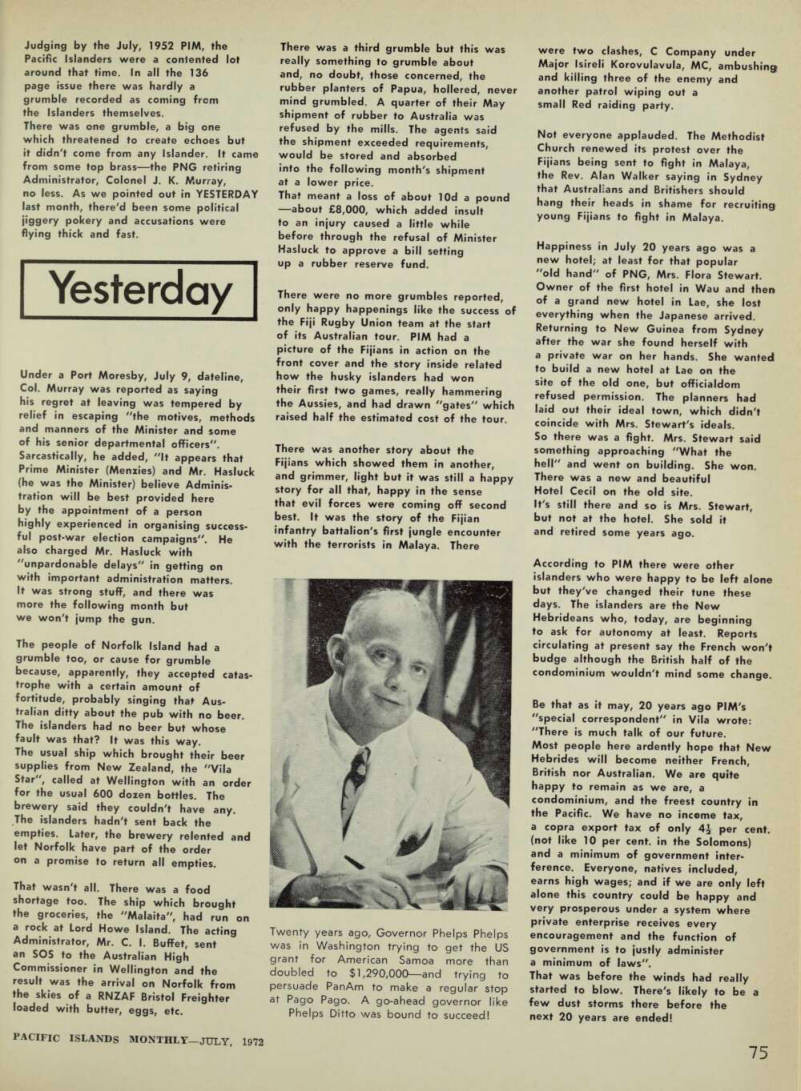
Twenty years ago, Governor Phelps Phelps was in Washington trying to get the US grant for American Samoa more than doubled to $1,290,000—and trying to persuade PanAm to make a regular stop at Pago Pago. A go-ahead governor like Phelps Ditto was bound to succeed!