Pacific Islands Monthly
pp. 13-15 · Read in the full issue
A Big French "Non" Upsets The
Entente In The New Hebrides
From correspondents in VILA and SYDNEY
Have the French said “never” to condominium hopes for autonomy?
Or have they said “when it comes, it’s going to come our way”?
This is the question being asked in the condominium after a startling policy speech by French Minister Pierre Messmer in Vila at the end of May. Made during a three-day visit to the New Hebrides, following his visit to New Caledonia (see p. 101 for story on his impact there), the speech shook the people who heard it as much by the way it was said as by what was said. Not only did the French Minister for Overseas Territories say non to any form of political progress in the immediate future, but he succeeded in trans gressing all the unwritten rules of political speechifying in the condo minium by making unilateral policy statements about which the British had not been approached beforehand.
His speech did something else. It made it clear for the first time publicly that British and French atti tudes on the political future of the condominium are widely divergent.
It was made at a large reception at the French Residency on the first day of his visit. Several hundred people, representing all sectors of the condominium’s varied community, listened as he read, with the same delivery and about as much emotion as a machine gun, a 30-minute state ment of France’s policy towards the territory which in essence said “Who pays the piper calls the tune. We, the French, have made the money here and this is the way things are going to happen (or not happen)”.
Unfortunately for the people who drafted the speech, a lot of the reasoning employed was based on some dubious premises.
Mr, Messmer said the condominium system that has operated since 1906 should still be the basis for “harmonious evolution” of the country, and it should not be thrust aside without a great deal of thought.
France considered that to trans
form the advisory council into a legislative council would be pre mature. Although the protocol was not immutable it “would be vain to think of hastily applying to the New Hebrides a facade of institutions destined above all else to appease international opinion”.
He said France’s ambition was “to make of the New Hebrideans of all origins, during the course of a pro gressive but complete development, a community which would be original, fully aware and responsible, better equipped than are certain of their neighbours in the Pacific to face the uncertainties of the modern world.
France is prepared to pursue, as long as necessary, the substantial effort she has already made in the interests of the New Hebrides”.
Mr. Messmer made it clear that France wanted no quick political development in the New Hebrides by any elite, but she aimed at a policy of political gradualism.
Although Britain has made no clear policy statement on what it thinks is the future of the New Hebrides, the British attitude seems to be that political development cannot be held back to the slower pace of economic
development, nor can political development be held at the pace of the lowest common denominator. The more politically conscious in the community will always push for progress ahead of the masses.
Mr. Messmer’s frank statement will probably force the British to lay their own cards on the table as squarely as the French have. Many people in the New Hebrides are certainly ex pecting a British reply.
Earlier this year the 24-man New Hebrides Advisory Council moved, almost unanimously, that a legislative council be phased in. The present advisory council is comprised of 12 New Hebridean members, four British, four French and four con dominium officials.
Some members are already angered because Mr. Messsmer referred to “some people here, Europeans and Melanesians” as wanting a speedy transformation of the advisory council. Mr. Bob Paul, a member, said the advisory council could hardly be regarded as “some people”, especially as the vote was almost unanimous. Nor did the council ask for a speedy transformation, but
COPRA PLAN A 'BIT BELOW THE BELT'
suggested that a legislative council be phased in.
Mr. Messmer’s answer to that was that France did not think that the general level of education in the condominium was sufficient to sup port such institutions. Local thinking on that was that it is one thing to tell a teenager that he can’t have a bicycle, but it doesn’t help your popu larity to tell him you think he is too stupid to ride it as well.
Mr. Messmer’s long statement traced the political and economic history of the condominium. He said France and Britain had agreed that the condominium was not a colony but a zone of communal influence, and the protocol of 1914 was devised to establish the security of the people, particularly to fight against the early excesses of the sandalwood collectors and labour recruiters. It “thus appears as an instrument for protection and not domination,” he said.
This was a shining example of the dubious reasoning employed by the minister. He should have been aware
that sandalwooding and blackbirding
had been suppressed more than 30 years before the protocol, largely through Australian action. To pre tend that the protocol was anything more than straight colonialism is hardly realistic.
Between the wars, said Mr.
Messmer, the two governments had limited themselves to maintaining the convention, of keeping the peace and rendering justice. But for the last 25 years “they have considerably exceeded their original engagements by making a considerable equipment effort. This task is far from being achieved”. It was “natural and desirable,” said Mr. Messmer, that the New Hebrideans should wonder about their future.
There had been great social and economic improvements, although currently the state of the economy was causing concern because of the crisis through the slump in oils. But the copra industry was still valuable to development, and France wanted to introduce a price stabilisation system for tropical products, and a system of guaranteed prices for copra.
This was presumably intended as a sop to the copra producers who have been hit so badly by the present low prices in France. He said, “such action would need to be bilateral and would need the British Government’s agreement”. This one was really a bit below the belt. The onus for accepting, or refusing, such a pro posal was placed publicly upon the
British, yet how do you establish a viable, guaranteed price scheme when the present New Hebrides price is $3O and the economic price needed by planters is more like $80?
There was not much hope for extension of the timber industry, but the most promising future was in cattle production. With the increase in world population and the rise of living standards in New Caledonia, the demand for meat must increase.
There was also no reason why the New Hebrides could not share in the growing increase in tourism, although its hotel facilities were still insufficient.
He added: “But whatever the reasons for hopefulness, one cannot ignore the fragility of the economy, which is indicated by the deficit in the balance of trade, strong depen dence on the franc zone for exports and on the sterling zone for imports, by the small amount of private and condominium budget investment, and by the inescapable recourse to financial assistance from the admini strative powers. Under these con ditions, while it is not forbidden to think of the archipelago’s political
future, it is advisable to do this in the light of experience, and guarding against easy and hasty solutions which would only mean resignation, and with concern to build the structure from the base and not from the top.”
Mr. Messmer declared that “the appearance of Melanesian movements based on local custom or led by educated indigenes, and the activities of certain European associations, mark the awakening of new aspira tions, but the only thing these move ments have in common is a question ing of the status of the condomi nium.”
He continued: “It is generally realised that this status has guaranteed security and allowed considerable development, but it is claimed that this status no longer answers the contemporary world demands of efficiency and participation. It is certainly easy to criticise an inter national convention which is now half a century old, but if France has proved that she did not hold the agreement immutable, she still today considers it to be the basis for the harmonious evolution of the country.
In spite of certain archaic provisions which could perhaps be remedied, the 1914 protocol offers the unique advantage of doubled financial, tech nical and cultural assistance, which the more impatient people should not thrust aside without a great deal of thought.”
In France’s opinion a legislative assembly could “only be based upon a wide, popular foundation of educated and well-informed citizens.
At this moment, such a foundation is still embryonic and practically con fined to the two town areas [Vila and Santo].”
Mr. Messmer said France, with Britain, had now agreed to create the first communes, with full powers, the members directly elected. He did not, however, give any further details of this system (which would pre sumably be similar to systems designed for French Polynesia and New Caledonia).
The minister said he did not agree that a fusion of the two national services in the New Hebrides would be wise and economic. The real economy would be doubtful and the efficiency illusory because the national services, especially on health and education, were designed to ful fil different needs and were organised according to the techniques and practices peculiar to each nation. Con sequently, they “provided guarantees of equality, maintained by com petition, and the possibility of choice would disappear if they were to fuse.”
Perhaps the major failing in Mr.
Messmer’s speech was the omission of any recognition of human spiritual needs and ambitions. Economics, profits, investment, financial aid, do not cover the whole of the field of human ambition.
The people of the New Hebrides, sleepy as they have been in the past, are awakening and are feeling the same needs as their fellow islanders in other parts of the Pacific. “We look upon our neighbours with envy,” said one New Hebridean member at the last Advisory Council meeting, and he wasn’t talking about economics. If the French continue to ignore rising New Hebridean nationalism, which exists in Euro peans in the condominium as well as in New Hebrideans, it could make for trouble in the future. “He who sticks head in sand, gets kick up backside,” says the proverb.
On one subject Mr. Messmer was entirely constructive—land. “France has often been reproached for keep ing possession of land which she does not use and for condoning what is called the monopolising of land by companies which are unable or un willing to make full use of it . . . the French Government has adopted the principle of handing over a large part of its land to indigenous com munities, and has decided to finance the return to these same communities of SFNH land, the development of which cannot be envisaged in the near future.” (SFNH =: Societe Francaise des Nouvelles Hebrides, largest landowner in the New Hebrides, with the majority of shares owned by French Government.) This was cheering news indeed for the islanders, but, on the whole, the feel ing seems to be that Mr. Messmer’s chauvinistic speech has done the French cause in the New Hebrides more harm than good.
After outlining the financial help France would give to the New Hebrides in its sixth (1971-75) development plan, including extra money to repair the serious damage caused by four successive cyclones, the minister said the teaching of French would be intensified, and the operating expenses of private schools would be accepted by the state from 1973. “Thus,” he said, “France will participate more extensively still in the education of the Melanesian, and will facilitate their inclusion in the bi-lingual world of the Pacific.”
Mr. Messmer concluded that as history had decided that France should share the responsibility of New Hebrides’ future with Britain, a partner “who had become even more staunch with the treaty of entry to the Common Market”, so France with her long experience in
overseas affairs intended to assume that responsibility “with all the prudence dictated here by an economy facing crisis and change, a civic and technical enlightenment which is just beginning, and with the strong hope of achieving in this archipelago an original happy synthesis of the different cultures which meet here”.
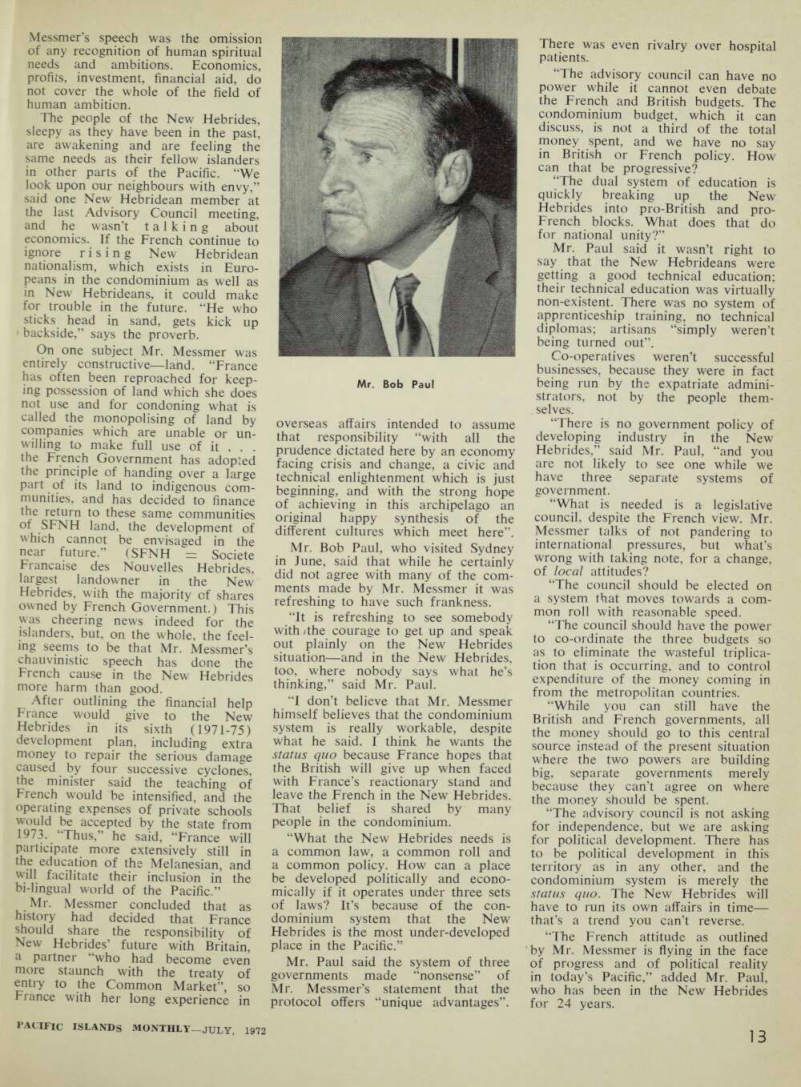
Mr. Bob Paul, who visited Sydney in June, said that while he certainly did not agree with many of the com ments made by Mr. Messmer it was refreshing to have such frankness.
“It is refreshing to see somebody with The courage to get up and speak out plainly on the New Hebrides situation—and in the New Hebrides, too, where nobody says what he’s thinking,” said Mr. Paul.
“I don’t believe that Mr. Messmer himself believes that the condominium system is really workable, despite what he said. I think he wants the status quo because France hopes that the British will give up when faced with France’s reactionary stand and leave the French in the New Hebrides.
That belief is shared by many people in the condominium.
“What the New Hebrides needs is a common law, a common roll and a common policy. How can a place be developed politically and econo mically if it operates under three sets of laws? It’s because of the con dominium system that the New Hebrides is the most under-developed place in the Pacific.”
Mr. Paul said the system of three governments made “nonsense” of Mr. Messmer’s statement that the protocol offers “unique advantages”.
There was even rivalry over hospital patients.
“The advisory council can have no power while it cannot even debate the French and British budgets. The condominium budget, which it can discuss, is not a third of the total money spent, and we have no say in British or French policy. How can that be progressive?
“The dual system of education is quickly breaking up the New Hebrides into pro-British and pro- French blocks. What does that do for national unity?”
Mr. Paul said it wasn’t right to say that the New Hebrideans were getting a good technical education; their technical education was virtually non-existent. There was no system of apprenticeship training, no technical diplomas; artisans “simply weren’t being turned out”.
Co-operatives weren’t successful businesses, because they were in fact being run by the expatriate admini strators, not by the people them selves.
“There is no government policy of developing industry in the New Hebrides,” said Mr. Paul, “and you are not likely to see one while we have three separate systems of government.
“What is needed is a legislative council, despite the French view. Mr.
Messmer talks of not pandering to international pressures, but what’s wrong with taking note, for a change, of local attitudes?
“The council should be elected on a system that moves towards a com mon roll with reasonable speed.
“The council should have the power to co-ordinate the three budgets so as to eliminate the wasteful triplica tion that is occurring, and to control expenditure of the money coming in from the metropolitan countries.
“While you can still have the British and French governments, all the money should go to this central source instead of the present situation where the two powers are building big, separate governments merely because they can’t agree on where the money should be spent.
“The advisory council is not asking for independence, but we are asking for political development. There has to be political development in this territory as in any other, and the condominium system is merely the status quo. The New Hebrides will have to run its own affairs in time— that’s a trend you can’t reverse.
“The French attitude as outlined by Mr. Messmer is flying in the face of progress and of political reality in today’s Pacific,” added Mr. Paul, who has been in the New Hebrides for 24 years.
Mr. Bob Paul