Hell's Gate'
pp. 62-63 · Read in the full issue
Through
To New Guinea's
Henganofi Caves
By 'Kakata’
During the past five years the Henganofi Caves, in Papua New Guinea’s Eastern Highlands District, have become a popular attraction for those tourists who prefer visiting outof-the-way places.
Although they are readily accessible from the Highlands Highway the caves are not mentioned in any of the tourist brochures featuring the district. Most of those who learn of their existence do so from talking with others who have been there.
Weekend visitors occasionally drive up from Lae, a distance of about 165 miles, to inspect them. Is the trip worth it?
The Henganofi Caves are situated in the base of Mt. Maramuga about five miles south of the Henganofi Sub - District headquarters station, Access is gained from the highway by a gravel road, the entrance of which is marked with a sign point ing the way to the Foursquare Gospel Mission at Fore.
The first village encountered on the right-hand side of the road is Yoho tegabe and it is here that native guides can be hired. From Yoho tegabe a foot track drops downhill to the west and after about 20 minutes walking one arrives at the base of Mt. Maramuga.
The visitor is immediately struck by the presence of a small stream which appears to be flowing in the wrong direction—towards the head of the valley and not away from it.
This is no illusion as it does flow to the foot of the mountain before quietly disappearing beneath a massive limestone wall!
Mt. Maramunga is honeycombed with caverns and subterranean river beds which offer the experienced caving enthusiast exciting and potenti ally dangerous adventure. If he con fines himself to the more accessible parts of the cave system the less experienced adventurer, if he is care ful and takes a guide with him, can share in the excitement.
The Henganofi Caves became known to Europeans after an Ad ministration Patrol Officer visited them in 1937. Their existence had been known to the local natives from time immemorial. Native folklore acknowledges the ancient origin of the cave system with the following legend.
One evening a spirit who dwelt near Yohotegabe decorated himself in all his finery and attended a dance in a neighbouring village. During the festivities a young woman be came deeply infatuated with him.
Just before dawn the spirit set off for home and daybreak found him climbing a spur beneath the summit of Mt. Maramuga.
Overcome with fatigue he lay down
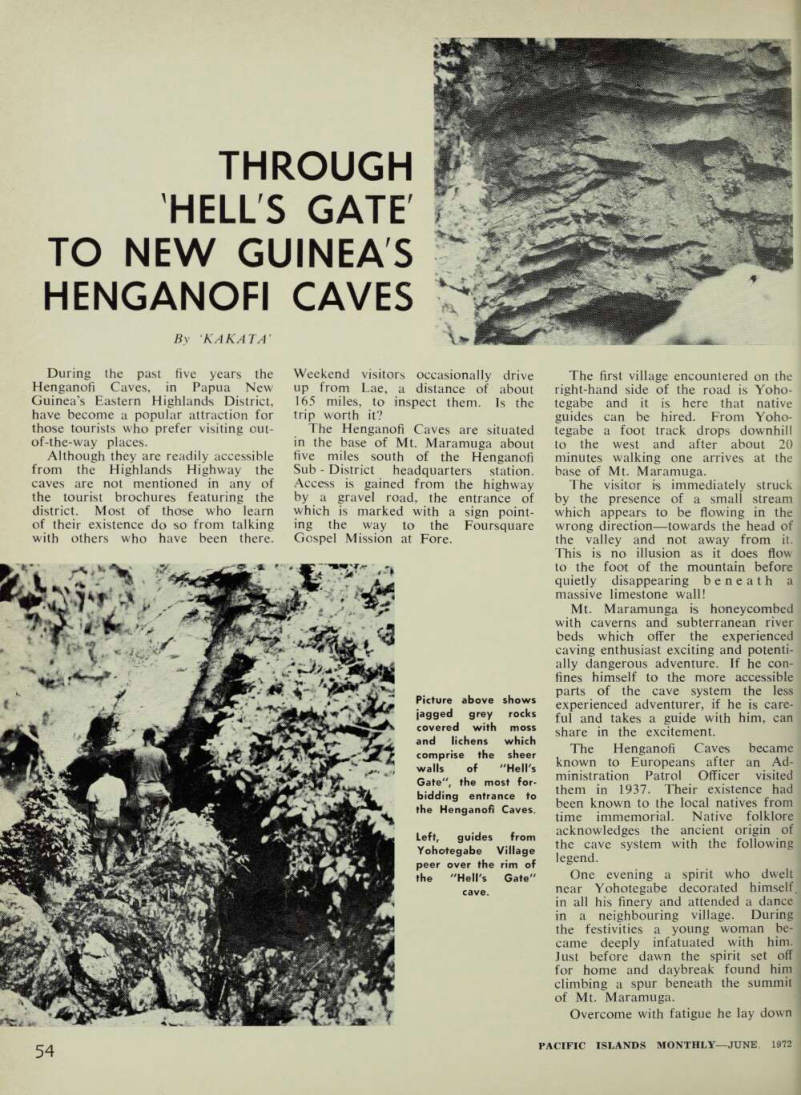
Picture above shows jagged grey rocks covered with moss and lichens which comprise the sheer walls of "Hell's Gate", the most for bidding entrance to the Henganofi Caves.
Left, guides from Yohotegabe Village peer over the rim of the "Hell's Gate" cave.
and fell into a deep sleep. Mean while, his young admirer, noticing that he had gone, set out to follow him and soon found him asleep by the side of the track. After availing herself of an immodest liberty with his person she too fell asleep.
When the spirit arose he realised what had happened and recognised his assailant. She awoke and ran off with the spirit in angry pursuit. He chased her to the top of Mt. Mara muga where he grabbed an axe. The terrified girl raced down the moun tainside with the spirit almost upon her. In his rage he struck at her but missed, cutting the earth instead, cleaving it into the cave system which remains as a monument to his out
raged dignity!
There are two prominent entrances to the system, the more accessible of these being through the Murifinka Cave. One enters Murifinka by climbing down the bed of a small stream which cascades into darkness about 15 ft below the entrance.
With the aid of a rope access is fairly easily gained. Inside, the cave takes the form of a narrow high-roofed limestone passage.
Large stalactites hang from the
roof and the atmosphere is cold and damp. About 100 feet from the en trance the cavern terminates abruptly at the rim of a large subterranean crater, the sides of which drop vertic ally for about 30 feet. To go past this point one needs proper equip ment, and it is here that the novice should turn back.
From the floor of this crater a number of passages lead off in various directions and these further sub-divide to form a labyrinth which has yet to be fully explored. The village people say that it is possible to enter the caves at dawn and come out at dusk without having visited them all.
The most imposing entrance to the Henganofi Caves is through Hell’s Gate, a forbidding rock chimney probably formed when a cavern roof collapsed leaving a shaft about 30 feet wide and perhaps 100 feet deep.
To look through the ‘gate’ it is neces sary to go perilously close to the edge and this can be dangerous as the rocks are slippery and covered with moss.
Hell’s Gate, or Tintinpangkai in the local dialect, is an awesome spectacle. Two small streams pour in over the rim of the crater and in the depths these are convulsed into clouds of mist which rise up like steam from a giant cauldron.
It is possible to descend into the Henganofi Caves by way of Hell’s Gate, but the descent is made diffi cult by a bend in the chimney about half-way down. This means that for
some distance the adventurer is sus pended in mid-air amid drenching mist, and with a bed of jagged rocks beneath him.
The local people visit the caves to hunt bats. Some have lost their lives when doing so, particularly when en tering through Hell’s Gate. There have been two occasions when Euro peans have got into difficulties. One man was lost for 24 hours in the bowels of the mountain before native rescuers found him. Another suffered partial paralysis of his arms when he became suspended on a rope which lodged under his armpits and cut circulation.
Once inside the Henganofi Caves one is inspired by their immensity more than their beauty. There are stalactites and stalagmites but these are drab grey and brown and perpetu ally damp.
Local tradition has it that those who desecrate the caves by damag ing them will be punished for their vandalism by bearing albino children.
The Yohotegabe people still hold to this belief and name a number of families with part-albino members.
Burum, my guide on my last trip to the caves explained that his brother had broken this taboo and had five part-albino children. He had offended on one occasion and his wife bore a light-skinned child!
A visit to the Henganofi Caves can be a pleasant outing even if en*ry is not made into the underground system. A supplementary attraction is the scenic drive from the highway to the road-head at Yohotegabe.
Over a distance of two miles the road rises nearly 1,000 feet, affording an unsurpassed panoramic view over the confluence of the Karmanantina and Kafetina Rivers and beyond.
Inside the Murifinka cave, one of many caves which honeycomb the base of Mt.
Maramuga in Papua New Guinea's Eastern Highlands District.
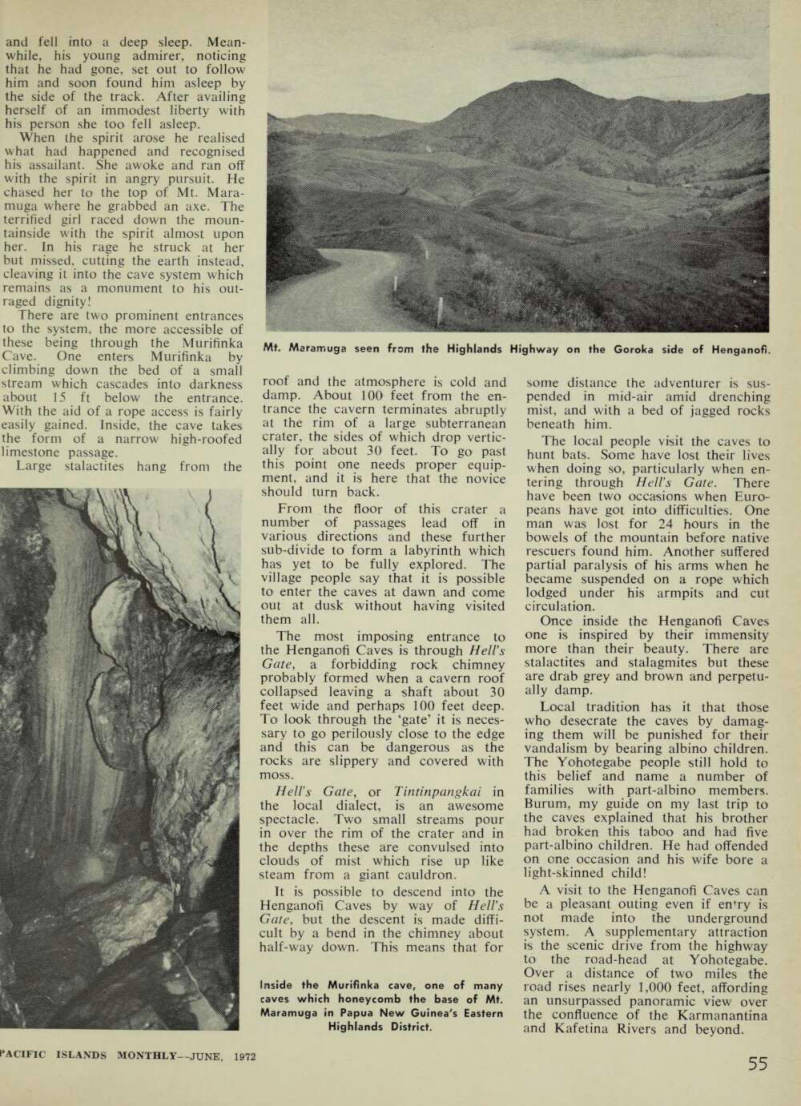
Mt. Maramuga seen from the Highlands Highway on the Goroka side of Henganofi.