US "had to negotiate"
p. 16 · Read in the full issue
for defence reasons
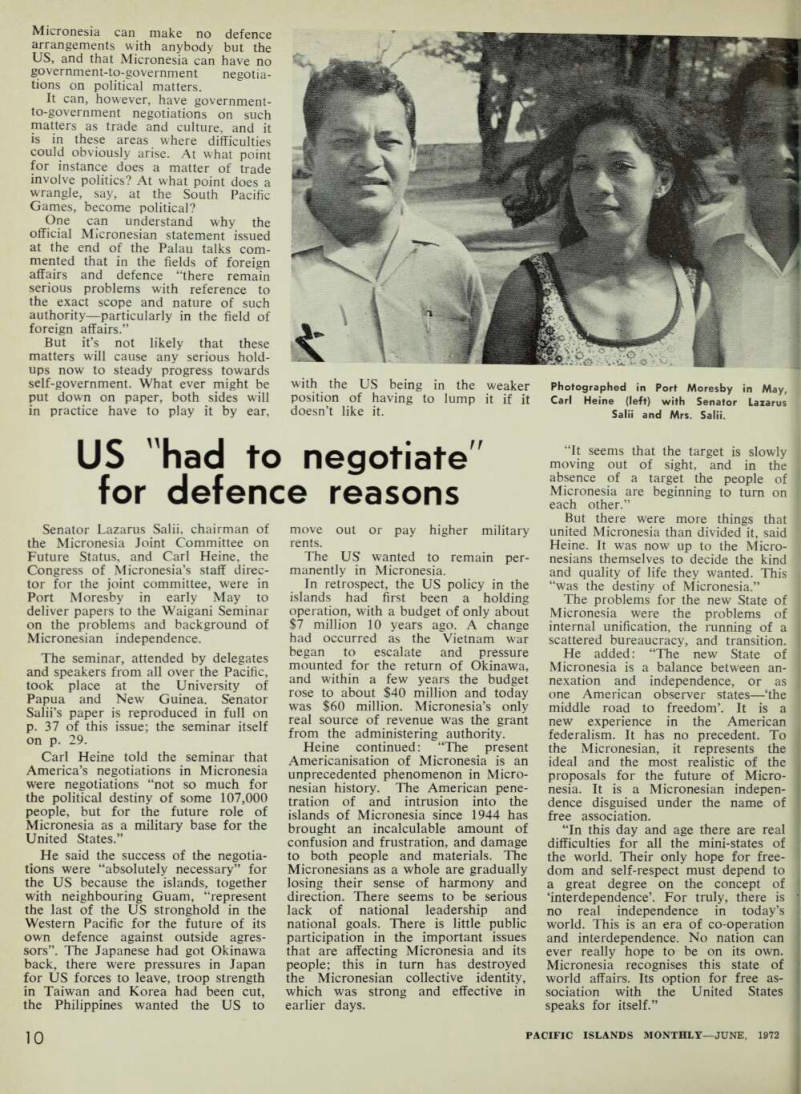
Senator Lazarus Salii, chairman of the Micronesia Joint Committee on Future Status, and Carl Heine, the Congress of Micronesia’s staff director for the joint committee, were in Port Moresby in early May to deliver papers to the Waigani Seminar on the problems and background of Micronesian independence.
The seminar, attended by delegates and speakers from all over the Pacific, took place at the University of p a n„a and Npw Hninpa <v-natnr SalTs paper .s reproduced in Su on p. 37 of this issue; the seminar itself on v 29 * ‘ . .. , .
Carl Heme told the seminar that Americas negotiations m Micronesia were negotiations not so much for the political destiny of some 107,000 people, but for the future role of Micronesia as military base for the United States.
He said the success of the negotiadom were “absolutely necessary” for the US because the islands, together with neighbouring Guam, “represent the last of the US stronghold in the Western Pacific for the future of its own defence against outside agressors”. The Japanese had got Okinawa back, there were pressures in Japan for US forces to leave, troop strength in Taiwan and Korea had been cut, the Philippines wanted the US to
move out or pay higher military rents.
The US wanted to remain per manently in Micronesia.
In retrospect, the US policy in the islands had first been a holding operation, with a budget of only about $7 million 10 years ago. A change had occurred as the Vietnam war Jf*®”. e i, calat f and f mounted for the return of Okinawa, pd mthm a few years the budget rose to alx) ut $4O million and today wa * 560 million. Micronesia's only from the administering authority.
Heine continued: “The present Americanisation of Micronesia is an unprecedented phenomenon in Micro nesian history. The American pene tration of and intrusion into the islands of Micronesia since 1944 has brought an incalculable amount of confusion and frustration, and damage to both people and materials. The Micronesians as a whole are gradually losing their sense of harmony and direction. There seems to be serious lack of national leadership and national goals. There is little public participation in the important issues that are affecting Micronesia and its people; this in turn has destroyed the Micronesian collective identity, which was strong and effective in earlier days.
“It seems that the target is slowly moving out of sight, and in the absence of a target the people of Micronesia are beginning to turn on each other.”
But there were more things that united Micronesia than divided it, said Heine. It was now up to the Micro nesians themselves to decide the kind and quality of life they wanted. This “was the destiny of Micronesia.”
The problems for the new State of Micronesia were the problems of internal unification, the running of a scattered bureaucracy, and transition.
He added: “The new State of Micronesia is a balance between an nexation and independence, or as one American observer states—‘the middle road to freedom’. It is a new experience in the American federalism. It has no precedent. To the Micronesian, it represents the ideal and the most realistic of the proposals for the future of Micro nesia. It is a Micronesian indepen dence disguised under the name of free association.
“In this day and age there are real difficulties for all the mini-states of the world. Their only hope for free dom and self-respect must depend to a great degree on the concept of ‘interdependence’. For truly, there is no real independence in today’s world. This is an era of co-operation and interdependence. No nation can ever really hope to be on its own.
Micronesia recognises this state of world affairs. Its option for free as sociation with the United States speaks for itself.”