Pacific Islands Monthly
pp. 15-16 · Read in the full issue
Now It's The Micronesians' Turn
To Tread Independence Road
By Stuart Inder
Micronesia is to become a self governing state in free association with the United States. Planning has already begun for a transitional period during which the full details are to be worked out before the reins are handed over. But it looks as if one of the six districts of the far flung trust territory—the Marianas— will not be part of the new state; it will make separate arrangements for a closer relationship with the US.
All these decisions flow from the fourth round of constitutional talks between the Micronesians and the US, held in Palau, in the Carolines, in April.
Senator Lazarus Salii, leader of the Micronesian delegation, told PIM: ‘At Palau we saw the end of the tunnel. What remains is the detail.
Fhere will be a lot of fighting on the wording of the compact, but it is of little importance. We’ve agreed in principle on all the matters which divided us in the past. This was the last round.”
The Palau talks finally gave the Micronesians a guarantee that all of ;heir four basic requirements for a US handover would be met. Some of hese had already been recognised it the third round of talks held last October at Hana, Hawaii, but the nost important of the four principles lad not been met.
The principles are Micronesia’s pasic right to self-determination, its ight to decide on its own constitution md laws, its right to control the land, md finally its right to terminate any :ompact with the United States milaterally— that is, by either side vithout the other side’s consent.
Right up until the Palau talks the US held that both sides should have ;o agree to a dissolution of any com pact.
This problem was resolved by a Micronesian proposal at Palau, slightly modified at the talks, that 'ree association be given a testing period, and that the association be erminable by mutual consent during
this period. At the end of this test period, the compact will become uni laterally terminable.
It was also agreed that termination will require a vote of both the Con gress of Micronesia and the people of Micronesia, and that if free asso ciation does end it will be replaced with a security treaty between Micro nesia and the US. The details of this treaty will be decided before the compact is entered into.
One important detail now to be decided is the length of the test period of self-government. The Micro nesians at Palau proposed five years, the Americans proposed 15, and the question is still open.
Micronesian leaders meanwhile are quietly triumphant at the outcome of negotiations which started formally as far back as 1969.
The timetable now is that the Micronesian delegation will meet with the US in Washington about July on the details of the compact. They will aim to get something on paper for presentation to the next meeting of the Congress of Micronesia to be held in Ponape in August.
After the Micronesian Congress discusses it, it will go to the US Congress and then to a Micronesian plebiscite. The plebiscite would not
be reached until next year, and will probably be run in conjunction with a constitutional convention in Micro nesia to discuss the form of the new State of Micronesia.
Enabling legislation for the con vention will probably go to the Micronesian Congress about January next. There are likely to be about 40 to 60 members of the convention, elected at large, and the convention’s deliberations will be speeded up by the Micronesian Congress making submissions on the future form of government.
Present thinking by the Micro nesian Status Delegation is that there should be an executive council of all districts, with an elected executive chairman as head of the Micronesian State. The US in the transitional period would be represented by a Presidential representative with ad visory functions. The courts will be separate and the Congress of Micro nesia will remain in existence.
The financial arrangements be tween Micronesia and the US have yet to be worked out, but Senator Salii told PIM that the US is com mitted “all the way” to supporting Micronesia financially.
It’s likely that Micronesia will re ceive compensation payments for its agreement to deny the use of Micro nesian lands and waters to other military forces; in addition, it will expect substantial payments for leases of specific military areas required by the US for military use, and other payments for options.
The details, too, have still to be negotiated on US insistence in con trolling Micronesian foreign affairs and defence. At Palau it was agreed that the US would have “broad authority” in these two fields. This agreement was reached only after what Senator Salii refers to as “a big compromise” on the part of the Micronesians. Undoubtedly it was a genuine compromise; the principle was stated clearly enough and under stood by both sides that is, that
Micronesia can make no defence arrangements with anybody but the US, and that Micronesia can have no government-to-govemment negotia tions on political matters.
It can, however, have government to-government negotiations on such matters as trade and culture, and it is in these areas where difficulties could obviously arise. At what point for instance does a matter of trade involve politics? At what point does a wrangle, say, at the South Pacific Games, become political?
One can understand why the official Micronesian statement issued at the end of the Palau talks com mented that in the fields of foreign affairs and defence “there remain serious problems with reference to the exact scope and nature of such authority—particularly in the field of foreign affairs.”
But it’s not likely that these matters will cause any serious hold ups now to steady progress towards self-government. What ever might be put down on paper, both sides will in practice have to play it by ear,
with the US being in the weaker position of having to lump it if it doesn’t like it.
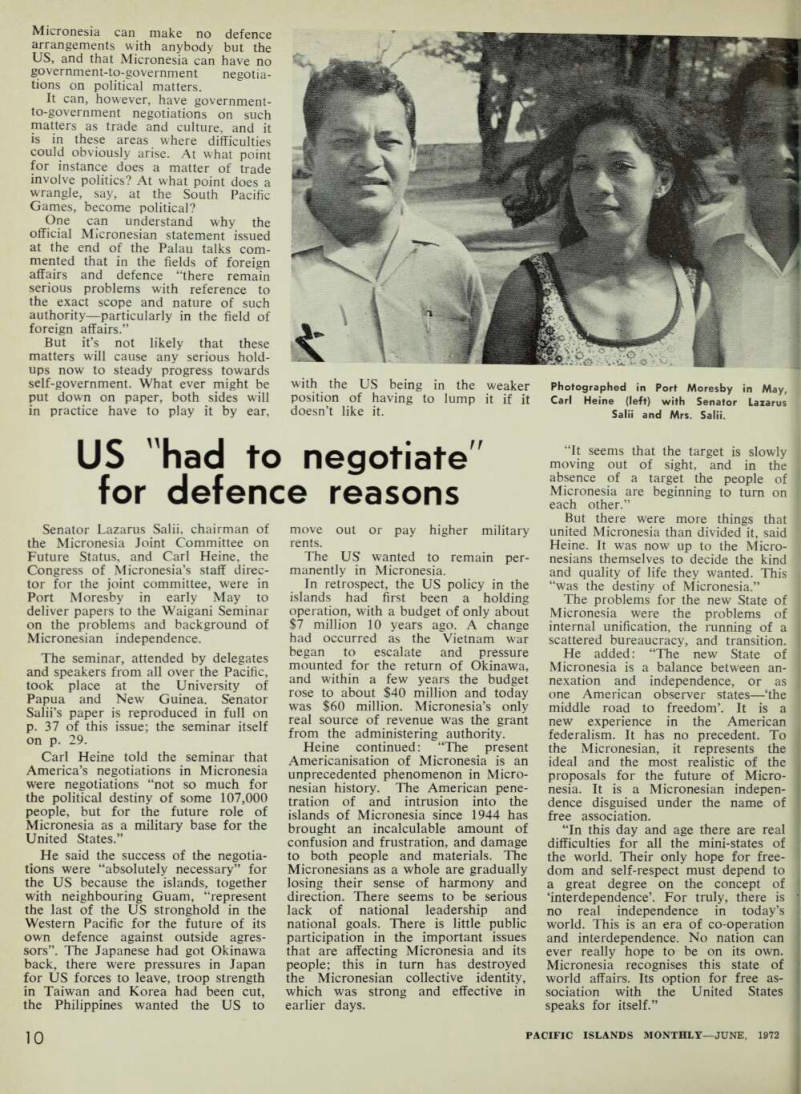
Photographed in Port Moresby in May, Carl Heine (left) with Senator Lazarus Salii and Mrs. Salii.