New breed of fisherman
pp. 119-121 · Read in the full issue
in American Samoa
From a Pago correspondent
A South Sea fisherman is usually visualised as a lava lava-clad Poly nesian, paddling his outrigger paopao from a palm-lined stretch of beach to the clear, blue water beyond the reef. That type of fisherman is still very much in evidence in the South Pacific, but a new breed is being de veloped in American Samoa.
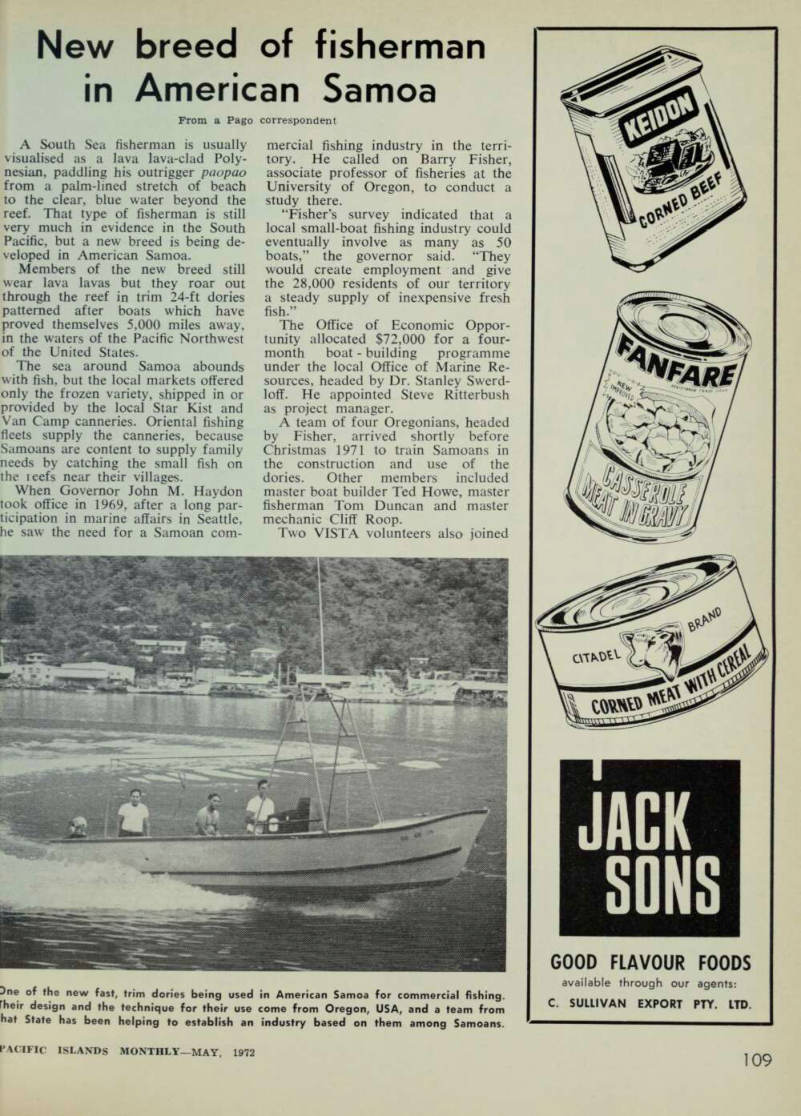
Members of the new breed still wear lava lavas but they roar out through the reef in trim 24-ft dories patterned after boats which have proved themselves 5,000 miles away, in the waters of the Pacific Northwest of the United States.
The sea around Samoa abounds with fish, but the local markets offered only the frozen variety, shipped in or provided by the local Star Kist and Van Camp canneries. Oriental fishing fleets supply the canneries, because Samoans are content to supply family needs by catching the small fish on the reefs near their villages.
When Governor John M. Haydon took office in 1969, after a long par ticipation in marine affairs in Seattle, he saw the need for a Samoan com
mercial fishing industry in the terri tory. He called on Barry Fisher, associate professor of fisheries at the University of Oregon, to conduct a study there.
“Fisher’s survey indicated that a local small-boat fishing industry could eventually involve as many as 50 boats,” the governor said. “They would create employment and give the 28,000 residents of our territory a steady supply of inexpensive fresh fish.”
The Office of Economic Oppor tunity allocated $72,000 for a four month boat - building programme under the local Office of Marine Re sources, headed by Dr. Stanley Swerd loff. He appointed Steve Ritterbush as project manager.
A team of four Oregonians, headed by Fisher, arrived shortly before Christmas 1971 to train Samoans in the construction and use of the dories. Other members included master boat builder Ted Howe, master fisherman Tom Duncan and master mechanic Cliff Roop.
Two VISTA volunteers also joined
[?]ne of the new fast, trim dories being used in American Samoa for commercial fishing. [?]heir design and the technique for their use come from Oregon, USA, and a team from [?]hat State has been helping to establish an industry based on them among Samoans.
Fast, powerful boats
:he programme. Boat builder Reino Randall worked with two Samoan trainees, and Bart Snyder trained two Samoans in marine engines. After he initial programme, calling for five joats, they planned to continue their raining programmes at the local Community College.
The dories, similar to hundreds ishing off the coast of Oregon, are >owered by 130-horsepower inboard mtboard engines which can drive hem at a speed of more than 30 mots. They can accommodate five >r six fishermen, have a range of 300 niles, and can carry a ton of fish, fhey are being widely distributed hroughout the territory.
The first boat, christened Taliava »y Mrs. Haydon, went to a group leaded by Chief Tufele in the Manu’a slands under a loan obtained through revolving fund set up for the boat Togramme by the Development Bank f American Samoa. Ritterbush said tie Manu’a group reported “fairly ood results” in preliminary tests onducted near its islands, which lie 0 miles east of Tutuila.
The second boat was purchased by group from Swains Island, which lies 80 miles north of Tutuila. Swains is ctually part of the Tokelau Islands, ut is linked to Samoa because it was sttled by an American trader in 1856. he latest dory to be completed went ) a Tutuila group, headed by House peaker Fainu’uelei Utu of the Legis iture of American Samoa. It will & out of Pago Pago Harbour.
The Tokelau group, headed by lucation official Paul Pedro, re nted excellent results in more than dozen runs out of Pago Pago. The aily catches have averaged nearly X) pounds and have run as high as X). The fish are sold to local mer lants at 50c a pound.
Governor Haydon and Fisher’s am from Oregon hope the local jet will eventually grow to as many 1 50 boats.
If the local market requirements •r fish are met, the two large can aries are capable of handling any nount the local dory owners can ing in. The canneries, currently are rved by 150 fishing boats with a unbined crew of 2,100 Koreans, ipanese and Taiwanese.
“We’ve learned a great deal from ir Oregon friends about fishing as a >mmercial enterprise,” said Pedro, we’ve supplemented that know dge with a few tricks of our own. fter all, South Sea islanders are not rangers to fishing. We’ve been at it our own way for thousands of :ars.”