Family
p. 47 · Read in the full issue
planning programme for pigs
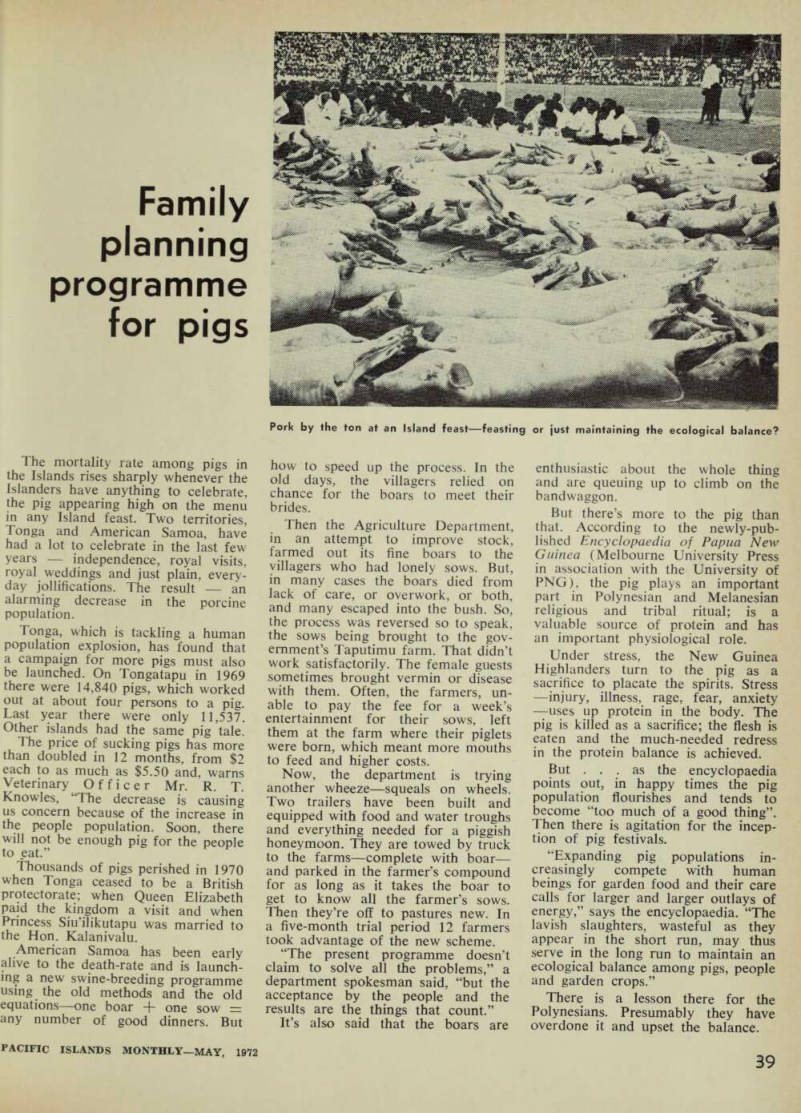
The mortality rate among pigs in the Islands rises sharply whenever the Islanders have anything to celebrate, the pig appearing high on the menu in any Island feast. Two territories, Tonga and American Samoa, have had a lot to celebrate in the last few years independence, royal visits, royal weddings and just plain, every day jollifications. The result an alarming decrease in the porcine population.
Tonga, which is tackling a human population explosion, has found that a campaign for more pigs must also be launched. On Tongatapu in 1969 there were 14,840 pigs, which worked out at about four persons to a pig.
Last year there were only 11,537.
Other islands had the same pig tale.
The price of sucking pigs has more than doubled in 12 months, from $2 each to as much as $5.50 and, warns Veterinary Officer Mr. R. T.
Knowles, “The decrease is causing us concern because of the increase in the people population. Soon, there will not be enough pig for the people to eat.”
Thousands of pigs perished in 1970 when Tonga ceased to be a British protectorate; when Queen Elizabeth paid the kingdom a visit and when Princess Siu’ilikutapu was married to the Hon. Kalanivalu.
American Samoa has been early alive to the death-rate and is launch ing a new swine-breeding programme using the old methods and the old equations—one boar + one sow any number of good dinners. But
how to speed up the process. In the old days, the villagers relied on chance for the boars to meet their
k r^ s ‘
Then the Agriculture Department, in an attempt to improve stock, farmed out its fine boars to the villagers who had lonely sows. But, in many cases the boars died from lack of care, or overwork, or both, and many escaped into the bush. So, the process was reversed so to speak, the sows being brought to the govemmenl’s T a p U timu farm. TTiat didn’l .r.m^t* atlS^k Ct ° n ui ft ma e Buests b nrt?n t I tn rm f l ° r dlsease nhis , hen ’; ° l en ’ f the farmers > Lia ‘ able to pay the fee for a week s I"’ ,u OWS ' • e !‘ m , at lhe ft™ w^ere tlleir Piglets were born, which meant more mouths to feed and higher costs.
Now, the department is trying another wheeze—squeals on wheels.
Two trailers have been built and equipped with food and water troughs and everything needed for a piggish honeymoon. They are towed by truck to the farms—complete with boar— and parked in the farmer’s compound for as long as it takes the boar to get to know all the farmer’s sows.
Then they’re off to pastures new. In a five-month trial period 12 farmers took advantage of the new scheme.
“The present programme doesn’t claim to solve all the problems,” a department spokesman said, “but the acceptance by the people and the results are the things that count.”
It’s also said that the boars are
enthusiastic about the whole thing and are queuing up to climb on the band waggon.
But there’s more to the pig than that. According to the newly-pub lished Encyclopaedia of Papua New Guinea (Melbourne University Press in association with the University of PNG), the pig plays an important part in Polynesian and Melanesian religious and tribal ritual; is a valuable source of protein and has an important physiological role, Under stress> the New Guinea Highlanders turn to the pig as a sacrifice to placate the spirits. Stress —injury, illness, rage, fear, anxiety uses up protein in the body Pig is killed as a sacrifice; the flesh is eaten and the much-needed redress in the protein balanc£ is achieved , r> . , • • : a J* encyclopaedia P° lnts ? ut > in happy times the pig population flourishes and tends to °5 com s to ° mu . <^ l of a thing”, *. en there is agitation for the mcep f estlva l s - “Expanding pig populations in creasingly compete with human beings for garden food and their care calls f° r larger and larger outlays of energy,” says the encyclopaedia. “The lavish slaughters, wasteful as they appear in the short run, may thus serve in the long run to maintain an ecological balance among pigs, people and garden crops.”
There is a lesson there for the Polynesians. Presumably they have overdone it and upset the balance.
Pork by the ton at an Island feast —feasting or just maintaining the ecological balance?