She'll Drive A Hard
p. 43 · Read in the full issue
Bargain For Papua
Josephine Abaijah is an attractive young Papuan with a diploma from London University, the ability to raise a $3,000 bank loan in two minutes and she is the first woman elected to the territory’s House of Assembly.
And even before she was declared winner of the Central Regional Electorate she was offered, and refused, a ministerial post by the country’s two major parties.
She is also refusing to be labelled a representative of women. A Women’s Lib tag, she said in an interview, is the last thing she wants.
“I was elected by men as well as women.’” she said. “The men in the house don’t just work for men. I’m not going to separate the sexes.”
Nevertheless, she is sufficiently a woman to refuse to disclose her exact age (she is about thirty).
One of 17 children from Milne Bay, Miss Abaijah has been training and working as a health education specialist in the Department of Public Health since leaving high school about 10 years ago. This has made her, she believes, an expert in village-level communications. The six
men she easily beat in Central Regional are unlikely to argue about her success as a communicator, Her campaign costing about $3,000 was a mixture of hard slog through the villages, which the athletic former territory netball vice-captain handled with comparative ease, and high pressure advertising by letter and in the national newspaper, She said she raised the campaign money in a two minute interview with her bank manager, Miss Abaijah said both Pangu and United Parties had offered her a ministerial post in return for her support, “I refused them,” she said. “I don’t want to be committed. Apart from that, one of the messages that came through most clearly while 1 was campaigning in the villages was that the people don’t want their member to be a minister. They think ministers are stooges and have no time to spend with their people.”
As things stand now Papua would be a junior and mendicant partner in a united and independent Papua New Guinea.
She said she is neither for nor
against national unity as a concept.
“I will support it if it’s best for Papua. I will oppose it if it is not,” she said.
Her attitude towards self-govern ment is equally pragmatic. “Australia wants to give us self-government as soon as it can,” she said. “So what’s the use of shouting for something we can have anyway.
“We should be capitalising on Australia’s eagerness to get out by driving as hard a bargain as we can.”
Miss Abaijah describes herself as a Papuan nationalist. She said she will be forming a movement called “Papua Besena”, which means roughly Papuan nationalism. It will aim to make Papuans more aware of their identity and to mobilise support for greater development.
Because of its separatist overtones it is this activity that is most likely to bring Miss Abaijah into conflict with the administration and Aus tralian Government. Australia’s most basic policy is that Papua and New Guinea shall proceed to independence as a single country.
Reservations about imposed unity are increasing in Papua. A movement called “Papua Action ”, with broadly similar aims to Papua Besena, made a brief appearance last year.
To the growing concern of Papuans about their future, Miss Abaijah will bring one of the most articulate and distinctive voices in the new House of Assembly.
Friendly smiles and a handshake after the signing of the wage agreement between the Airline Workers' Union and Air India. Left to right: The airline's Fiji manager Madan Lall, union secretary Apisai Tora and Air India's manager for Australasia, R. K. Narpat- Singh. Photo by Stan Ritova. Story in "Fiji Talanoa", p. 36.
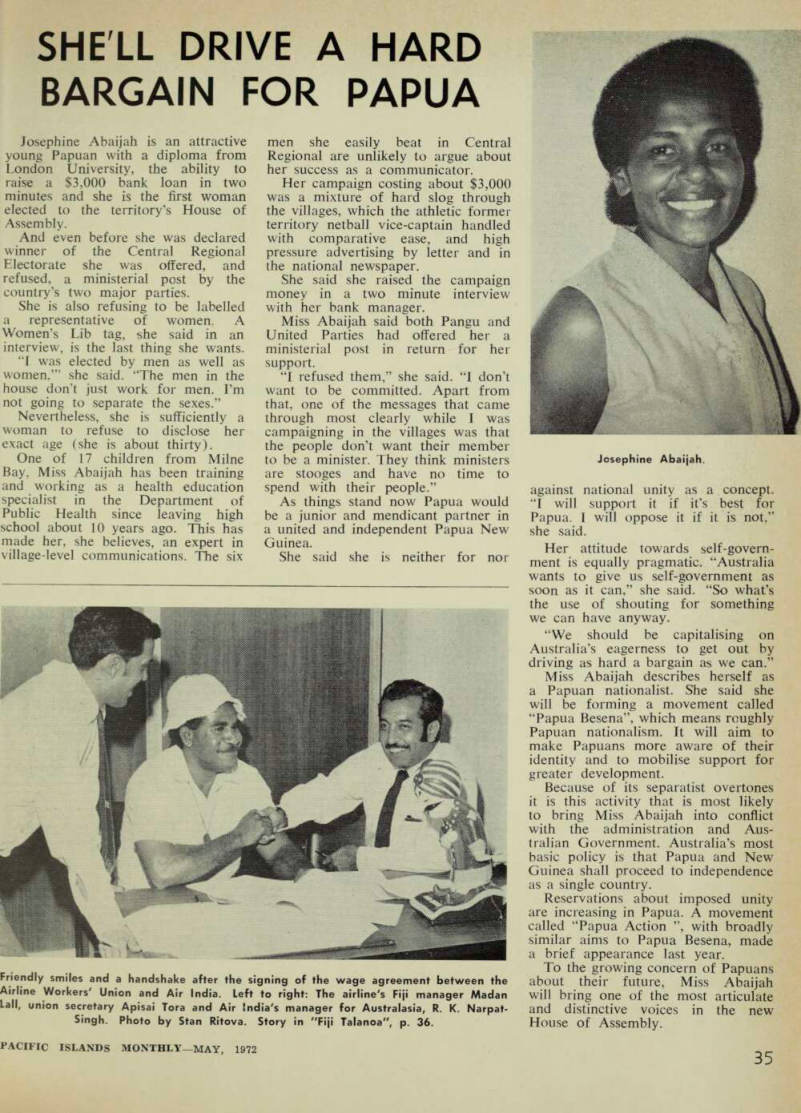
Josephine Abaijah.