Witchcraft, A Way
p. 32 · Read in the full issue
To Achieve A Goal
Which witch is which? Or to put it another way, which witchcraft is bad and which is good—and is it really rife in Fiji, even on the sporting field? Although the practice of witch craft is outlawed in Fiji, indications are that belief in mystical powers is as strong as ever it was.
It was reported recently that people of all races were flocking to consult 30 year-old Mrs. Lusia Seini Vunibaka, who claims to have special healing powers endowed upon her by the legendary Fijian sharkgod of the sea, Dakuwaqa. Rumour has it that she’s so busy that her clients are issued with numbers, as is the case in a hospital waiting room.
In a report in The Fiji Times, Mrs.
Vunibaka claimed to have first en countered the seagod one night in 1967. Her family thought she had gone crazy when she was taken by a violent fit, but later they came to believe in her strange powers when her predictions started coming true.
She’d been told by Dakuwaqa that he would appear again in four years’ time. It happened in June last year, when she was again empowered to make predictions which she says are beginning to come true.
Mrs. Vunibaka, an attractive gentle faced woman who speaks in the
Mrs. Vunibaka isn’t the only one with a touch of magic, it seems.
Those craving greater prowess on the sporting field might find inspiration in a report on witchcraft in a recent issue of Fiji Sport.
Writer Vijendra Kumar claimed that witchcraft was secretly solicited by soccer players and team supporters “in bizarre attempts to influence the outcome of major matches.” Some of Fiji’s top footballers were reported too to have vouched for the success of the black art.
They talked of people going into trances and performing mystical rituals; of words inscribed on foot ball bladders to ensure success; of messages written inside a player’s boots; of teams crumbling at the mere rumour of black magic having been employed by the opposing team.
The March issue of Fiji’s sporting newspaper reported: “There are various ways in which a witch-doctor does the Devil’s busi ness to help his client’s team win.
Usually, he does not levy a fee for services rendered. Some are content with yaqona and cigarettes. Others, with apparently more rapacious spirits, ask for a rooster (preferably white-feathered) and an occasional bottle of whisky or brandy.
“In return, he assures his client team’s representatives that the Devil s denizens would join the team in visibly to attack the opposing goal and defend their own.” .
Some witch doctors worked during the night before a big match, using all manner of incantations and incense powder in order to adversely affect the accuracy of the opponents’ shooting. , .
There’s no doubt that belief in witchcraft —call it draunikau or what you-will—is very much a part of the Fiji way of life. Ask someone whether he believes in its power and invariably he’ll say he doesn’t know. But few will gainsay the fact of its existence.
Cakaudrove dialect, which she says she cannot speak without Dakuwaqa’s power, declines to treat those who have not first visited a doctor. She maintains that hers must be the second hope of cure.
Her clients, she says, include government ministers, members of religious organisations and other prominent people. She claims to have healed a nun with a lame leg and a Kadavu church elder whose sight was failing.
Payment for her attentions hasn’t yet been affected by inflation —one requires only some yaqona and a 5c piece. The yaqona is said to signify the actual soothing and healing power and the 5c piece to represent the poor in need of help.
Her instructions from Dakuwaqa, says Mrs. Vunibaka, require her, on the first Sunday of the month and the 15th of each month, to put $1 in the collection box of some place of worship.
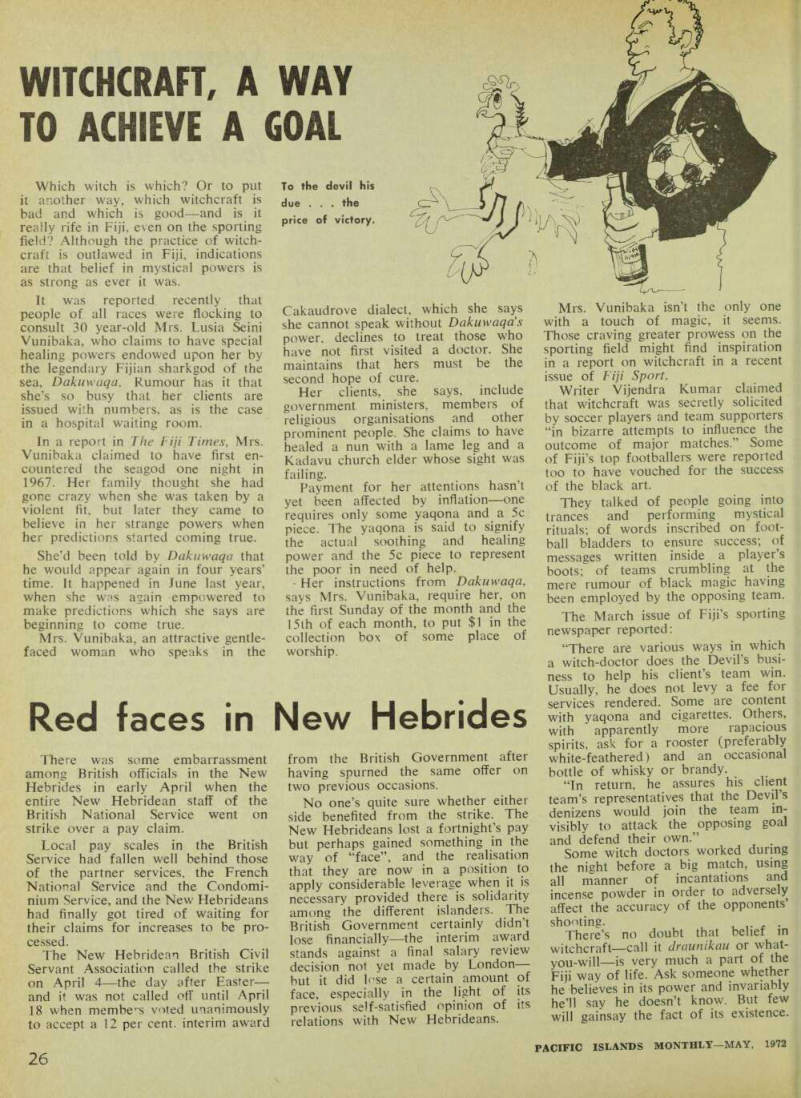
To the devil his due . . . the price of victory.