Pacific Islands Monthly
pp. 25-27 · Read in the full issue
It's The Moment
Of Truth For
Png And
Testing Time For
A New Leader
The winds of change are blowing hard around the Islands.
Papua New Guinea has been to the polls and there are new faces in the new House led by a new leader, Mr. Michael Somare. Will he be its first Prime Minister? PlM’s editor, Stuart Inder assays his chances. Fiji is also in the throes of a general election, its first since independence came. Will there be changes there too? The Cook Islanders have chosen their government for the next three years—the mixture as before.
From Stuart Inder,
in Port Moresby
Parliamentary government in Papua “w Guinea has developed into a uggle to capture the minds of the asses. The cut and thrust of politics about to become severe. The new eed of politician is aware that he mself has to win public support for 5 particular political aims.
Those are not my words. They me from Dr. John Guise, Speaker the 1968-72 House of Assembly, 10 has emerged from that exalted litical backwater to become active ain on the floor of the new House deputy parliamentary leader of the w Nationalist Coalition. Politically u f e as ever, he’s one of the men 10 will see to it that the cut and mst indeed becomes severe in the
big new House of 100 elected mem bers and four officials.
Sir Paul Hasluck, former Austra lian Territories Minister who is now Governor-General of Australia, officially opened the new House on April 20 with all the pomp and ceremony expected of these occasions.
There to see him do it were all the postwar PNG Administrators (Jack Murray, D. M. Cleland, David Hay and L. W. Johnson) and two other surviving Territories Ministers (C. E.
Barnes and Andrew Peacock), together with a corps of visiting VIPs you couldn’t shake a stick at.
The official ceremony was over shadowed by the political events that led up to it, from as far back as
March 11, when the results of the general election began to come in. to the very day of the opening when the behind-the-scenes political struggle was only finally drawing to a close.
And that was merely the close of the first phase of the new, active parlia mentary politics.
Papua New Guinea now has a black government which will move the country towards independence, and a conservative but highly ex perienced black oppositon which will be a determined watchdog.
It was a dramatic struggle for con trol.
The first election figures gave nobody a majority and the right to form a government. As the returns
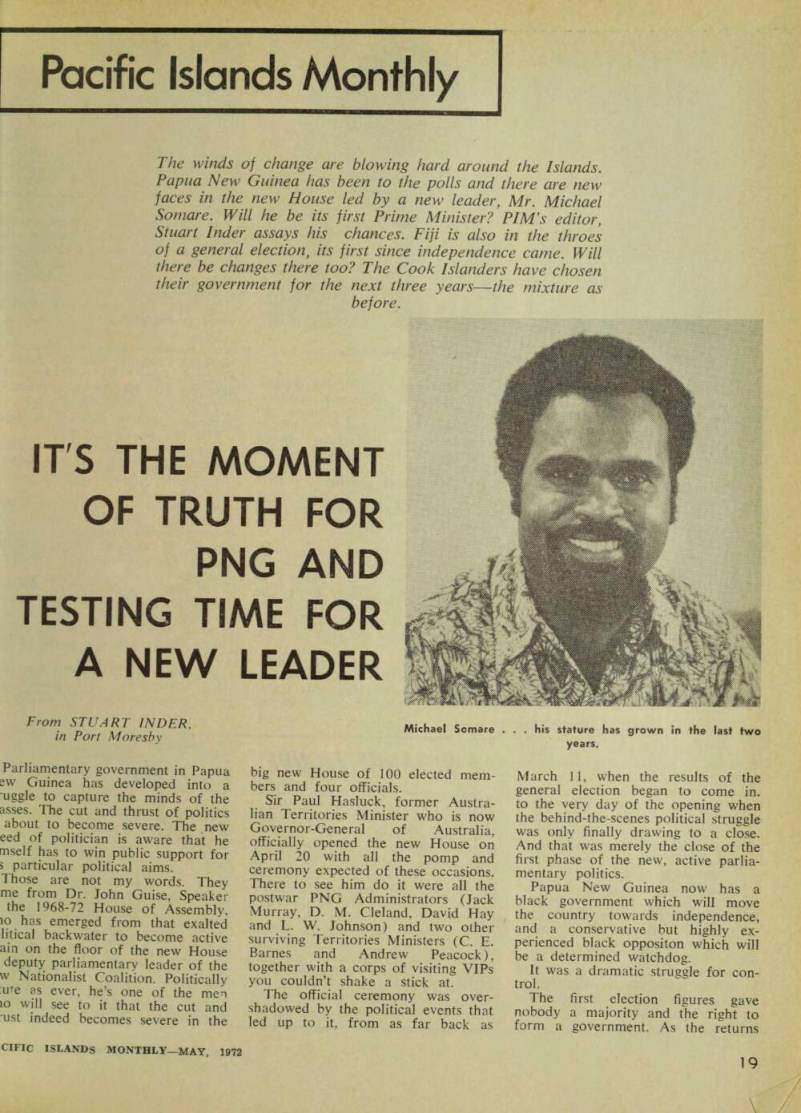
Michael Somare ... his stature has grown in the last two years.
continued to trickle in, and seat after seat was filled, both the con servative United Party and the more radical Pangu Party both claimed they were winning sufficient support to govern.
The result depended on the inde pendents and the splinter parties— the People’s Progress Party, Niugini National Party, the Mataungan As sociation. So it became the numbers game. The lobbying was intense.
Most wooed was the PPP, which eventually turned out to have 10 supporters and held the balance of power.
The United Party, whose members included the ministerial strength of the last House, seemed to have the edge on Pangu—much to the dismay of the Australian Government, which privately hoped for a coalition which would give the radicals a voice in government.
Three days before the official opening of the House, Michael Somare, Pangu’s leader, was finally becoming dispirited because the numbers seemed not to be there. The Mataungans would come in; John Guise appeared to be ready to come in, bringing with him a small team of independents; but PPP, patronised by both sides, remained aloof. Both United and Pangu continued to put it about that they were gaining the right numbers, and each provided the PPP with lists of their adherents showing some of the same names.
Two days before the opening, Guise announced that he and five others would support Pangu; at a Pangu parliamentary meeting it was decided to form a Nationalist/Pangu coalition, with the Niugini Nationalist Party (bringing in 10). For Pangu the clouds were beginning to lift.
Before the end of that day Somare announced that the new coalition had 50 members—3l Pangu, 10 Nationalist, 6 Guise and 3 Mataungan —and that he had been elected parliamentary leader and Guise his deputy. Guise confirmed that he would sink himself and his supporters in the coalition; the Nationalists said their 10 members were “Somare’s to do what he likes with and no strings”.
There was, however, some doubt as to whether there really were 10 Nationalists. But in the absence of more dramatic claims from the United Party, all attention was now riveted on Somare’s men as they fought to cross the line in the numbers game.
“I’ve got 50 now,” said Somare on the eve of the official opening.
“And a traditional Highlands leader is about to defect from the United
Party to us and bring some people with him. I’ll try to form a govern ment in the morning.”
He had his government that night.
All day Julius Chan and his PPP men were meeting and arguing.
Would the 10 join the new coalition and on what terms?
Said a Pangu man late that evening “They are arguing fiercely.
But they’ll come to us, not United, either whole or in part. Whatever happens we’ll have the numbers now.”
At 9.30 that night, Somare and his new supporters came out of the parliamentary rooms to a small group of newsmen who had been waiting since early afternoon for the crisis to break at last.
“Is this the moment of truth?” asked one newsman.
“It’s an announcement,” said the tired Somare. “We are forming a National Coalition with the People’s Progress Party. We will have 59 members and form a government.”
That was it, after five weeks of confusion. And in the nick of time.
The rest was anti-climax.
But anti-climax or not, the develop ments in the House next day showed that the new coalition intends to play it tough.
It nominated part-Chinese Perry Kwan, aged 35, of Kavieng, for the prestigious post of Speaker, and got him in, 49 votes to 48, against the United Party nomination, Matthias Tollman.
For the post of Deputy Speaker and Chairman of Committees it suc cessfully sponsored Chimbu ap prentice motor mechanic lambakey Palma Okuk, aged 28, again against Tollman.
For the vital Ministerial Nomina tions Committee, which selects the list of members to be offered the 17
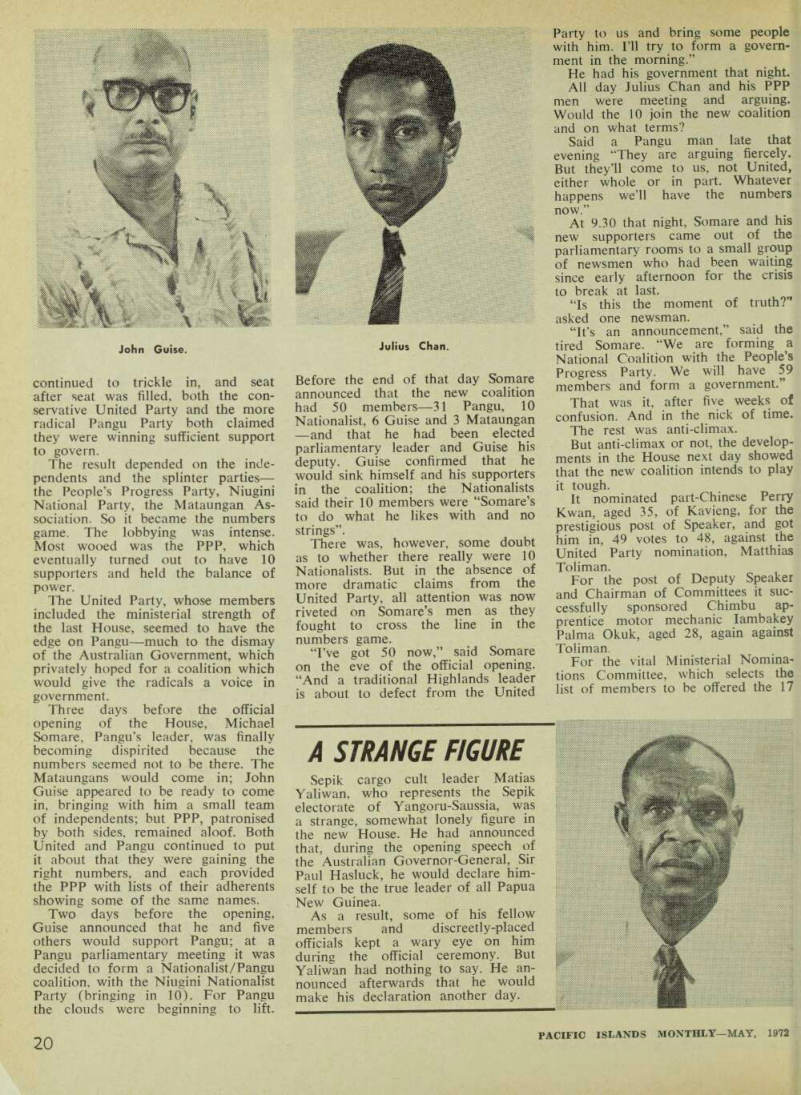
Julius Chan.
John Guise.
ministerial positions, the coalition gave even less quarter. Somare pre sented the House with a list of all seven names of the committee and forced the ballot through.
The result was 55 to 42 for Somare’s list (which included Somare himself, John Guise, PPP leader Julius Chan, Nationalist leader Thomas Kavali, and Kaibelt Diria, who turned out to be the defecting Highlands leader).
Observers were now able to see for the first time the physical evidence Df the coalition’s support. They had 57 supporters in the House if you ;ook into account that Mataungan nan Oscar Tammur was absent for :his vote, but would have voted for he coalition, and that the Speaker did lot vote. And the coalition may be ible to pick up a further supporter it the forthcoming Middle Ramu Jection (made necessary because one )f the candidates died during the Killing).
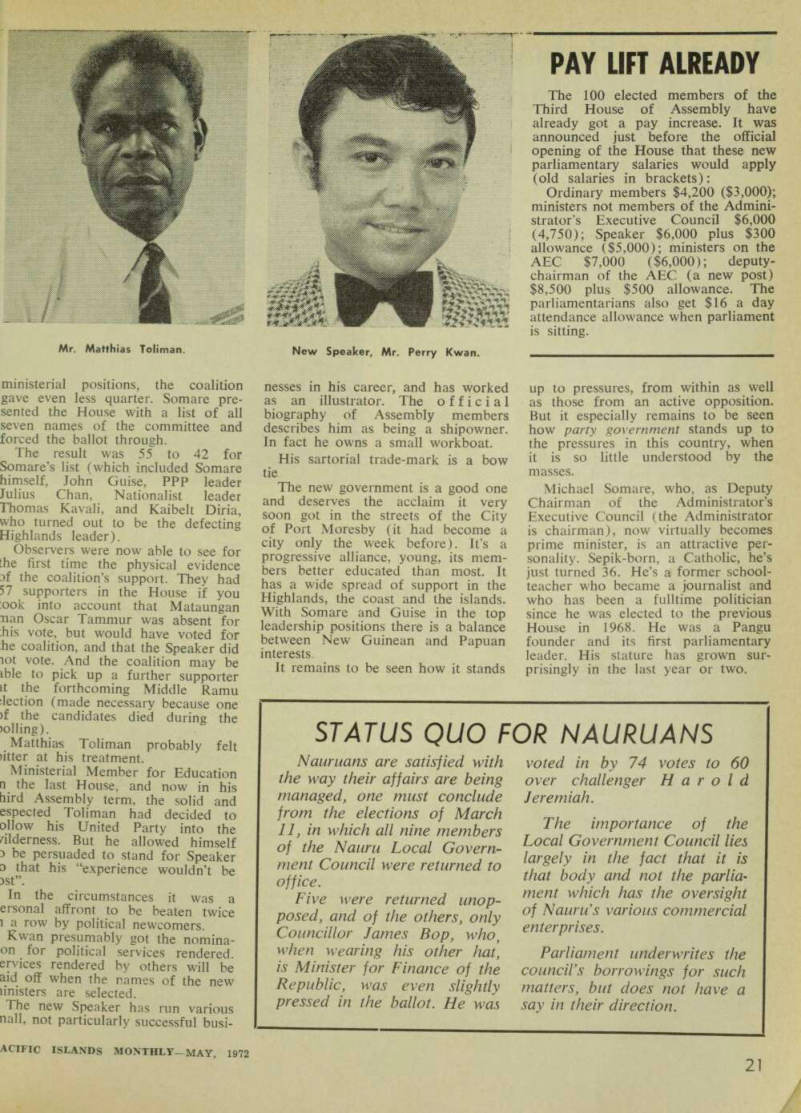
Matthias Toliman probably felt >itter at his treatment.
Ministerial Member for Education n the last House, and now in his bird Assembly term, the solid and espected Toliman had decided to ollow his United Party into the dlderness. But he allowed himself i be persuaded to stand for Speaker a that his “experience wouldn’t be Ist”.
In the circumstances it was a ersonal affront to be beaten twice i a row by political newcomers.
Kwan presumably got the nomina on for political services rendered, ervices rendered by others will be aid off when the names of the new linisters are selected.
The new Speaker has run various nail, not particularly successful busi-
nesses in his career, and has worked as an illustrator. The official biography of Assembly members describes him as being a shipowner.
In fact he owns a small workboat.
His sartorial trade-mark is a bow tie The new government is a good one and deserves the acclaim it very soon got in the streets of the City of Port Moresby (it had become a city only the week before). It’s a progressive alliance, young, its mem bers better educated than most. It has a wide spread of support in the Highlands, the coast and the islands.
With Somare and Guise in the top leadership positions there is a balance between New Guinean and Papuan interests.
It remains to be seen how it stands
up to pressures, from within as well as those from an active opposition.
But it especially remains to be seen how party government stands up to the pressures in this country, when it is so little understood by the masses.
Michael Somare, who, as Deputy Chairman of the Administrator’s Executive Council (the Administrator is chairman), now virtually becomes prime minister, is an attractive per sonality. Sepik-born, a Catholic, he’s just turned 36. He’s a former school teacher who became a journalist and who has been a fulltime politician since he was elected to the previous House in 1968. He was a Pangu founder and its first parliamentary leader. His stature has grown sur prisingly in the last year or two.
Mr. Matthias Tollman.
New Speaker, Mr. Perry Kwan.