The Editor's Mailbag
The Kokoda "Track"
Sir, —I write this letter in the hope lat I may reach the large public ho read PIM with interest.
It is written in the hope that I may ilist your support in having the ame “Kokoda Track” instead of the ord “Trail”, brought before the mrist world, and the public.
There have been many episodes in istory where, over a period of time, ic name of a famous statue, city, iwn or place has been gradually langed, until the original name has ;en lost to history.
I make this plea because the path mnecting the spot now known as wen’s Comer and the township of okoda was known as the “Kokoda rack” before World War 11, during e war and after the war, until a gn was erected at McDonald’s orner some years ago.
The “Track” was used as a line of unmunication between Port Moresby id Kokoda many, many years before e war, when the only other method transport was by ship around the >ast to Buna or Cape Killerton. The Yack” was used as the fastest ethod of getting official and private ail in and out of the Kokoda Patrol >st.
The word “Track” is a typically ustralian word, and was used con mtly by the great Australian poets d balladiers of the past, while the Drd “Trail” is an importation of zent date.
The stone monument built by the jstralian Military Forces to com ;morate the loss of lives of Aus lian and native soldiers, bears the me “Kokoda Track”.
The plaque set by a pilgrimage rty of the 39th Battalion at cDonald’s Comer, whose members ffered badly on the “Track” during s particular campaign, also has j same title.
In August this year a party of proximately 80 people, ex-members the 39th Battalion, their wives and ildren, will spend some time in pua to honour the dead on the te of the 30th anniversary of the thdrawal from the Kokoda Track mpaign. A further plaque will be iced at the memorial on this :asion.
Dudley McCarthy, in his Australian
war history. South West Pacific Area Kokoda to Wau, repeatedly refers to the “Kokoda Track”.
My hope is that you may be able to correct this mistake in future pro ductions of publicity brochures, pam phlets, etc. Looking forward to your support in this matter that is very near to me.
F. W. Turner.
Turner’s Tropic Tours, Port Moresby.
Tami River
I refer to lan Hughes’ letter (PIM, March, p. 16) concerning the Sechstroh-Fluss, now known as the Tami River.
Heinrich Sechstroh was boatswain on the Samoa when, captained by Dallmann, she brought Dr, Finsch to Mioko in the Duke of York Islands on September 26, 1884. (See O. Finsch, Samoafahrten [Leipzig, 1885].) Sechstroh commanded the Samoa in October, 1886, when, with von Schleinitz aboard, several islands near Finschhafen, Dregerhafen, and the Tami Islands were discovered.
During the voyage, from October 7- 13, the Samoa also sailed as fa.r as the border with British New Guinea. (See A. Wichmann, Entdeckungs geschichte von Neu Guinea [Leiden,
191 °10 Harry Jackman.
Port Moresby, PNG.
A Dying Institution
1 wish to express my views on the future of the South Pacific Commis sion over the next 25 years as raised by the Editor in his Up Front (PIM, Feb. p. 15).
It is my opinion that the SPC as a regional body has reached its peak and should no longer have any jurisdiction, socially or technically, in this progressive era. It is a dying institution. Now, on the eve of the advent of the South Pacific Forum, the commission has outlived its use fulness. Politics nowadays hold the key solution to any deadlocks, or could be used to mediate for an amicable settlement of social inequi ties at the highest government level.
By allowing the commission to steer a course alongside the forum, delegates in the future who are going to attend the SPC conferences will be second class hand-picked citizens of their countries. Whereas, the forum meetings will be attended by prime ministers, presidents and premiers of the independent nations.
However, it is not good to lose sight of our neighbours in the Pacific who have not yet achieved full inde pendence status. But there remains that this move could accelerate their early settlement to statehood.
The recent high-level conference held under the auspices of the leaders’ forum has clearly indicated in so short a span the progress it achieved. This has never been the case with the commission. By doing away with the commission, the forum would be left with far sweeping powers socially, economically and politically.
I find that if the two bodies exist together, it would hamper more the progress of the island nations and would tend to create havoc with their already crippled economies.
The present SPC budget needs just near a million dollars to keep it on the road. However, the forum’s budget would be no less favourable.
If the Island leaders are still opting for more trade in their primary com modities for a common market, then the only body that could negotiate with the Australian Government, New Zealand and Britain on a satis factory basis would be the Leaders’
Forum, and not the commission. It is about time the commission packed up and relinquished its own position for a better deal, or more powerful organisation.
Yours faithfully.
PS; —Would you please reserve my name from publication as to avoid personal and unjustified criticisms.
Nauru.
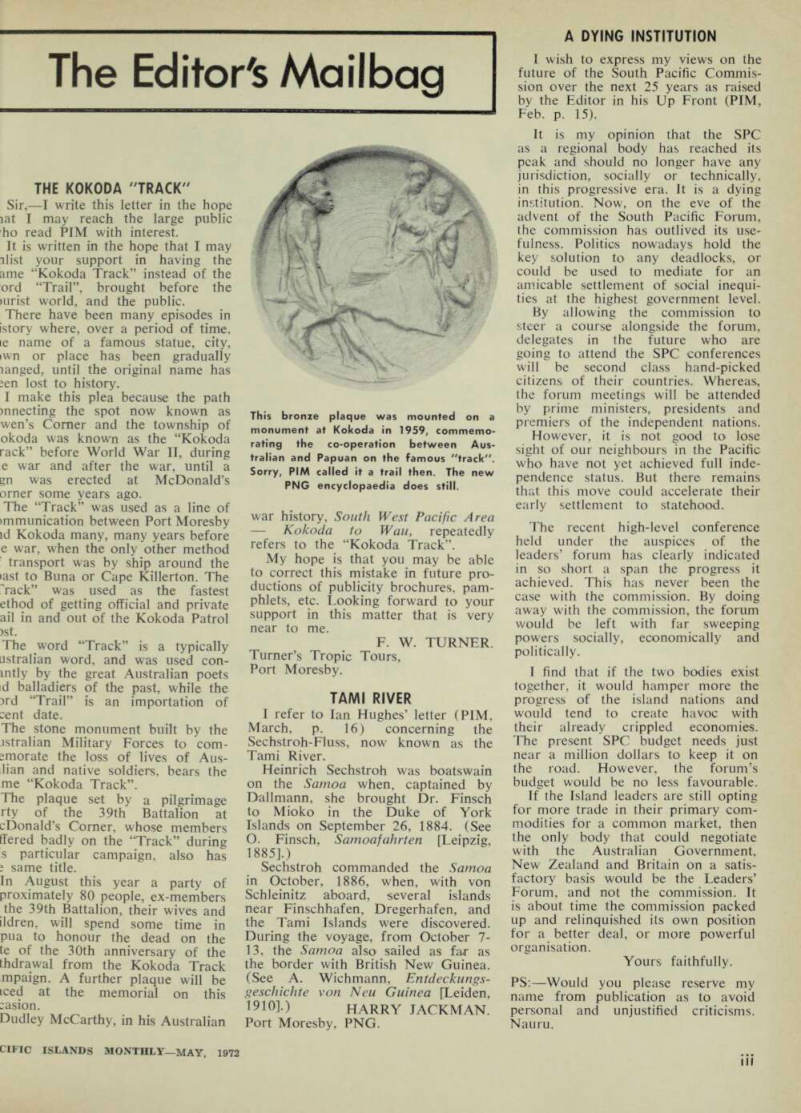
This bronze plaque was mounted on a monument at Kokoda in 1959, commemo rating the co-operation between Aus tralian and Papuan on the famous "track".
Sorry, PIM called it a trail then. The new PNG encyclopaedia does still.