paradise
pp. 119-125 · Read in the full issue
Tourists gain foothold on paradise
From BETTY SANFT in Nukualofa In the expanse of Oceania, the tourist industry has been catering mainly for the flow of traffic into the established resorts of Hawaii, Tahiti, New Caledonia and Fiji. Few, as yet, are aware of the existence and potential of Tonga as a tourist destination.
In common with other South Sea islands, Tonga enjoys the lush green beauty of the tropics. But a more equable climate and moderate rain fall give the visitor to the Friendly Islands even more.
Grave doubts were earlier enter tained that the country would bog down on such issues as finance, availability of hotel sites, manpower and despoiling the land and its culture. Happily those difficulties are vanishing in the wake of a joint determination by government and the private sector to capitalise on the
world’s fastest growing industry.
These are clear signs that it is off the ground. • An overseas tourist adviser has t>een appointed. • A tourist association and several ravel agencies are operating. • For the first time, a govern nent appropriation for promotional vork has been published. • Upgrading of the existing air >ort to take BAG 111 jets in 1972 las begun. • Beach development and the rection of new accommodation has >een stimulated. • Regional and overseas adver ising has begun, • Expansion of tours and facilities 0 other islands in the group has been ccomplished.
Tonga, the last remaining Poly esian kingdom in the Pacific, lies less tian 1,100 miles north-east of Auck md. It is almost in a direct line ■°m that city, through Pago Pago 1 American Samoa, Honolulu to an Francisco. The group of 152 ’lands, connected by a series of eepwater passages winding through ti intricate maze of reefs, is shaped
like an elongated filigree pendant set with green emeralds.
The island of Vava’u, 170 miles to the north of Nuku’alofa, the capital, with its high volcanic formation contrasts vividly with the flatness of the southern and central parts of the group. Its 40 square miles of green, rolling countryside is never far from the sea because of its broken coastline surrounded by deep coves and ,n l ets - One of the largest of these, on the south-west corner of the island, forms a natural harbour of extraordinary beauty. It is almost landlocked, and the circling hills mirror the calm waters which have become an all weather haven for large and small craft. Mount Talau, 700 ft high, with a symmetry reminiscent of an inverted giant deep-sea keeler, stands guard at the narrow entrance. This is where the island’s largest settlement of Neiafu has sprung up and 111 the evenings, at sunset, the people sit out in convivial groups along the waterfront, chatting and enjoying the fascmating glow of sea and sky behind Mt. Talau.
T • In this setting of happy village life and tropic plenitude, Australian interests have gained a foothold on a
magnificent five acre area overlooking the harbour, which will become the s * te °f the island’s first tourist hotel, Partnership with two local busi nessmen who own the land, they ave f° rm ed the Tonga Tourist and Development Company Ltd.
Construction of a 100-room luxury hotel, designed to merge with the Polynesian environment is under way.
Individual, self-contained accommo dation suites will stand separately r ? m . I l * l6 central service block which include a spacious lounge, drink bal > conference and dining rooms, J“ 1S h rst stage, at a cost of $A500,000, is expected to be corn- Pleted early in 1972.
Already a great curved stairway built of whole slabs of natural rock connects the hotel suite with its own private beach and outdoor entertain ment area at the water’s edge 200 ft below. A second stage of construc tion will later add a centrally con trolled air-conditioning plant to the service block, as well as two large swimming pools in a landscaped set ting above the beach, .
Man y see m this million dollar promotion, enriched by so much natural beauty, the beginning of a new exciting standard of visitor enter-
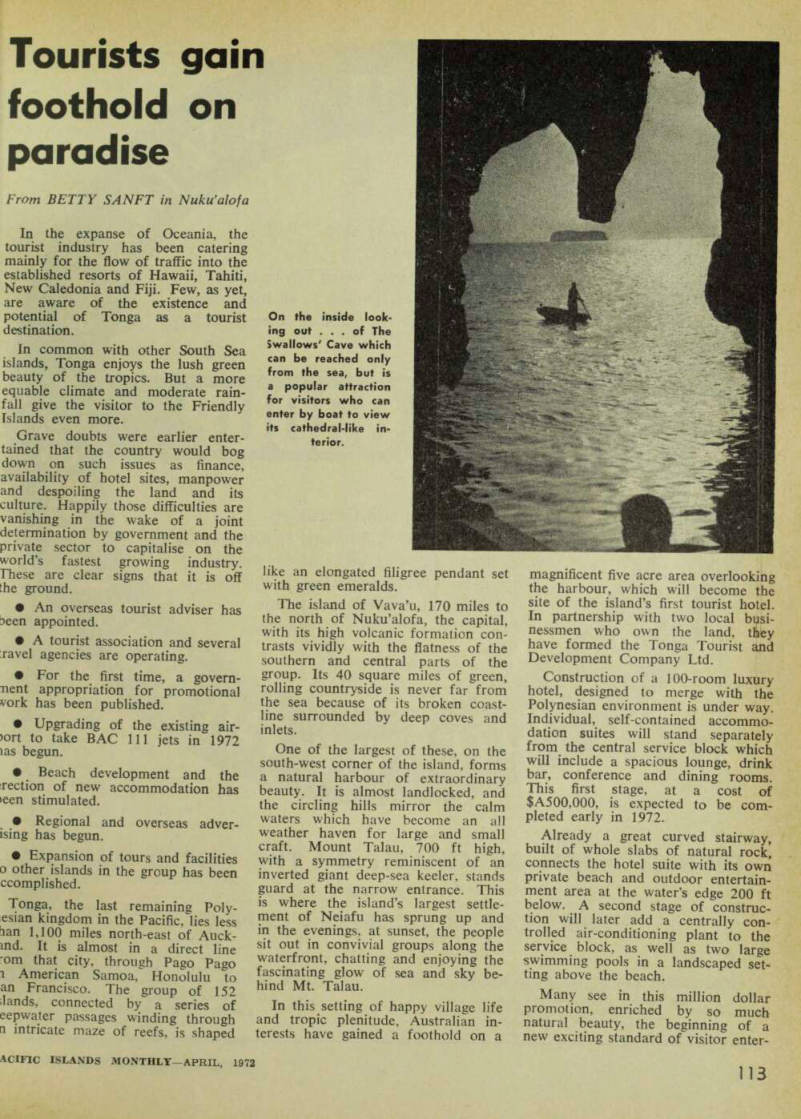
On the inside look ing out ... of The Swallows' Cave which can be reached only from the sea, but is a popular attraction for visitors who can enter by boat to view its cathedral-like in terior.
Villagers involved
tainment. Mr. Don Sundin, one of the Sydney directors told me, “As the project gets under way, we will de velop fishing and all manner of water sports in the harbour. And at night, groups of beautiful Tongan girls, with their perfect gift for singing and lancing, will entertain our guests.
Fhey will be encouraged to give only uithentic acts wearing correct raditional costumes.
“We’re privileged to be the first to ievelop this island and we believe we lave the goodwill of His Majesty and he Governor, and we’re not going o forget the people of Vava’u. More md more we intend to involve illagers on the supply side of our msiness, not only with fruit, vege ables and fish but with quality hand raft which they do so well, but also o act as transport drivers, boatmen nd guides.
“We want them to put on large cale village receptions, picnics and hose exotic island feasts for tour arties who wish to explore the ountryside and surrounding beaches, n this way the visitor will come to now and appreciate the richness nd charm of Tongan culture, and le people will have the chance of arning an income to develop their omes, their gardens and village insti jtions.”
It is understood the Tonga Tourist nd Development Company will ventually move part of their activity own harbour to several of the sand rewn, untouched islets. They intend > construct a series of boatels where housegirls and boatmen ill be assigned to cater for family roups and fishing parties who prefer ic free and easy life of the sea.
Two score of Vava’u’s satellite lands are dotted within 10 miles : the mainland. They range from >w-lying, green and white atolls mating in a crystal sea to giant lushrooms of solid rock capped with ick foliage, to sheer tablelands with ire cliff faces rising to 500 ft out : deep blue water. These latter ve the impression of miniature urds guarding the approaches to the ain harbour.
On the west side of the precipitous and of Kapa is the famous vallows’ Cave, formerly depicted on postage stamp. Its high, shapely itrance permits a launch carrying ) to 30 people, to glide into its thedral-like interior. The water side the cave is cool, deep and ystal clear. A large rock overhang g the entrance rings like a bell
Mariner's Cave
when struck with a wooden oar. This is where the sea swallows build their nesis in springtime.
A similar-sized cave is found on a nearby island of Nua Papu, but in this case the entrance is submerged under the sheer cliff face. This is Mariner’s Cave, named after the English cabin boy who was one of the few survivors from the ill-fated British privateer Port-au-Prince in 1806. Mariner was taken to this curious hideaway by two young Tongan friends during his four-year stay in Tonga.
Leaving their canoe behind, they dived into inky darkness and found a hole in the wall. After kicking through a 10-15 ft connecting tunnel, they miraculously surfaced in what seemed to be another world of eerie, silent twilight. When the mist cleared and their eyes became accustomed to the subdued light, they espied a cavernous chamber of considerable proportions—like a great house with a vaulted ceiling.
On the back wall there was a rock ledge decorated with weird shapes that looked like a pagan altar. Here the three young people rested while Mariner, over a bowl of kava specially prepared for the occasion, was regaled with various legends about this secret hideout.
As may be expected, the extensive reef complex is a rich cafeteria for an endless variety of marine life.
Hie whole area is a treasure chest for shell collectors, snorklers and scuba divers, also line and game ishermen. Cowries through to giant :lams are plentiful; tropical fish abound in a vast, natural acquarium af coloured coral; reef ledges, for xiiles, contain deep holes yielding arge groper and crays to the enter arising skindivers; and for the angler tlbercore, giant trevalli and bill fish ire never far away.
The opinion of several visiting ravel writers and operators is that loliday-makers will find tremendous enjoyment in Tonga. At least one old fongan told me with obvious feeling, hat the island was fashioned by the ;ods as the paradise of the Pacific.
Current weekly air schedules to he group are adequate, four flights •oth ways from Fiji and two flights >oth ways from Western Samoa.
Uthough they all terminate at the uam island of Tongatapu, a site for .new airstrip on Vava’u is now on he priority list. The cost of con traction is to be borne by the British /ho have an aviation adviser already
Ready for the rush
on hand awaiting the announcement of a starting date.
P & O line despatched two of their officers from Sydney recently to take a look at the island. This could result in regular calls by the company’s cruise liners starting in October. Already the smaller luxury liner West Star, operated by Wes tours of America between Tahiti and Fiji, is a regular visitor to Vava’u.
King Taufa’ahau Tupou has called for increased food production on land and sea to meet the expected flow of tourists focussing on the new inter national Port of Refuge Hotel. This from the king is a hopeful sign that an early date may be set for the con struction of the airstrip, the key to the situation. Its position too will have instant appeal, being less than 300 miles at the receiving end of both Nadi and Pago Pago. This places the island right in the main stream of international air traffic, eliminating back-tracking and extra fares.
The Tonga Tourist and Develop ment people have indeed gained a valuable foothold on Paradise and deserve to succeed. Their policy of involvement has galvanised the popu lace into action. Under the guidance of a central committee representing the services and village interests, several working groups are busy preparing a fitting welcome likely to be unrivalled in the area.
With her variety of natural re sources in terms of people, climate and scenery, Vaya’u lays claim to being the dream island of tomorrow.
Legacy For Tonga.—Books
worth $2O will be handed over to Tonga in a ceremony in June at the Co-operative College in Lough borough, England. The books, to be presented to Siola’a Tu’itupou, the only Tongan student at the college, are a legacy which represent a memorial to Arnold Bonner, senior tutor at the college for 35 years, who died in 1966. Each year, as a memorial to Bonner, books are given to developing countries. Mr. Tu’itu pou, who will return to Tonga at the end of June, is a technical officer with the Tonga Department of Agri culture, who has been on a course at Loughborough.