Pacific Shipping
pp. 85-91 · Read in the full issue
Shippers' Council Poses
Questions For Islands
By William Olson
The Federal Government an nouncement that a National Shippers’
Council is to be formed to negotiate export freight rates with international shipping conferences poses interesting questions for the Pacific Islands’ trade. At the moment there is no conference binding Islands’ lines into a single rate-fixing body.
But it is conceivable that under amendments to be made to the Re strictive Trade Practices Act that they could be forced into a rate fixing body to deal with the shippers’ council.
Apparently neither shippers nor shipping companies in this trade want a conference. They are happy with the present arrangement of individu ally negotiated agreements on rates.
But with government becoming more and more interested in overseas ship ping, it may not be a question of what the shipping company and shipper want as far as ex-Australia rates are concerned.
The announcement by the Minister for Trade, Mr. Anthony, of intention to form the council and to back it with government funds is being care fully studied by Islands’ shipping lines with a view to getting clues to government intent.
The shipping council is to be formed of exporter associations to provide a single freight rate negotiat ing body on Australia’s behalf. In this role its negotiators will confront the 15 conferences which operate out of Australia. It will also have a permanent staff of professional re searchers to provide the negotiators with ammunition for freight rate talks.
The background to the council is the wish of both the government and the exporters to confront shipping conferences with tough opposition at the negotiating tables. It has been felt for some time that Australian exporters have not performed as well as overseas shipping people at annual freight negotiations. Lack of research
material has largely contributed to Australians battling to hold their own with the well-prepared conference representatives.
When the Restrictive Trade Prac tices Act was introduced it recognised closed conferences with the proviso that they were economic, adequate and efficient in performance. It also provided for shipper bodies to be formed to negotiate rates of freight with the conferences.
To date only two shipper bodies are functioning with another in process of forming. Conferences without shipper bodies have been able to impose higher rates of freight after informing shippers of their in tention to do so.
By next year every conference will have to negotiate with the single, powerful body, the Australian Ship pers’ Council. Most exporters see this as a big step forward in shifting Aus tralia’s overseas trade at reasonable rates of freight.
But the Islands’ trade stands out side of dealing between conference and shipper. The dozen or so lines serving the Pacific Islands from Aus
traha operate under individual agreements with shippers, although when there is a rise, it has generally been a concerted one.
The last such rise was a 9 per cent, lift in June. Then the Australian Department of Trade asked the lines for figures to justify the increase and generally took a close interest in matters. (There have since been in dependent rises by some shippers to some Island ports, notably to Fiji.) At the moment the trade is fairly stable, but the possibility of sky-high increases in waterside workers’ wages later in the year would certainly force the lines to seek a further increase in rates.
The interesting point so far as future freight increases are concerned is whether the Islands’ trade will have to form a conference to deal with the shippers’ council. Mr. Anthony has clearly stated that the council will take over the role of existing shipper bodies designated under the Restric tive Trade Practices Act and in addition will undertake negotiations in trades where no shipper body has
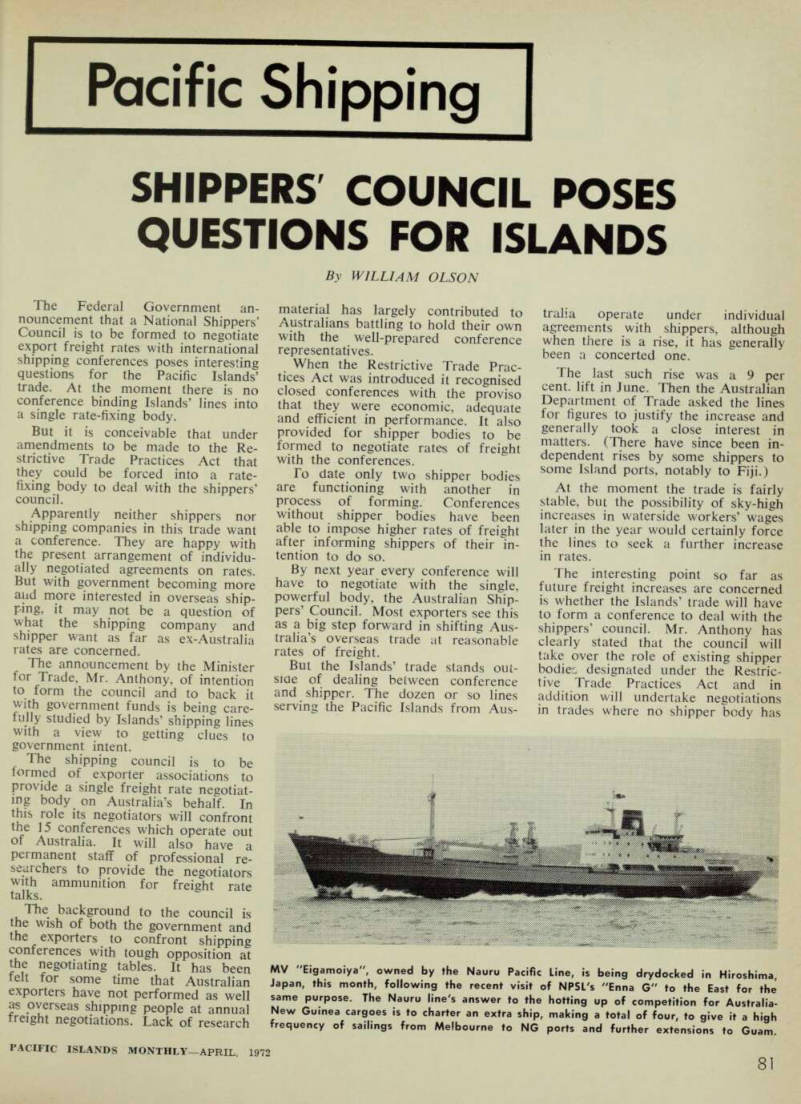
MV "Eigamoiya", owned by the Nauru Pacific Line, is being drydocked in Hiroshima, Japan, this month, following the recent visit of NPSL's "Enna G" to the East for the same purpose. The Nauru line's answer to the hotting up of competition for Australia- New Guinea cargoes is to charter an extra ship, making a total of four, to give it a high frequency of sailings from Melbourne to NG ports and further extensions to Guam
existed. Although he does not say so, the new shipper-shipping situation could mean the rationalisation of the Islands’ trade into a conference in order to negotiate with the Australian Shippers’ Council.
On the other hand the Minister for Shipping and Transport, Mr. Nixon, has said it is a matter of prime con cern that the Australian shippers have the best possible shipping service at their disposal, with the govern ment leaving the choice of the type of shipping in the hands of shippers themselves.
He has gone further to say that it is government policy that so far as the various export industries are concerned, it is up to those industries to obtain the best shipping services they can at the best possible price they can. “It is also government policy not to interfere with any com mercial decisions made by ship owners,” he said.
Both shippers and shipping lines will await clarification of the situ ation with more than usual interest.
Us Navy Lends Ship To
Train Island Sailors
The Trust Territory has received from the US Navy, on “indefinite loan”, a navy boat which will be used as a training ship for students
Another US Navy ship, LCU 1520, has been turned over to the people of Ebeye, also on idefinite loan. The Marshall Islands District now has two LCU’s, and each other district has one.
Aitutakes Watersiders
Want Better Conditions
Aitutaki waterside workers have demanded better pay and conditions.
Their president, Jacob Benioni, and secretary, Taura Upu, visited Raro tonga and made this clear at a meeting with the Rarotonga Water side Workers Union. Their first demand was that they be affiliated with the Rarotonga Union, and this was agreed to at the meeting. Other demands were: 9 That the wages paid to workers in Aitutaki be brought up to the level of those being paid in Rarotonga. • That workers on the Aitutaki barges and lighters be asked to join the union and to buy union workers’ cards. • That food supplies be brought up to the Rarotonga standard. • That any ship calling at Aitutaki be worked by Aitutaki men. • That a waterside workers’ canteen be built at Aitutaki, as has been done at Rarotonga.
W. Samoa Wants
Deeper Berths
With the Asau channel at Savaii deepened to a minimum 25 ft, the Western Samoa Government wants the contractors, Wilkins and Davies, of New Zealand, to do further deepening work at Mulifanua and Salelologa inter-island wharves.
Deeper berths are needed because the government plans to introduce a car ferry service between the islands about the end of this year. In ad dition, terminal buildings will be erected at both wharves. Total cost is put at $500,000.
Rabi Islands Have
Their Eye On Own Ship
Coromel, 100-ton steel ship built for the New Zealand coastal trade and recently in use for fishing, may be bought by the Rabi Island Council, in Fiji, as an inter-island vessel. She would operate between Suva and Rabi, and any neighbouring islands that wanted cargo.
Coromel is at present on the west coast of NZ, where she was inspected on behalf of the islanders by Suva marine consultant Captain Stan Brown. If bought, she would be re converted for cargo and passengers —probably 25 passengers.
Ships In Trouble
Around The Islands
Tong Ching Fu No. I sank four miles off Mabualau Island, Fiji, on March 2. Twenty survivors from the steel fishing vessel were landed at Levuka by the motor vessel Tovata, which sighted a distress flare at 5.30 a.m. The vessel sank three hours 20 minutes later.
The motor vessel Ame Rupa resisted all efforts to refloat her after a grounding on the Fly River, Papua, on February 7, and in late February her owners sent a helicopter to evaluate the situation.
Adjustments to the foils of the damaged Rabaul hydrofoil Ermes necessitated the visit of an expert from Italy in February. Other repairs were effected without trouble.
The damaged wooden motor vessel Piri was still anchored in Rabaul in February following her mishap mid last year and no decision had been made regarding her future.
Jardine, regular north Queensland- Papua trader, was to leave Sorong, West Irian on March 1 for Thursday Island, where a survey would be held.
Her engine-room was severely damaged by fire at Sorong on February 18.
Pacific Enterprise, 720-ton motor tanker which is a regular sight around the Islands, changed owners recently.
She was sold by Dilmun Nav. Co.
Ltd., London, to Nagata (Pte.) Ltd through Banks Bros, and Street.
Damage to fishing vessel Nam Hae No. 259, stranded for four days on Matoa Reef, Fiji, from January 13 is now found to be restricted to frames, plating, bent propeller blades and outer bearing surface.
Oil Spill Danger
In Yap
There was a strong protest in the Congress of Micronesia in February about the oil spillage from the freighter Solar Trader which grounded a West Fayu atoll in the Yap Dis tnct of Micronesia in December, and which has been abandoned. Late m the month the oil spillage had increased, with the oil concentrated m the lagoon.
Senator Petrus Tun, of Yap, attacked the government in the Senate tor having failed to take action on Jae spillage, although he said Yap District officials had warned the government in December that this night happen.
The government had been more oncerned with salvaging automobiles rom the ship than with oil spills, ie said, although the uninhabited
atoll was not only a major source of food for nearby islanders, “but one of only eight major breeding spots for green turtles in the entire Pacific.”
The delicate ecology of the reef was now in tragic danger of being ruined by the oil, the senator said.
He asked that the appropriate agency of the UN be asked to investigate the government’s failure to do anything about the oil leak.
Men Die In Explosion
On Big Tanker
Three seamen were killed and three others were missing after an ex plosion aboard the 58,000 ton Norwegian tanker Aurore about 25
miles off Madang, New Guinea, on March 3. The vessel was en route to NZ from Borneo in ballast when the explosion occurred, followed by a fire. The crew contained the fire.
The explosion peeled back the fore part of the 775 ft vessel like a banana skin.
'Rona' Finds A New Trade
Rona, CSR’s 6,620 ton sugar carrier has been sold through Banks Bros, and Street to the Campania Panoriente SA of Panama. The ship has been renamed Panoriente, and will be operated by Eastern Shipping Lines Inc. of Manila in the trade between the Philippines and Japan.
Shipyard's Biggest
Export Job
The biggest steel ship yet built in Fiji by a private company was launched from the Millers Ltd. ship yard in Suva in February. She is the $164,000 Santa Teretia 111, ordered by the Roman Catholic Church for work in the Gilbert and Ellice Islands. Designed and built under the supervision of Mr. Colin Dunlop, marine architect at Millers, the ship is 86 ft long and will displace about 200 tons.
After fitting out in Suva, the ship was due to leave during March for the Gilbert and Ellice Islands, where she will replace the wooden mission ship wrecked in Nauru about two years ago. She can carry 60 tons of cargo, a crew of 12 and 10 passen gers.
Although Santa Teretia 111 is the biggest ship yet exported from Fiji Millers shipyard has several hundred thousand dollars worth of orders on hand.
Skipjack Trials
In Samoa
A trial was being made during March of skipjack fishing in Samoa. A live bait boat from Hawai, the 100 ft Anela with a capacity of 90 tons, is being used in the Hawaiian off-season both to test the prospects for skipjack hshmg in Samoa and also whether the Hawaii fishing fleet could profitably operate in Samoa during the northern off-season.
Dr. Stan Swerdloff, Director of Marine Resources in American Samoa, said m January that an ap proach was being made to Western Samoa for a possible share in the venture. • Bellama, formerly the GEIC V ihTn^ k ° ria> - Will be used to me GEIC contingent of performers and carvers to the Suva Arts Festival m May, and while there will undergo a short refit.
Paying Off Pennant For 'Iberia'
The P & O liner, Iberia, well known in the South Pacific, has made her last voyage there under the P & O flag. After her last cruise in the South Pacific in February-March she returned to England, where she will be sold.
The Iberia, 29,614 tons, was built in Belfast in 1954. On her last call at South Pacific ports she flew an 18 ft long white paying-off flag. Each foot represented a year’s service.
At the end of the voyage in London, the captain. Commodore M. A. Trentfield, will retire.
"Santa Teretia III", after her launching at Millers' shipyard, Suva. She will be the Roman Catholic church's vessel based in Tarawa, replacing "Santa Teretia II" which was wrecked in 1970.