Cuff-Hanger
pp. 28-112 · Read in the full issue
New Guinea
Elections
From a Port Moresby correspondent The national elections for the 100 elected seats in the new House of Assembly, which will be in office for the next four years and which is ex pected to bring self-government to Papua New Guinea, has turned out to be a cliff-hanger.
By the end of March, when this is being written, it was still not sure who was to attempt to form a govern ment,as no party had the numbers at the ballot box. There is now fierce lobbying going on.
Prior to the start of voting on February 19, candidates and parties had been campaigning with consider able vigour and in some cases at considerable expense.
We saw some candidates flying around overhead in planes and heli copters while others were foot slogging it from village to village; and we have seen some spending money like water (where did it all come from?) on lavish advertise ments, string bands, paid campaigners, party T-shirts and fancy caps, while others fought their campaigns on a shoe-string budget.
The United Party, the most lavish spender, was confident of a sweeping victory, and predicted that it would win 60 seats out of the 100 being contended for.
Althought the counting of votes
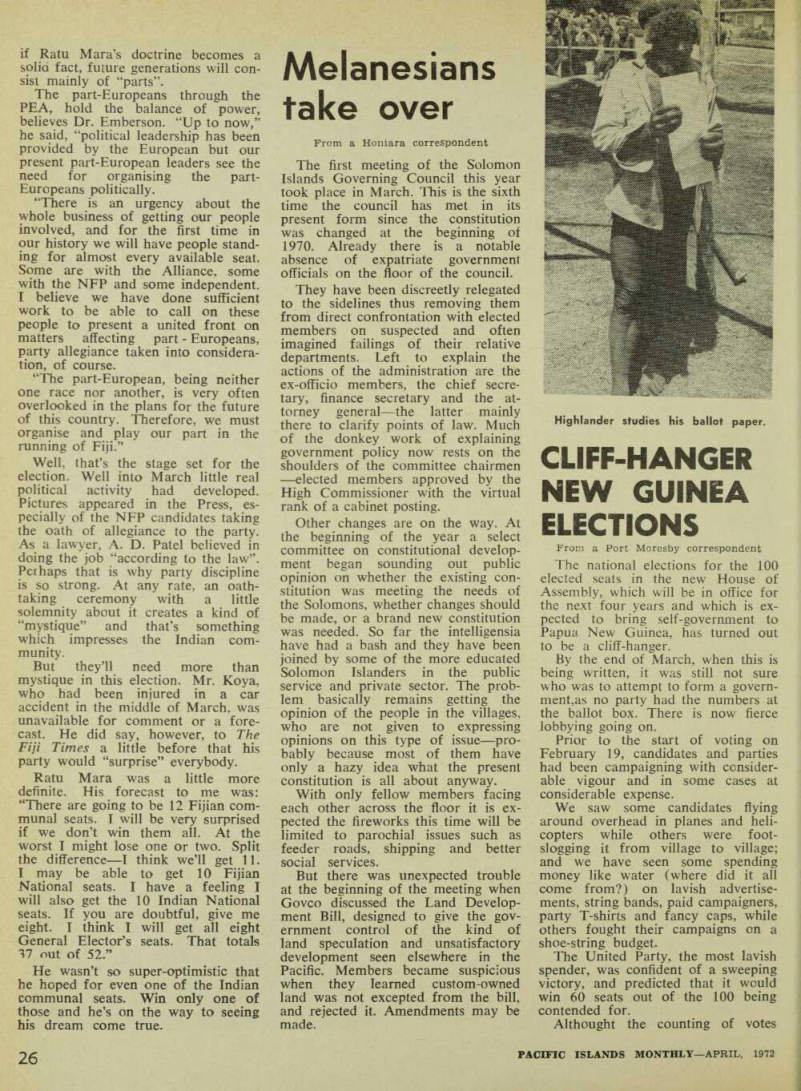
Highlander studies his ballot paper.
began on the evening of March 11, it turned out to be a long procedure.
By late in the month most candi dates were declared elected, although there was still some cliff-hanging.
The elected members at that stage were aligned as follows: United Party (right) 34; People’s Progress Party (centre) eight; Pangu Party (left) 20; Niugini National Party, one; Mataun gan Association, three; Peli Associ ation (an offshoot of the Mt. Turn Cargo Cult) one; the remainder being uncommitted.
These figures will probably repre sent the state of the House when the final count is made, but obviously both United Party and Pangu will have to do better than this if they are to form a government.
Both are actively lobbying the un committed members, and candidates tipped to become members, in order to gain their adherence. Both are also wooing the People’s Progress Party with a view to a coalition.
Some of the uncommitted members will no doubt prefer to remain inde pendent; others will fence-sit till they see how things shape; but most of them will probably have aligned themselves with one or other of the parties by the time the House meets for its official opening on April 20.
They will do this no doubt when the members get together in Port Moresby in early April for “orienta tion” before the House sits. The matters of a Speaker and ministerial nominations may well be thrashed out then. Dr. John Guise has already announced he won’t be a candidate for Speaker this term; perhaps he has his eye on the “Prime Minister’s” job, and as a compromise in a very tricky situation, he might well get it.
One of the surprises of the election has been the poor showing of Euro pean members.
Dennis Buchanan, managing direc tor of Territory Air Lines and generous provider of free air trans port for United Party candidates, has been defeated by Pangu’s Barry
(Continued on p. 106)
Holloway for the Eastern Highlands Regional seat. Wally Lussick has been defeated by an indigenous PPP candidate in the New Ireland Regional electorate. Bill Fielding in Central Regional did badly and is out; while in Markham Open Tom Leahy, scion of a famous territory family and spokesman for the Ad ministrator’s Executive Council in the last House, lost by fewer than 100 votes to a Pangu unknown, Phillip Buseng. On the other hand, Ron Neville in Southern Highlands Regional and John Middleton in Sumkar Open have held their seats, and Tim Ward in Esa’ala Open.
PPP has lost both its European sit ting members—Warren Dutton and Jim McKinnon. Pangu has none to lose; its two European members, Tony Voutas and Cecil Abel, did not stand for re-election.
While several new European candi dates have been successful in securing elections, it looks as if the number of European members in the third House will be substantially smaller than in its predecessors.
Turing to the ministerial members: Roy Ashton did not seek re-election; Tei Abal and Sinake Giregire (Leader and Deputy Leader respectively of the United Party) and Angmai Bilas have retained their seats; Matthias To Liman and Tore Lokoloko will probably retain theirs; but Toua Kapena has lost Moresby Coastal; on the whole a pretty good survival rate. Among the assistant ministerial members the casualty rate has been higher, and it looks as if about half of the eight AMMs will lose their seats.
A number of indigenous back benchers are also set to lose their seats. There will be many new faces in the new House, and on the whole it will be a younger and better educated House than its predecessors.
Of the four women candidates, three have been definitely eliminated.
But the fourth, Miss Josephine Abaijah, soon established a very sub stantial lead over her six male opponents (five Europeans and one Papuan) in the primary count, and has now become Papua New Guinea’s first woman parliamentarian.
The Mataungan Association has had something of a triumph, three of its four candidates —John Kaputin, Oscar Tammur and Damien Kereku —having been elected. These, with Mount Turn’s charismatic cult leader, Matthias Yaliwan, should help to make the third House of Assembly a colourful one.